Pricing, Offtake & Customer Economics
A Smaller SAF Premium Does Not Mean More Customers Can Afford It
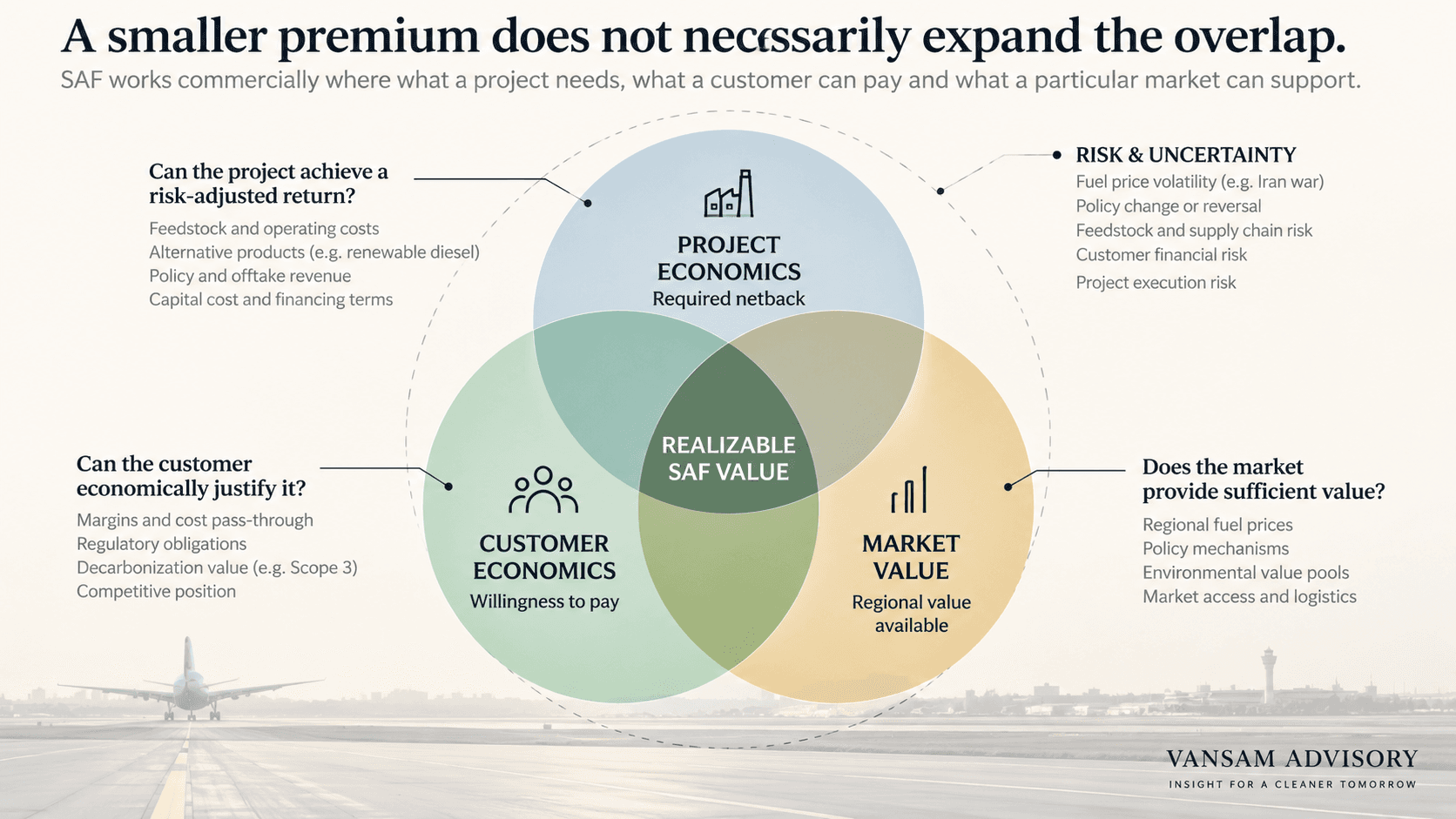
When jet prices rise, the SAF premium can shrink even as customers and producers face tougher economics. The real question is not the premium alone. It is whether project economics, customer willingness to pay and market value actually overlap.
September 22, 2026 · 11 min read · Elvis Ebikade
What this changes
A smaller SAF premium does not necessarily mean more SAF is affordable. Producers need to work backward from the markets and customers where their fuel can generate the strongest durable, risk-adjusted netback, then design the offtake, delivery and revenue architecture around them.
A smaller premium can hide a larger affordability problem
A strange thing can happen when conventional jet fuel gets more expensive: sustainable aviation fuel can suddenly look more “affordable”. Imagine SAF at $6 per gallon when conventional jet is $3. The premium is $3. Now imagine an energy shock pushes jet to $5 while SAF rises to $7. The premium has narrowed to $2: SAF looks more competitive or attractive relative to jet, but both fuels are more expensive and the airline’s underlying fuel bill has risen sharply. A buyer under greater operating pressure may have less, not more, capacity to absorb the remaining SAF premium.
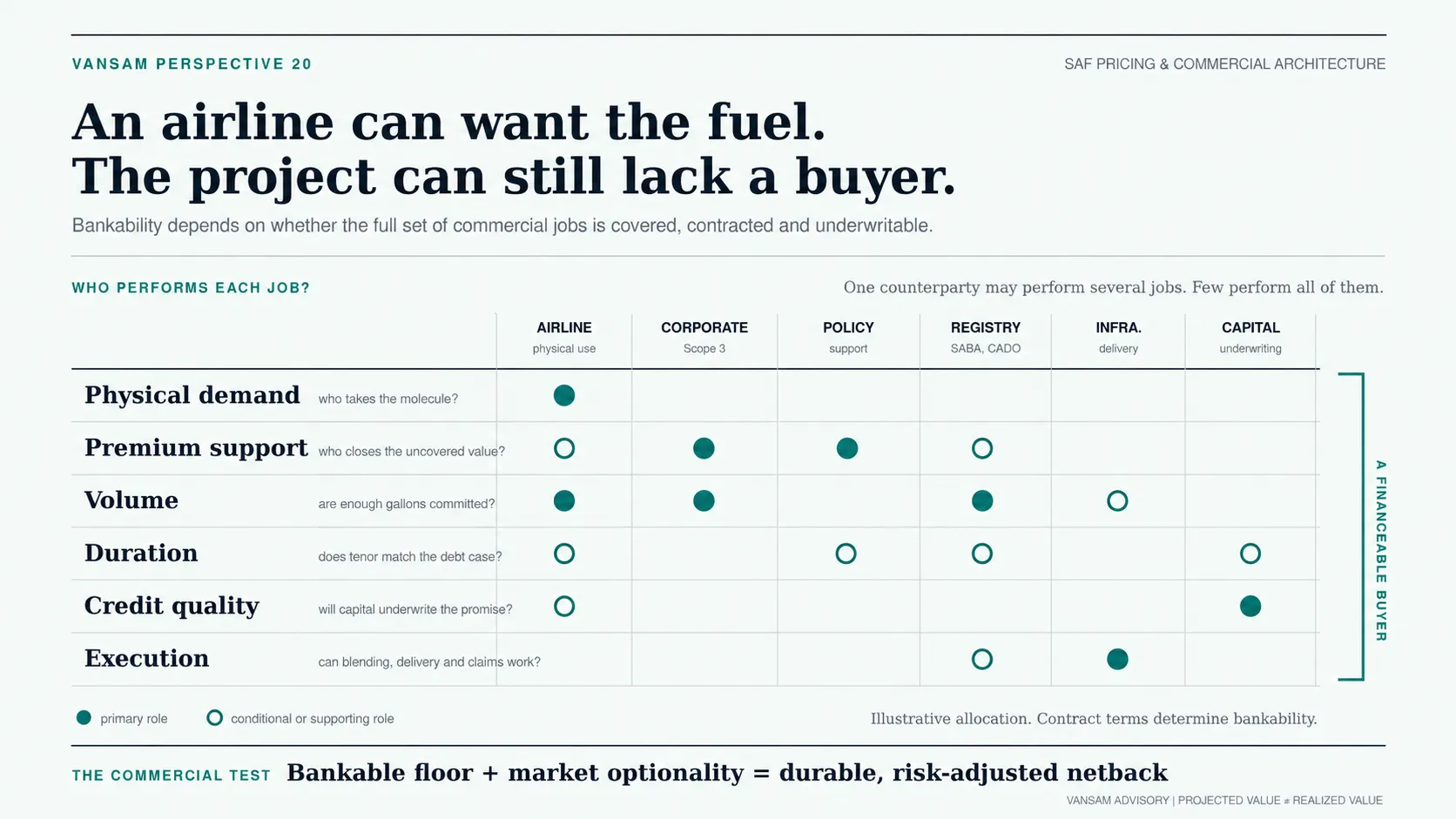
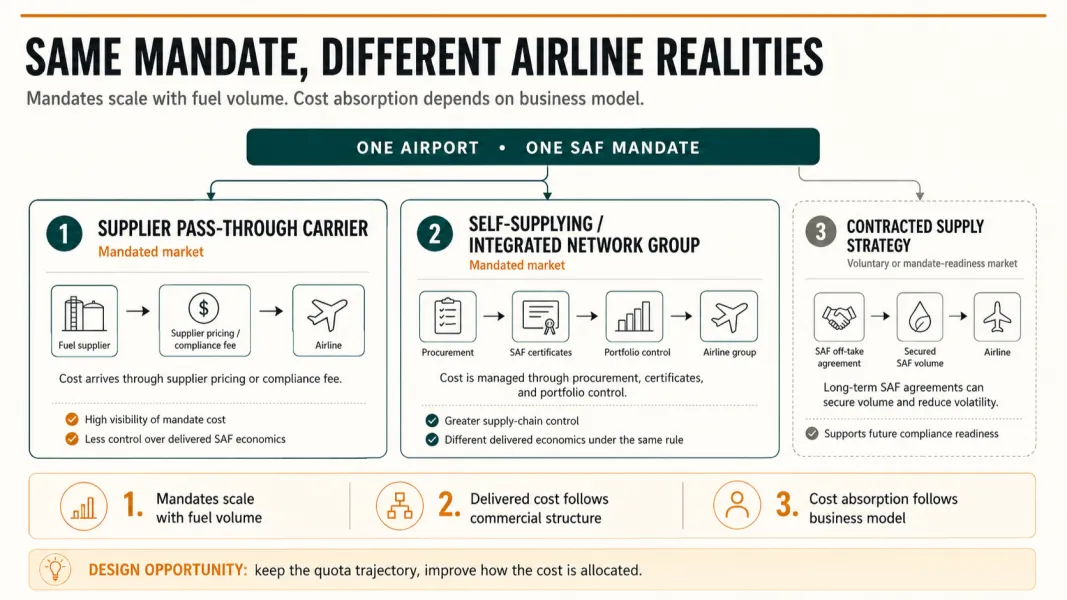
The Iran war and resulting disruption to global energy markets have made that distinction visible. Higher conventional fuel prices can narrow the relative SAF premium while simultaneously worsening airline economics and that effect will not be uniform because aviation does not have one customer with one willingness to pay. A network carrier, low-cost carrier, cargo operator, corporate Scope 3 buyer and obligated fuel supplier are making different economic decisions which I have explored particularly in “The Airline Is Not One Customer” and “The Commercial Buyer Is a Stack.” The pricing implication is the next step in that argument as there is no single SAF affordability threshold either. The relevant question is not simply how large the premium is, but which customer is being asked to pay, what value that customer receives and what happens to its willingness to pay when its own economics change.
Before asking whether SAF is affordable, let’s first define the price.
Even that customer question starts one step too late if the SAF price being compared is poorly defined.
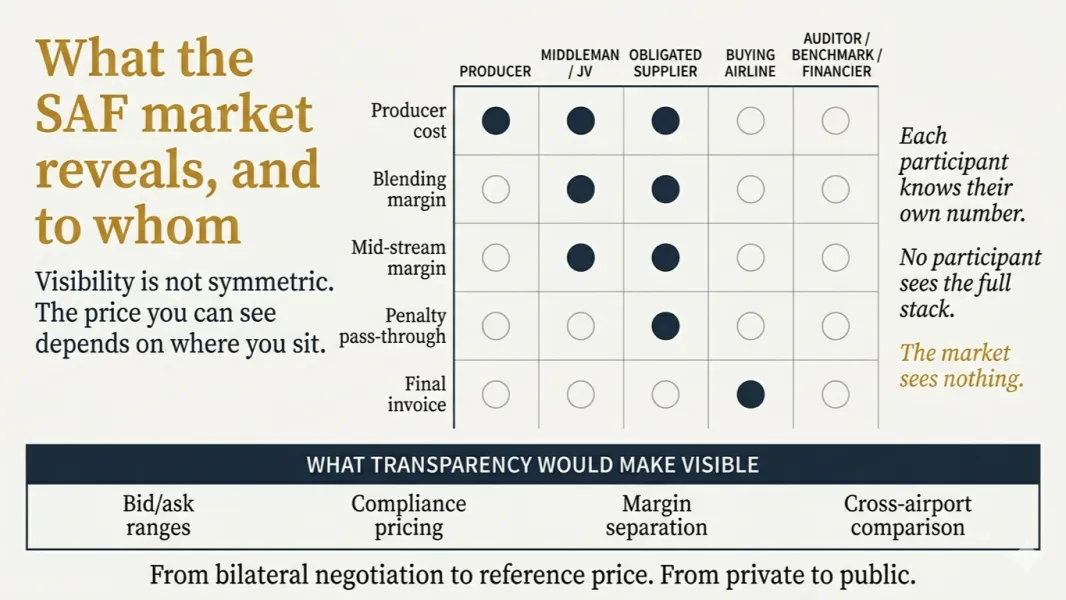
EASA’s first full-year ReFuelEU Aviation data provide a useful example. For 2025, EASA reported an average SAF reference price of €1,925 per tonne and a conventional aviation fuel reference price of €640 per tonne. The €1,285 difference is useful for regulatory and market analysis, but it is not the complete cost of putting SAF into an aircraft at a particular airport. EASA’s methodology distinguishes the costs captured in its price-reporting-agency inputs from downstream components. Depending on the transaction and geography, neat SAF may still need transport, storage, blending, certification and custody, terminal throughput, pipeline or truck movement and airport access before it becomes usable fuel. I examined that downstream stack in “The cost of SAF, according to whom?” and “Beyond the Refinery Gate.” The newer evidence makes the regional implication harder to ignore.
Platts’ new Brazil SAF import-parity assessment, for example, begins with a US Gulf Coast SAF basis and adjusts for items including demurrage, insurance, transit losses, storage, specification differences and import costs. We can observe that SAF price in one market is therefore not automatically the economically relevant price in another.
- For a producer, what matters is the progression from production cost to relevant regional value, delivered economics and realized project netback.
- For the customer, it is the delivered SAF price relative to the conventional alternative and the total cost the business can absorb.
A narrowing premium tells us how two prices moved relative to each other, but it does not tell us whether either side of the transaction became economically stronger.
HEFA makes the producer-side decision impossible to ignore
This producer-side question is especially important because HEFA remains the source of most meaningful SAF volume today. IATA’s current outlook estimates that HEFA and co-processing could account for roughly 95 percent of credible global SAF capacity in 2030. Other pathways are essential to long-term decarbonization, but near-term SAF availability remains heavily influenced by HEFA economics. HEFA also makes the producer’s alternative use of capacity unusually visible: at a flexible facility, the question is not only what SAF costs to make. It is: what is the highest-value use of my feedstock and hydroprocessing capacity to maximize project netback value?
Renewable diesel can be part of that calculation because the two products can compete for lipid feedstocks and, at some facilities, processing capacity. Current diesel-market tightness makes the opportunity cost more visible. The Iran war, compounded by disruptions elsewhere in global refining, has contributed to a severe diesel shortage, pushing U.S. retail diesel above $6 per gallon nationally, with higher prices in some local markets. Retail diesel is not directly a renewable-diesel producer netback and should not be compared directly with a SAF selling price. However, the underlying allocation question remains as a flexible HEFA producer has a minimum risk-adjusted value at which directing feedstock and capacity toward SAF makes sense relative to alternatives. The customer has a maximum economically supportable willingness to pay, and more SAF becomes commercially attractive where those economics can be reconciled.
This builds on the producer-floor question I explored in “This Was Supposed to Be SAF’s Moment: The Sequel.” The new point is that a smaller SAF-to-jet premium does not necessarily improve either side of that intersection as the airline customer may be under greater fuel-cost pressure while the SAF producer simultaneously sees stronger value in an alternative product.
Policy changes the intersection rather than eliminating the gap
Policy matters because project economics and customer willingness to pay do not naturally overlap at sufficient scale today. But different policies intervene at different points in that gap.
- Illinois provides a $1.50-per-gallon purchase credit for qualifying SAF used by air common carriers through 2032, improving buyer economics.
- ReFuelEU creates obligated demand and a non-compliance penalty tied to at least twice the annual SAF-to-conventional-fuel reference-price difference multiplied by the supplier shortfall. Using EASA’s 2025 reference prices, the €1,285-per-tonne differential implies a minimum penalty calculation of €2,570 per missing tonne (2 × €1,285). That is not an alternative EU SAF market price. It is a compliance boundary applying to a particular obligated volume.
- The EU also allocated approximately €430 million of ETS allowances to 130 aircraft operators for SAF used in 2025, helping bridge airline-side cost.
- The UK Revenue Certainty Mechanism targets a different problem by seeking to reduce revenue uncertainty for first-of-a-kind SAF projects.
- Singapore’s levy-funded model spreads part of the cost across aviation users and explicitly incorporates not only the projected SAF premium but associated certification, blending and delivery costs.
The mechanisms differ because the commercial problems differ: a purchase credit can increase effective customer willingness to pay, a mandate and penalty create compliance value, an allowance can reduce an airline’s incremental cost, revenue support can stabilize a producer’s income, and a levy can distribute cost across a broader demand base.
None creates permanent certainty as policy has magnitude, eligible volume, duration, conditions and change risk. Singapore demonstrated that directly when it deferred its SAF levy during the Middle East conflict as airline and passenger economics changed. The policy direction remained, but the implementation timetable moved. That is not a reason to discount or disregard policy value, but is a reason to architect around it rather than depend on one mechanism remaining unchanged indefinitely. A project that requires one credit, one penalty level or one revenue-support structure to stay fixed for fifteen years has not removed risk; it has concentrated it.
“I need an offtaker” is not a commercialization strategy
This is where the conventional project-development sequence can become too simple for SAF. A project proves its technology, chooses a site, builds a production-cost model and eventually arrives at a box labelled “offtake,” then the commercial task becomes finding an airline willing to sign. This underweights how much of SAF’s realizable value sits outside the plant.
- The airline is not one customer.
- The offtaker is not one single party
- The market can span multiple geographies or regions.
- The relevant SAF price is not one number.
- Policy and environmental attributes create different value in different jurisdictions.
For flexible facilities, the opportunity cost of producing SAF can also move while the offtake negotiation is happening. A stronger sequence starts with what the project can produce and the value it needs to realize. It then asks where that fuel, pathway, carbon intensity and certification status create the strongest value; what it costs to reach those markets; which customer types have the strongest economic reason to buy; what policy, compliance or environmental-attribute value can support the transaction; and how much volume each combination can absorb for a credible duration. Only then is “find an offtaker” sufficiently precise.
This is the critical distinction between plant-forward selling and market-backward commercialization. The first largely defines the project and then asks who will buy its output. The second uses market and customer economics to help determine where the project should sell, which counterparties matter, what commercial and delivery architecture is required and which risks must be allocated before the most expensive decisions become difficult to reverse.
Uncertainty exists across the whole system
No commercial architecture absolutely eliminates uncertainty: projects can be delayed, feedstock costs can rise and counterparties can fail on their obligations. Airlines can move from profit to loss, restructure networks or reduce discretionary spending. Markets, benchmarks, logistics and competing-product economics move, and most importantly, Governments change policy more often than desired. The practical question is therefore not how to make every revenue assumption certain, but how much of the project depends on any one assumption remaining right.
A technically de-risked SAF project can still be commercially concentrated around one customer, one geography, one policy mechanism, one delivery route or one price basis. Project teams naturally develop their greatest information advantage around the asset they are building. The risk is then allowing the assumptions outside the fence line to remain less resolved than the engineering inside it, even when those external assumptions ultimately determine revenue, and commercial architecture makes those concentrations visible early enough to manage them.
Pragmatic optimism means designing for the market that actually exists
The complexity of SAF commercialization is not, in itself, a reason for pessimism as that same complexity creates optionality: projects can access different customer archetypes, regional markets, policy mechanisms and environmental-value pools. Some assets can preserve product optionality. Contracts can allocate price, volume, policy, counterparty and delivery risks differently. A project can diversify rather than require one airline, one market and one policy mechanism to carry the entire commercial case.
- One project may find its strongest risk-adjusted economics in mandated physical volume into Europe, voluntary airline demand elsewhere, a production incentive at home and corporate participation in part of the environmental value.
- Another may rationally choose a different geography and customer mix.
- A flexible HEFA producer may preserve renewable-diesel optionality while deciding how much capacity can credibly be committed to aviation.
- An eSAF project may discover that power, certification and route-to-wing costs make an apparently attractive market less valuable once the complete system is modeled.
There is no universal answer as there is no universal SAF project. However, the discipline is to identify which combination of project economics, customer economics and market value produces the strongest durable, risk-adjusted netback, then build the revenue and risk architecture around it.
That requires more than adding an investor and an offtaker to a technically credible plant. It requires understanding where the fuel creates the most value, which customers can support which parts of that value, what it costs to reach them, what alternatives the producer is giving up and which assumptions the project can afford to be wrong about. A smaller SAF premium can be good news as it can improve relative competitiveness and make some transactions easier. Yet, it does not tell us how many customers can afford more SAF, how much producers will choose to make or whether the resulting revenue can support the next project. Those answers sit in the architecture around the premium and the projects that navigate that architecture well will be better positioned to create value despite uncertainty.
Sources
- European Union Aviation Safety Agency, ReFuelEU Aviation Annual Technical Report 2026 and reference-price methodology, September 2026.
- European Union, Regulation (EU) 2023/2405, ReFuelEU Aviation.
- European Commission, EU ETS support for SAF uptake in 2025, September 2026.
- S&P Global Commodity Insights / Platts, US Gulf Coast SAF and Brazil import-parity assessment methodology, September 2026.
- Illinois Department of Revenue, Sustainable Aviation Fuel Purchase Credit.
- Civil Aviation Authority of Singapore, SAF Levy and implementation materials, 2025–2026.
- UK Department for Transport, SAF Revenue Certainty Mechanism materials.
- International Air Transport Association, SAF production and pathway outlook, June 2026.
- Reuters, global diesel-market reporting, September 2026.
- Vansam Perspectives archive: “This Was Supposed to Be SAF’s Moment”; “This Was Supposed to Be SAF’s Moment: The Sequel”; “The cost of SAF, according to whom?”; “Beyond the Refinery Gate”; “The Airline Is Not One Customer”; and “The Commercial Buyer Is a Stack.”