Markets, Policy & Incentives
There Is No Single SAF Market
SAF projects must navigate mandated and voluntary markets, customer requirements, delivery constraints and policy risk to maximize risk-adjusted value.
August 19, 2026 · 9 min read · Elvis Ebikade
Why customer, geography, policy, product state, and delivery architecture must shape a SAF project before its design choices harden. A SAF project is not simply choosing where to sell fuel. It requires choosing between mandated and voluntary demand, then configuring itself for the customer, policy, and delivery system through which that demand becomes revenue. Imagine a SAF project being developed in Texas, where project-level development incentives may be available but there is no state SAF consumption credit comparable to those in Illinois or California. The facility may be located in Texas, yet its design and investment case will depend on which external customer-market system it intends to serve. If California is the target, the project could move fuel west by rail or use coastwise marine transportation, bringing Jones Act vessel requirements into the commercial equation. The Low Carbon Fuel Standard can create carbon-intensity-based value, although the credit price changes over time, so the opportunity ultimately depends on both the fuel's emissions performance and the value available when it reaches the California market.
- An Illinois strategy would require a different configuration. The project could establish a Houston-area blending solution and potentially move finished fuel through Explorer Pipeline's refined-products system to Wood River, subject to pipeline and terminal acceptance. Illinois provides a fixed $1.50 credit for each whole gallon of qualifying SAF, but an air common carrier earns the credit and can use it only against qualifying Illinois aviation-fuel sales or use-tax liability.
The same Texas facility therefore faces two distinct investment propositions: California may offer greater volume flexibility, but it also introduces a longer more expensive delivery route and exposure to a variable credit market. Illinois provides a fixed incentive and an existing northbound pipeline corridor, while limiting realizable value to what the airline can actually use. Comparing the headline incentives alone would miss the commercial differences that determine the project's return. The more useful question is not simply where SAF can be sold, but which project configuration can serve a defined customer-market system and produce durable, risk-adjusted value.
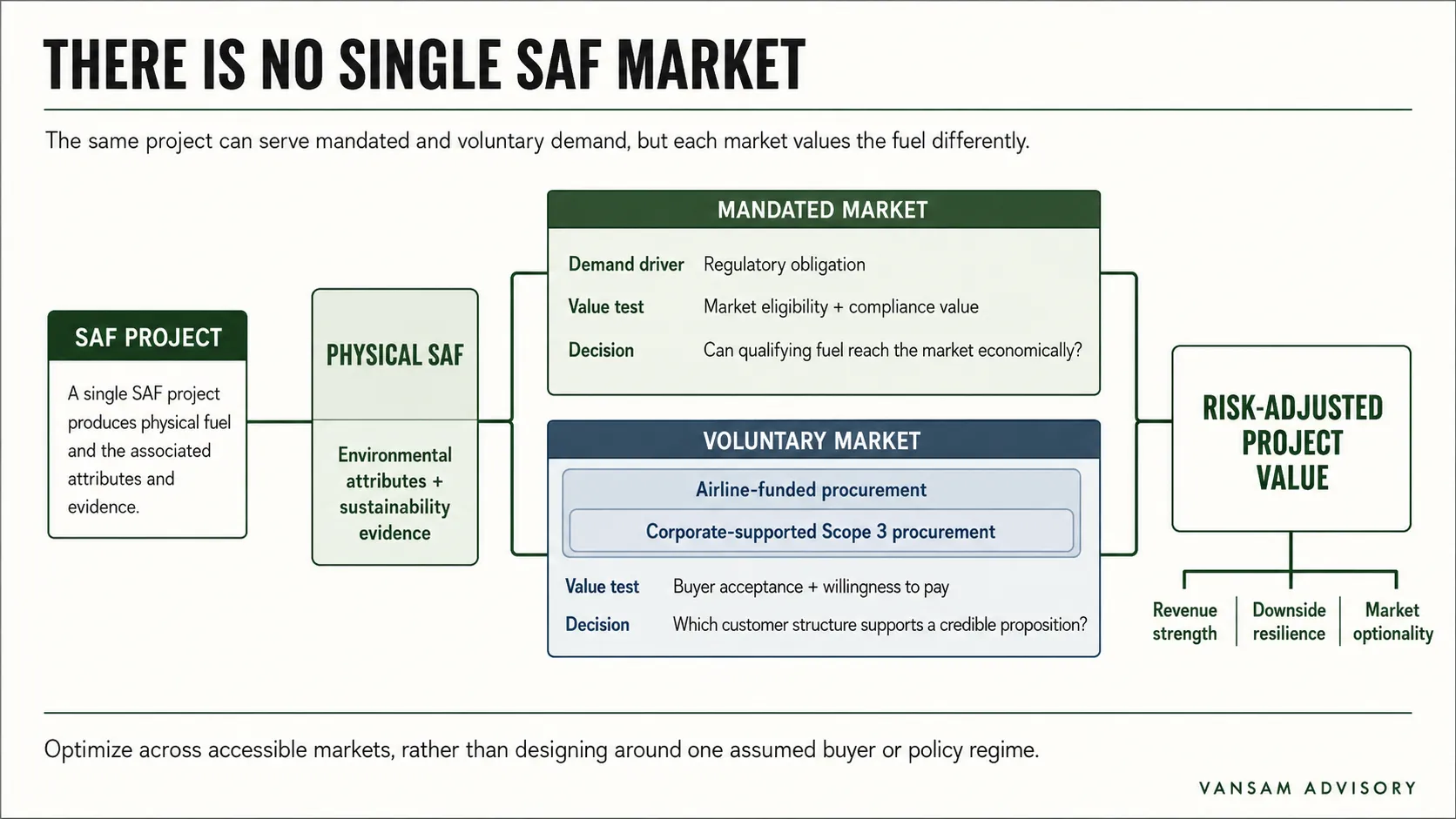
Although “the SAF market” is useful shorthand, it is a poor basis for project design. There are two principal demand markets, mandated and voluntary, but neither is uniform. Opportunities carrying the same label may solve different customer needs, operate under different rules, and require different commercial propositions. Those distinctions influence both the margin a project can realize and the confidence investors can place in its forecast return, including whether the project has a financeable route to market at all. Both principal markets depend on physical SAF entering the aviation fuel system. Many standalone producers make a synthetic blending component (SBC) at the plant gate rather than the finished Jet A or Jet A-1 that enters airport operations. Depending on where it draws its commercial boundary, a project may offer that plant-gate SBC component, a certified finished fuel, or a delivered airline-ready proposition.
The physical fuel also gives rise to environmental attributes and sustainability evidence. Those attributes may remain bundled with the fuel or be transferred through an accepted chain-of-custody or book-and-claim structure, particularly within voluntary demand. Corporate Scope 3 procurement is therefore an important segment of the voluntary market, not a third top-level SAF market. These propositions assign responsibilities and costs differently, while the operational mechanics of moving from a plant-gate component to finished fuel warrant separate treatment.
- In a mandated market, demand is shaped by who carries the obligation and what counts toward compliance. The United Kingdom, for example, places an increasing SAF obligation on fuel suppliers, while its £4.70-per-litre main-obligation buyout provides an alternative method of compliance and effectively caps the scheme's cost rather than guaranteeing a selling price to a producer.
- In the voluntary market, the same fuel faces a more discretionary decision: does its climate value and operating fit justify the premium against other uses of the airline's decarbonization budget? Voluntary demand may be funded directly by an airline or supported by a corporate Scope 3 customer purchasing the associated environmental attributes. That corporate participation can narrow the addressable market if the underlying feedstock, evidence, or claim does not fit the buyer's sustainability position.
Formal eligibility does not guarantee customer acceptance. I have seen corporate customers decline Scope 3 attributes associated with distillers corn oil or degummed corn oil (DCO) because, despite the feedstock's waste-based treatment, the word “corn” created a food-crop association they did not want in their programs. Their response did not change the technical classification of the feedstock, but it did narrow the addressable voluntary market. A project that assumes all eligible attributes are commercially equivalent may therefore overstate the demand available to it.
A market map should do more than rank incentives, determining whether policy value can be realized and whether the physical fuel can reach the airline operations that make demand commercially useful. That route to the customer is a shared execution requirement across mandated and voluntary markets, not a separate market in itself. This is why site selection and market selection cannot be separated cleanly. A site may appear attractive because of feedstock, power, labor, or a production incentive, yet be poorly aligned with the airports and airline operations most likely to support durable demand. Another site may carry higher plant-gate cost but create a stronger delivered proposition because it is better connected to the target customer and its operating network.
The same logic applies within one country and across jurisdictions. Illinois, California, and the United Kingdom are not simply three places with different SAF values; they are different policy and customer systems, each with its own route to realized value. The highest nominal incentive, the nearest airport, and the largest announced demand should therefore be treated as inputs to the decision rather than answers in themselves.
Rather than maximizing headline price in isolation, a project should select the configuration capable of delivering an attractive IRR after accounting for the costs and risks required to reach the customer. Producer netback connects the commercial proposition to project cash flow, while IRR tests whether those cash flows justify the capital and timing required. The preferred configuration is therefore not simply the one with the highest modeled return, but the one whose return remains credible when policy value, customer demand, or execution assumptions move against the project. A lower apparent price can therefore create a stronger investment case if it comes with more bankable demand or fewer conditions between production and payment. Conversely, a premium market can weaken the investment case if the project must retain too much uncertainty to access it.
Because uncertainty is inherent in project development, a first offtake may stall, a policy may weaken, or a counterparty may change its timing. When the entire path to bankability depends on one customer-market combination, the project carries concentration risk even if that anchor opportunity appears strong. The industry already applies this principle at the product level, with some renewable-fuels producers able to shift production between renewable diesel and SAF as relative economics change. Within SAF, a developer can create similar flexibility by pursuing a clear primary market while understanding which other regions, counterparties, or demand structures could support an alternative offtake. This does not mean pursuing every market equally, but using a priority framework to direct resources toward the strongest route to a bankable first offtake, while developing enough knowledge and relationships in selected secondary markets to avoid starting again if the primary path changes. Optionality matters because it protects the credibility of the return, not because it adds another item to a valuation checklist.
The most useful starting point is the ultimate customer. For an airline-centered project, this means:
- Identifying the need being addressed, where the fuel can support the airline's operation, and what proposition the airline can actually use.
- From there, the project can form an initial view of what it will offer, what must accompany that offer, and which downstream parties will be needed to realize its value. That view does not need to presume that the producer will build or control every downstream element. An airline may already have preferred partners and operating pathways. The point is to arrive with a credible hypothesis that can be refined with the customer, rather than an assumption that a plant-gate component will integrate automatically.
- This market-backward view should then shape the project choices that matter most: where to site, what performance to design toward, which commercial milestones must precede capital commitments, and which alternative market path should remain open. It should also shape the questions put before investors.
Before accepting the plant economics, test the customer-market configuration:
- Which customer-market combination is the project's primary route to a bankable first offtake, and why?
- What must the project actually deliver for that customer to use the fuel and for the modeled value to become producer netback?
- Does the resulting IRR remain credible when the most important policy, demand, and execution assumptions are stressed?
- Which secondary market is credible enough to preserve the investment case if the primary path changes?
A production-cost case remains incomplete until the project has demonstrated a credible route from its output to an accepting customer and an investable return. Announced demand may not become contractable demand, policy value may not accrue to the producer, and technical eligibility may not translate into voluntary customer acceptance. For the same reason, an attractive plant-gate margin does not necessarily survive through delivery and payment.
The answer is not to delay development until every downstream detail is fixed, but to treat the target market as a design input while the project can still respond to what it learns. Different customers and jurisdictions create different routes from production to realized value, so projects that select a primary route early and preserve a credible alternative are better positioned to direct capital toward a return that survives contact with the market. Those that defer the decision may optimize a plant for a market they cannot fully serve.
The decision question is simple: Is this project configured for the customer-market system it intends to serve, or only for the fuel it intends to make?
- Illinois Administrative Code, Section 130.333, Sustainable Aviation Fuel Purchase Credit. https://ilga.gov/commission/jcar/admincode/086/086001300C03330R.html
- Illinois Department of Revenue, PIO-747 Sustainable Aviation Fuel Purchase Credit Transaction Participants. https://tax.illinois.gov/research/publications/otherpub/pio-747.html
- California Air Resources Board, Low Carbon Fuel Standard resources. https://ww2.arb.ca.gov/our-work/programs/low-carbon-fuel-standard/resources
- California Air Resources Board, Monthly LCFS Credit Transfer Activity Reports. https://ww2.arb.ca.gov/resources/documents/monthly-lcfs-credit-transfer-activity-reports
- UK Department for Transport, The SAF Mandate: an essential guide. https://www.gov.uk/government/publications/about-the-saf-mandate/the-saf-mandate-an-essential-guide
- MPLX Operations, Explorer Pipeline tariffs. https://www.mplx.com/Operations/Tariffs/
- U.S. Customs and Border Protection, CROSS Ruling H358624. https://rulings.cbp.gov/ruling/H358624
- Texas Comptroller, Jobs, Energy, Technology and Innovation Act. https://comptroller.texas.gov/economy/development/prop-tax/jeti/
hello@vansamadvisory.com