Markets, Policy & Incentives
The Price of Fuel Is Visible. The Cost of Not Having It Isn't.
Why the 2026 energy shock is changing the investment case for sustainable fuels, from decarbonization to economic security and national sovereignty.
November 3, 2026 · 19 min read · Elvis Ebikade, PhD
What this changes
How the 2026 fuel shock reframes sustainable aviation fuel investment through energy security, economic security, national sovereignty and bankability.
This year, the airline industry's fuel bill is projected to rise by roughly $98 billion, an increase more than twenty times larger than an illustrative estimate of the global green premium for all the sustainable aviation fuel the industry is expected to use. Europe, which now produces most of its sustainable aviation fuel within its own borders, has discovered that it imports most of what goes into it. And in October, two airports in southern Italy ran out of jet fuel, not because the world had run short of crude oil, but because truck drivers protesting the cost of diesel had stopped the deliveries.
Ready to pressure-test a live SAF commercialization decision? Book a consultation
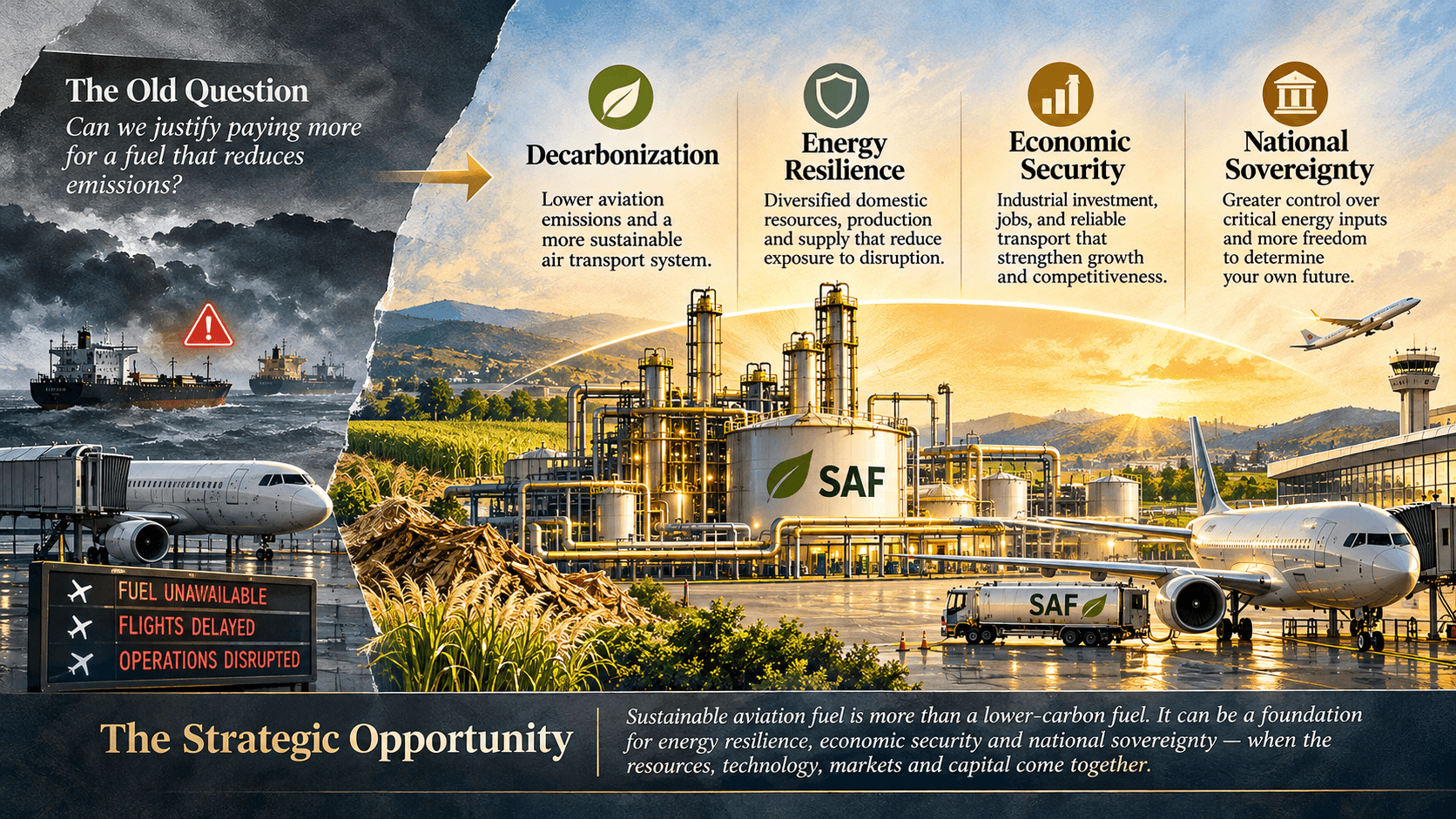
For a decade, the sustainable-fuels industry has been asked whether its product is worth its premium. The 2026 energy shock poses a harder question to everyone who finances, buys or regulates fuel: what is it worth for a nation, an airline or an economy to be able to obtain usable fuel at all, and who is prepared to pay for that capability before the next disruption makes the answer obvious? The argument is that the investment case for sustainable fuels can no longer be written in the language of decarbonization alone. It now runs through energy security, into economic security, and ultimately into national sovereignty. That shift does not make every project bankable, and it does not excuse weak project economics. It does change what developers, investors, airlines, corporate buyers and policymakers should be pricing, and it exposes several assumptions the industry has not yet been willing to examine.
1. The decarbonization case was necessary, but never complete
Sustainable aviation fuel (SAF) has been evaluated mainly on two measures: the lifecycle emissions it avoids and the additional cost of producing it compared with conventional jet fuel. On the second measure the gap is wide. The European Union Aviation Safety Agency (EASA) reported 2025 reference prices of about €1,925 per tonne for SAF against €640 for conventional aviation fuel, and the International Air Transport Association (IATA) expects global SAF production to reach approximately 2.4 million tonnes in 2026, or 0.8% of jet-fuel use. Across airline fuel procurement, producer commercialization and project investment, I have watched promising technologies run into the same hard questions about who will buy the fuel, under what obligation, and with what evidence that the plant can deliver it. Those foundations of bankability remain, and nothing in what follows changes them.
What has changed is the scale against which the premium should be judged. As an illustration only, applying EASA's 2025 EU reference-price differential of roughly €1,285 per tonne to IATA's projected global 2026 volume suggests a worldwide green premium on the order of €3 billion. Because that estimate combines a European price spread with global production, and is expressed in a different currency from IATA's airline figures, it should be read as an indication of relative scale. In the same year, IATA raised its forecast of the industry's fuel bill from $252 billion to $350 billion with consumption broadly unchanged, and cut its industry profit forecast from $45 billion to $23 billion.
None of this suggests that SAF investment could have avoided the shock, since today's SAF volumes are far too small to have moved the market and SAF's own price is not insulated from it. The comparison nonetheless shows that the premium the industry has debated for a decade is small relative to the cost of exposure, and that the more consequential question has shifted from what cleaner fuel costs to what it costs to have too few ways of obtaining any fuel at all.
2. Energy security is an industrial capability, not a geological endowment
Crude oil does not power a truck, heat a home or fuel an aircraft. Refining, storage, blending, transport and distribution determine whether an energy resource becomes a usable product where it is needed, and in 2026 that chain, rather than the oil itself, became the binding constraint. Industrial Info Resources data show that more than 8 million barrels per day of refining capacity, or 12.13% of global crude and condensate capacity, was offline in September, the highest level since the pandemic, with conflict in the Middle East and drone attacks on Russian refineries accounting for most of it.
Aviation in particular shows both the vulnerability and the capacity to adapt. IATA estimates that Middle Eastern jet-fuel production fell by an average of 640,000 barrels per day between March and June compared with February, while refiners in Europe, North America and West Africa raised output by roughly the same amount. Asian refiners that depend on Middle Eastern crude moved in the opposite direction, cutting runs as their inputs tightened, and airlines across Asia cut flights, carried extra fuel from home airports and added refueling stops. Europe, which had drawn around 40% to 44% of its imported jet fuel from the Persian Gulf in 2025 according to S&P Global, turned to the United States and West Africa, and for a period this summer Nigeria, supplying entirely from the Dangote refinery, emerged as one of Europe's leading sources of imported jet fuel.
While supply adapted substantially, that adaptation neither eliminated shortages nor equalized national exposure. The more instructive lesson is that countries entered the disruption with very different capabilities, and the market's response protected them unequally: nations with working refineries, diversified crude access, strategic stocks and established routes had options, while others had only prices. A single large refinery turned a country long dependent on imported finished fuels into a supplier Europe turned to in a crisis, which is as clear a demonstration as any that fuel security is something nations build rather than something geology hands them.
3. The bill is paid by households, freight and public budgets
In Who Pays for the Energy Transition? I examined how the costs and benefits of decarbonization are distributed across society. The 2026 shock forces the mirror-image question of who pays when essential energy becomes scarce, and the answer travels through an economy in layers. The Italian episode shows how quickly those layers connect. In October, protests by truck drivers over diesel costs disrupted food deliveries, stranded produce and interrupted fuel supply to the airports at Crotone and Reggio Calabria, where crews were advised to plan refueling elsewhere. A household-affordability problem became a freight problem and then an aviation-fuel availability problem within a single national supply chain, and the government responded with additional support for hauliers, farmers and fishers. The same transmission is visible on every continent:
- The European Commission estimates that the EU spent an additional €100 billion on fossil-fuel imports between March and the end of September, on top of an import bill of roughly €340 billion in 2025.
- Pakistan raised diesel prices by 54.9% in a single adjustment in April, and ACLED has recorded more than 1,200 demonstrations across South Asia linked to fuel availability, cooking gas and living costs.
- In Chile, Reuters reported that diesel prices in Santiago rose by roughly 60% once a stabilization mechanism costing as much as $140 million a week could no longer hold them down.
- Kenya, which imports its finished fuels, saw its regulator raise maximum diesel prices again in October.
- In France, the Interior Ministry counted 410,000 people at nationwide demonstrations against rising living costs on October 24.
The aggregate outlook is no gentler as the International Monetary Fund projects global inflation of 4.7% in 2026, and the World Bank expects energy commodity prices to be 32% higher this year, with food commodity prices rising a cumulative 18% across 2026 and 2027. This is why energy resilience belongs in the same conversation as economic security: the capacity to keep fuel moving protects purchasing power, the continuity of work, the movement of goods and a government's ability to maintain essential services.
4. Dependence does not disappear; it moves
The most uncomfortable energy-security question is also the simplest: who controls a nation's access to the resources it needs to function? Export restrictions, sanctions, contracts, currencies and transport corridors can decide whether a refinery receives crude or a country receives finished fuel at all. Cuba has lived the extreme case this year. After the loss of major Venezuelan shipments and US measures discouraging other suppliers, its transport minister told Reuters that he expected public-transport passenger trips to fall by 75%, and daily bus departures from Havana to the provinces fell from 419 in 2025 to 11. Restricted fuel access became a restriction on everyday life.
Europe's exposure is far less severe but more instructive for this audience, because it shows how dependence can migrate into the cleaner-fuel economy that was meant to reduce it. European refineries supply about 70% of the EU's jet fuel and 85% of its diesel, according to the Commission, yet imported fossil fuels still account for 57% of the energy the Union consumes. Sustainable aviation fuel was expected to change that equation, and EASA's 2026 ReFuelEU Aviation report suggests it has changed the location of the dependency rather than its existence.
EU SAF SUPPLY, 2025
- 86% of SAF supplied at EU airports was produced within the Union.
- 85% of the feedstock used to make it originated outside the EU.
- 61% of SAF supplied traced back to feedstock originating in China, and 80% was made from used cooking oil.
Source: EASA, ReFuelEU Aviation Annual Technical Report 2026.
Europe has not so much eliminated its fuel dependency as moved it upstream, from the barrel to the feedstock, and concentrated much of it in a single supplying country and a single waste stream. If Asian economies increasingly use their waste oils at home, if export policies change, or if input prices rise, European producers face a concentration risk that the current trade conceals but does not remove. Regulation is moving in the same direction: Germany's recent cabinet approval of RED III sustainability rules is part of a wider tightening of certification and supply-chain verification that is making feedstock traceability a condition of market access.
Sovereignty, in this sense, is the practical capacity to meet essential domestic needs while still participating in international trade from a position of stability, built through diversified suppliers, critical infrastructure, strategic reserves and domestic production. A nation better able to meet its own essential needs is also better placed to support its regional partners when the next disruption arrives.
5. What nations can build
There is a question the transition debate rarely confronts directly: what does energy transition mean for a nation that has never enjoyed reliable, affordable energy in the first place? For such a country, dependable energy is the foundation of industrialization, productive employment and essential services, and the task is to build that capability while avoiding both the carbon intensity and the external dependencies that defined the last century of energy development. Sustainable fuels matter here because they draw on resources a nation can influence directly.
Petroleum is distributed by geology, and no country can decide to possess an oilfield. Many of the inputs to sustainable fuels, by contrast, can be generated, recovered, cultivated or expanded through domestic activity. Each of the following offers a route to drop-in jet fuel where the resource, the technology and the economics align:
- Agricultural and forestry residues
- Suitable municipal and food wastes
- Ethanol and other biogenic intermediates
- Captured carbon combined with low-emissions hydrogen
Because long-haul aviation will rely on energy-dense liquid fuel for the foreseeable future, these pathways are the main route by which aviation can draw on domestic resources at all. The development dividend is real as sustainable collection and cultivation can support rural incomes, farmers, forestry operators, waste-management businesses, logistics providers and skilled manufacturing jobs, and those benefits become durable when resource access is paired with fair contracting, traceability, credible lifecycle performance and dependable markets. The discipline, however, is unforgiving. A tonne of waste recorded in a government study is not the same as a sustainably recoverable tonne that can be collected year-round, verified under the applicable fuel rules, contracted, delivered and converted into an eligible product, and nations and investors that confuse the two will build stranded plants.
Destination also matters as much as origin especially since a domestic SAF plant whose entire output is committed to foreign customers may generate jobs and export earnings while doing little for local aviation security, whereas a plant with credible domestic delivery arrangements can do both, particularly where eligible book-and-claim systems allow physical local supply to be combined with international revenue for the environmental attributes.
6. Five questions that will shape the next sustainable-fuels market
If resilience is part of the value of sustainable fuels, the 2026 shock raises five questions for those building, financing, buying and governing new fuel supply.
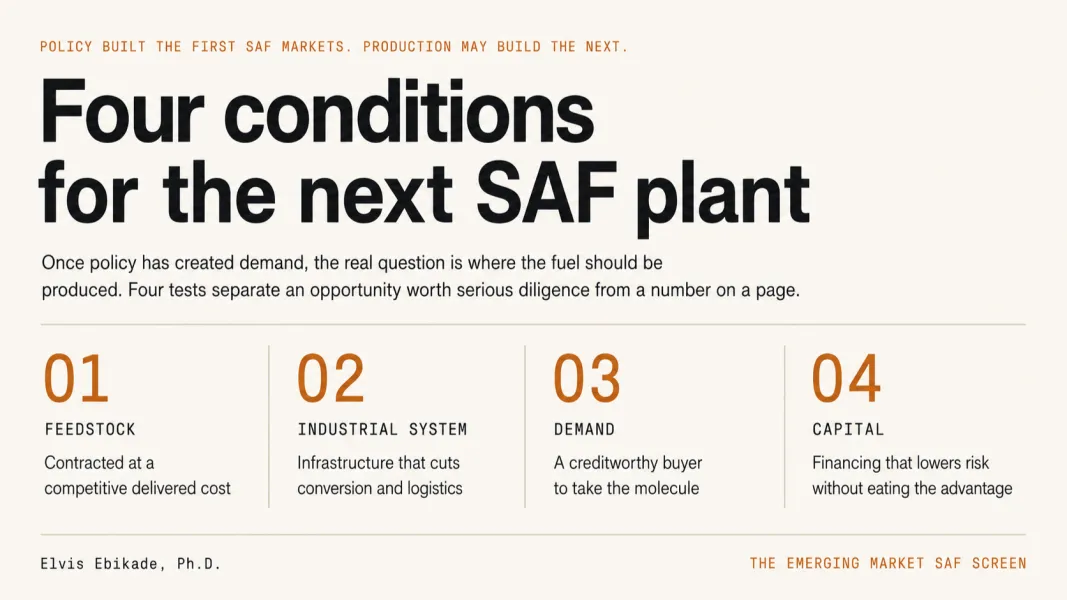
For project and technology developers: can your project deliver competitive fuel beyond a single policy signal? A mandate creates demand, but it does not make every project competitive, and 2026 showed how quickly a case built on one incentive, one feedstock or one buyer can be exposed when trade routes, input prices or policies shift. Developers therefore need to show where technology, feedstock access and delivered economics create a durable advantage for real customers. A plant-gate cost advantage can disappear through blending, logistics, delivery obligations or pricing terms, so the investment case must hold through to the airline and to the net revenue the producer retains. Incentives can strengthen that case, and durable, enforceable policy support can underpin financeable revenues. What lenders distinguish is cash flow they can reliably underwrite from policy-dependent upside whose value, duration or eligibility remains uncertain, so the strongest thesis pairs that underwritable core with reliable performance, access to more than one market and resilience in the downside, rather than one that depends on everything staying as it is.
- For investors and lenders: who prices the requisition risk? Emergency fuel-allocation powers are a credible option for governments that take fuel security seriously, and there are good reasons to establish them. To a lender, however, such a provision means that a state may direct a plant's output in a crisis. Projects can remain financeable where those powers come with clear obligations, defined compensation and contractual treatment that is predictable from the outset, and investors who are not yet asking how a target jurisdiction would treat their offtake in an emergency are leaving a material risk unpriced.
- For airlines: is SAF offtake a compliance cost or a supply-security instrument? Most carriers still treat SAF commitments as a decarbonization expense to be minimized. The airports in Calabria and the scramble for jet fuel across Asia this spring suggest that a long-term contract with a producer in a diversified location also carries value as supply insurance, provided it balances the producer's need for revenue certainty against the airline's exposure to fuel prices, shifting incentives and future production costs. Boards that recognize that value will negotiate those contracts differently.
- For corporate buyers of SAF certificates: are you buying decarbonization or resilience? Book-and-claim has been one of the industry's most useful innovations, allowing companies far from any producing plant to fund real emissions reductions. A certificate, however, transfers an environmental attribute rather than access to fuel. Companies whose logistics depend on aviation should ask whether part of their sustainable-fuel spend ought to secure physical supply for the networks they operate, and whether contracts can be structured to deliver both.
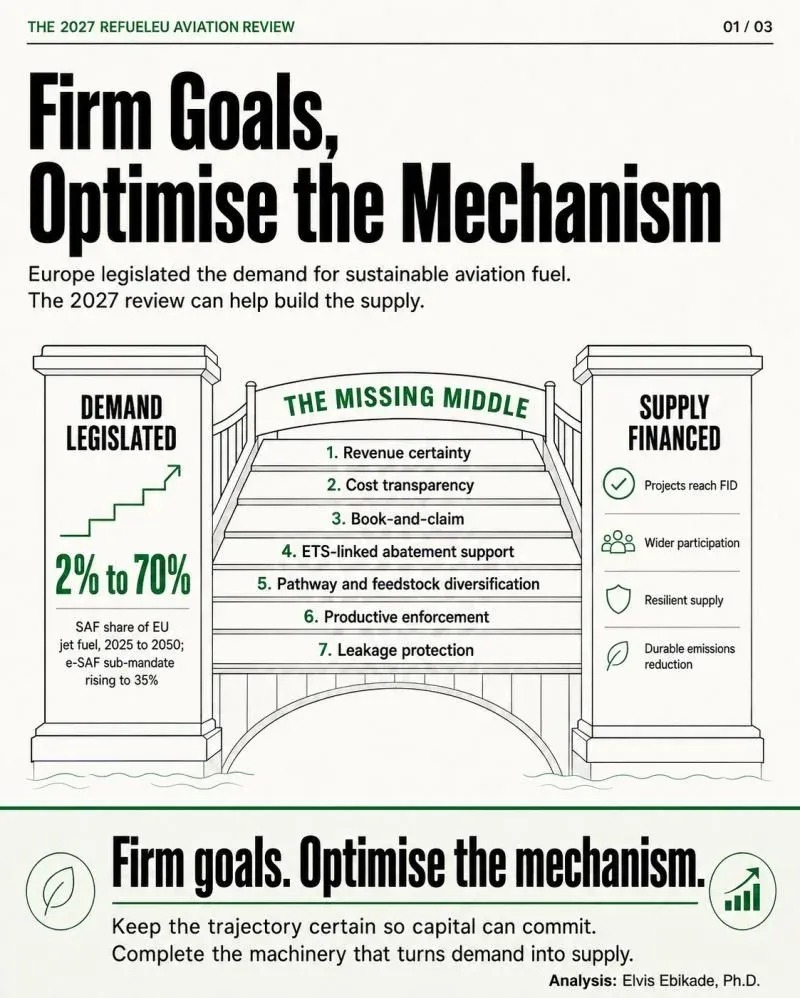
- For governments: do your policies build productive capacity and diversify critical inputs? Laws, mandates, procurement and industrial policy set the conditions under which capital operates, and frameworks that reward where fuel is produced or blended while overlooking where its feedstock originates can, as Europe's experience shows, reproduce the concentration that importing nations are paying to escape. Importing countries can diversify feedstock sources and secure domestic supply, while resource-producing countries must consider whether local conversion creates more enduring value than exporting raw inputs to support someone else's security. The answer differs by national resources and development needs, but feedstock origin is a security question, not merely a trade detail.
7. Where capital goes next, and how to judge it
Some governments are already folding energy resilience into industrial strategy:
- Japan, with energy self-sufficiency of about 16.3% in 2024, has built its Green Transformation strategy around stable energy supply, industrial competitiveness and decarbonization, aiming to mobilize roughly ¥150 trillion in public and private investment over ten years.
- Canada has proposed Clean Fuel Regulations credit multipliers favoring qualifying domestically produced low-carbon fuels.
- The European Commission’s 28 October dialogue with refiners treats maintaining strategic fuel output, adapting existing refineries and developing sustainable biofuels and e-fuels as connected questions of energy security and industrial competitiveness.
Instruments like these shape where capital can pursue durable production opportunities, and financial institutions are examining the same exposure from the other side: JPMorganChase's September report, The Race to Resilience, treats the ability to keep energy flowing under stress as an investment concern. The projects reaching financial commitment are instructive less for their climate credentials than for how they secured their inputs and outlets:
- In Malaysia, PETRONAS, Enilive and Euglena broke ground at Pengerang in November 2025 on a biorefinery designed to process up to 650,000 tonnes of renewable feedstock a year, anchored by sponsors that already own refining infrastructure and market access.
- In Brazil, Acelen Renewables announced approximately $1.5 billion in financing arrangements in May 2026 for a Bahia biorefinery that integrates agricultural and waste-oil feedstock strategies from the outset.
- In Egypt, the SAF Fly Egypt project secured a $142.9 million debt package within a $212.4 million investment, with Shell acting as both primary feedstock supplier and long-term take-or-pay offtaker.
The common thread is that capital followed secured inputs and secured outlets; the resilience and climate value was real, but it was financed through commercial structures that lenders could underwrite. That points to a clear division of labor:
- Public capital and policy can pay for what individual fuel buyers cannot, including domestic supply options, industrial capability and essential connectivity.
- Development finance and blended capital can close specific gaps that commercial lenders will not yet carry.
- Private equity, infrastructure funds and banks can then finance the competitive projects with credible inputs, buyers and risk-adjusted returns.
When those roles are confused, governments subsidize weak projects while investors walk away from strong ones.
Capital must also match the risk and milestone being financed. Venture investors may fund technology validation, while infrastructure investors and lenders require far greater construction and revenue certainty. Between those stages lies a financing challenge of its own: development capital. Independent developers without an established balance sheet or a history of delivering commercial facilities must finance engineering, permitting, technology licensing, independent validation and executable agreements before they can demonstrate the conditions required for construction financing.
A project can therefore be economically attractive and still fail to reach a final investment decision (FID) because it cannot finance the work needed to become bankable. The ability to mobilize that capital, whether through strategic partners, established sponsors or development finance institutions, can itself influence which countries turn promising resources and technologies into operating fuel capacity. The discipline lies in identifying which uncertainty each development dollar will resolve, what evidence that expenditure will produce, and which financing partner can support the next milestone. This is the problem my work at Vansam Advisory is built to address, through three connected decisions:
- Market Attractiveness. Where is the opportunity, and how durable is the need? This means examining a market's aviation-energy requirements, import exposure, accessible domestic resources, policy conditions and capacity to respond.
- Project Attractiveness. Which facility and technology can turn that opportunity into competitive, recurring production, given its feedstock, process maturity, construction and operating economics and execution risk?
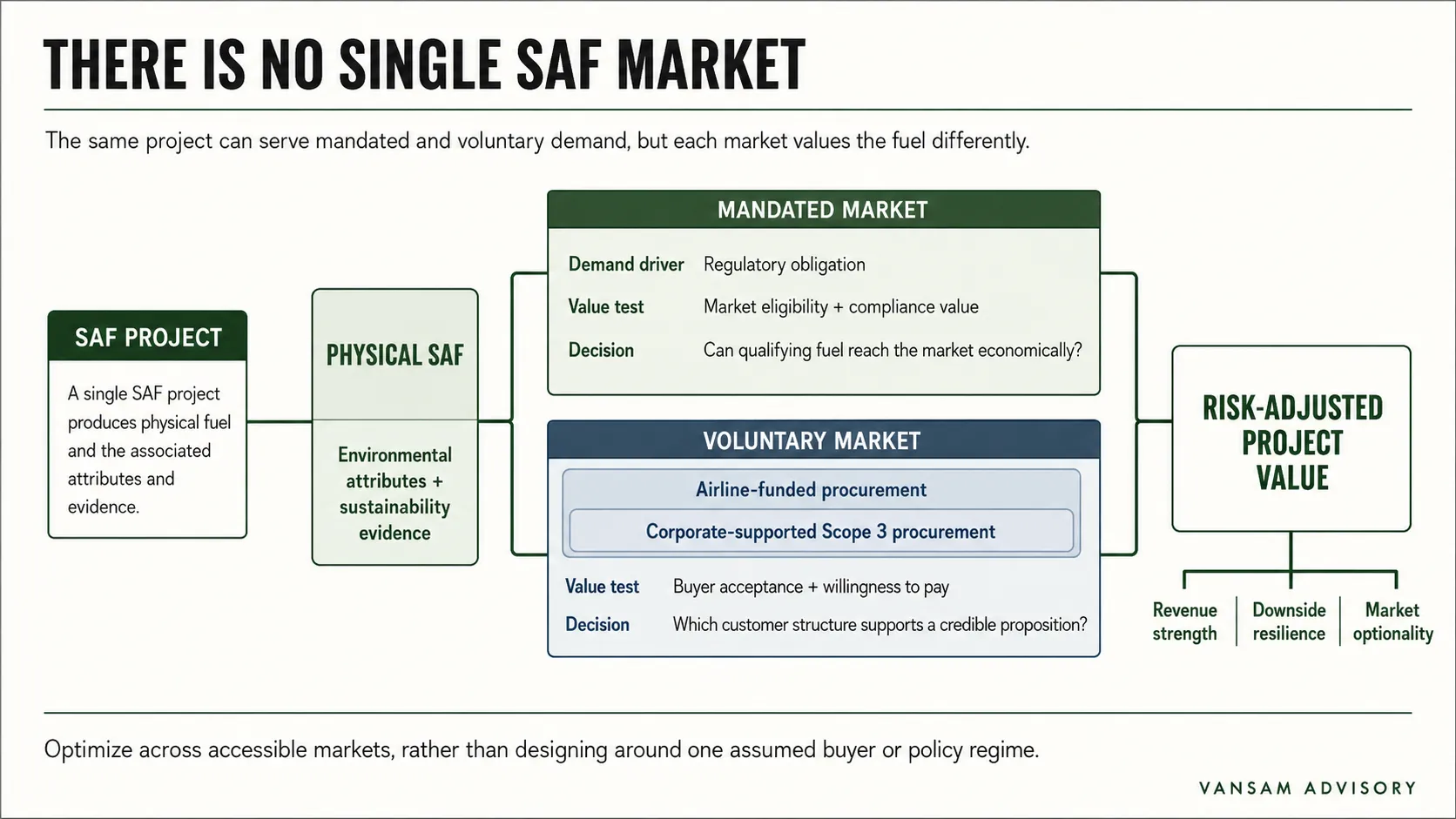
- Market Access & Revenue Optimization. Where can the fuel and its environmental attributes realize the most value across domestic and export customers, contract structures, price formation and producer netback?
The Vansam SAF Bankability Framework connects these decisions through seven assessment areas: feedstock, technology, construction and execution, offtake, market access, economics, and financing and capital. It evaluates the evidence behind a project's commercial and development plans, separates the areas where evidence is weakest from the risks most likely to block the next investment decision, and identifies the evidence needed to reach the next financing milestone.
In summary
- Resilience has economic value, but not every resilience argument produces a bankable project. The task for developers, investors, buyers and governments is to identify where these investments create the greatest durable value, who captures that value and who bears the risks, and whether the benefits justify the capital required to deliver them. The wider benefits to society matter even when they do not appear in project revenue, which is why public policy, private capital and commercial buyers must each price the part they can.
- Decarbonization remains essential, but the next chapter of sustainable fuels will be shaped by the nations and investors who recognize that the ability to make fuel is itself a strategic asset, and who build it before they need it.
The price of fuel is visible, but the cost of dependence is often revealed only when the choices disappear.
Sources
- EASA, ReFuelEU Aviation Annual Technical Report 2026 (2025 data)
- IATA, 2026 global SAF supply outlook
- IATA, global airline financial outlook, June 2026
- Industrial Info Resources, global refining capacity offline (September 2026 data)
- IATA Economics, Global Refining Response Cushions Jet Fuel Supply Shock, July 24, 2026
- Arab News / Reuters, IATA on jet-fuel supply recovery and Asian airline disruption, April 8, 2026
- S&P Global, Europe's jet-fuel import exposure to the Persian Gulf, May 8, 2026
- OPIS, Nigeria emerges as a leading jet-fuel supplier to Europe, August 14, 2026
- ANSA, Crotone and Reggio Calabria airports run out of fuel, October 21, 2026
- European Commission, AccelerateEU: import exposure and additional spending
- ACLED, fuel-price and cost-of-living protests in South Asia
- Reuters, Chile fuel price adjustment, March 24, 2026
- Kenya EPRA, maximum retail petroleum prices, October 15 to November 14, 2026
- Reuters via Investing.com, nationwide demonstrations in France, October 24, 2026
- IMF, World Economic Outlook, October 2026
- World Bank, Commodity Markets Outlook, October 28, 2026
- Reuters, Cuba public transport and fuel restrictions, October 22, 2026
- IEA, Japan 2026 Energy Policy Review
- JPMorganChase, The Race to Resilience, September 2026
- Eni / Enilive, Pengerang biorefinery groundbreaking ceremony, November 2025
- Acelen Renewables, Bahia biorefinery financing, May 2026
- Clifford Chance, SAF Fly Egypt financing, August 2026
- European Commission, high-level dialogue on refining, October 28, 2026
- Bioenergy Insight, German cabinet RED III sustainability rules, October 29, 2026
- Government of Canada, proposed Clean Fuel Regulations amendments, October 2026