Delivery, Infrastructure & Operations
Making SAF Is Not Delivering SAF
Producing an ASTM-qualified SBC is only the beginning. SAF projects also need blending, testing, infrastructure and a credible route to the aircraft wing.
August 21, 2026 · 15 min read · Elvis Ebikade
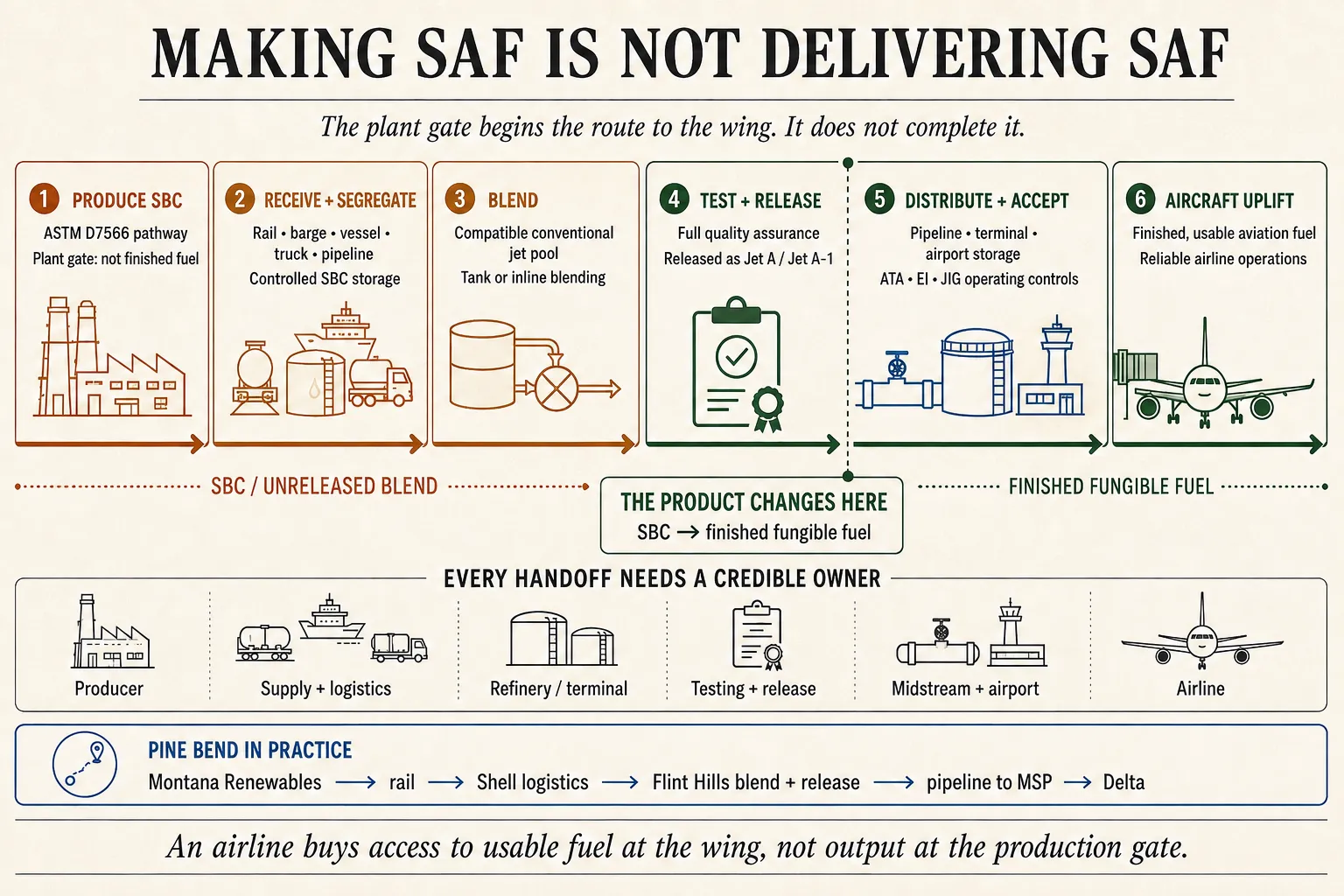
sustainable aviation fuel project can reach mechanical completion, produce an ASTM-qualified synthetic blending component and still remain unable to supply usable fuel to an airline. That distinction is often obscured by the language of the market as producers, policymakers and investors routinely refer to a production facility as making SAF. Technically, however, most approved pathways produce a synthetic blending component, or SBC, under an annex of ASTM D7566. The component must then be blended with conventional jet fuel, tested, certified and released as a finished Jet A or Jet A-1 fuel before it can enter the established aviation fuel system. Producing the component is therefore an essential milestone, but it is not the finish line. The airline is buying access to usable fuel at an airport, not simply output at a production gate. For project developers, this changes what it means to be ready for market. Feedstock access, technology performance, carbon intensity and production cost remain fundamental, yet none of them answers the operational question that ultimately determines whether the product can reach an aircraft: how will the SBC be converted into a finished, fungible fuel and delivered through an accepted route to the wing? The plant gate is not the finish lineASTM D7566 establishes approved pathways for producing synthetic aviation fuel components and specifies the conditions under which each component may be blended with conventional jet fuel. These conditions include pathway-specific blending limits and fuel property requirements. Once the synthetic component and conventional jet fuel are blended in accordance with ASTM D7566, the resulting batch must undergo the required testing and quality controls. When it meets the applicable requirements, it can be released as a finished aviation turbine fuel and treated as meeting ASTM D1655. In markets using Jet A-1, additional requirements may apply under specifications such as DEF STAN 91-091. This sequence matters because an SBC is not yet a fungible airport fuel since it cannot simply be transferred from the production facility into an airport fuel system and treated as interchangeable with conventional jet fuel. The producer has made a technically valuable component and the downstream system must still turn it into the product the airline can use. That conversion requires more than selecting a blend ratio. SBCs from different pathways, and sometimes from different producers using the same pathway, may have different compositional profiles, conventional jet fuel pools also vary in properties such as aromatic content, density or even flash point. The final blend must satisfy the full fuel specification, not merely an assumed percentage or a single property. In some cases, the blending operation may require another component to correct a particular property. Commercial blending can involve more than adding a fixed quantity of neat SAF to conventional jet fuel since properties such as viscosity, density, aromatics and the distillation curve must work together in the finished blend. The commercial implication is straightforward: a project cannot define its finished product solely by what leaves the production unit. It must understand the conventional jet fuel with which the SBC will be paired, the blending configuration, the testing protocol and the party responsible for certifying and releasing the finished batch. Meeting ASTM does not complete the supply chainASTM qualification addresses the technical specification of the fuel. It does not, by itself, establish that every terminal, pipeline, storage operator, airport or airline will accept the product. Aviation fuel moves through an operating system governed by overlapping product specifications, quality-assurance standards and facility procedures. Depending on the geography and supply arrangement, these may include ASTM D7566 and D1655, DEF STAN 91-091, EI 1533, EI/JIG 1530, ATA Specification 103 and the Joint Inspection Group standards governing airport storage, hydrant systems and into-plane fuelling. These requirements govern different parts of the chain. EI 1533 addresses quality assurance for synthetic blending components and semi-synthetic jet fuel.
- EI/JIG 1530 covers the manufacture, storage and distribution of aviation fuel to airports.
- ATA Specification 103 establishes jet-fuel quality-control expectations at airports
- JIG 2 and JIG 1 govern airport depots, hydrant systems and into-plane operations.
The precise combination varies by market and operating model, but the principle is consistent: technical compliance at the production facility does not remove the need for controlled handling, documentation, traceability, sampling, testing, filtration, certification and release throughout the supply chain. This is why an airline may remain cautious even when a producer can demonstrate that its technology and product comply with the relevant ASTM pathway. The airline must also be confident that the finished fuel can enter its fuel supply operations without introducing new quality, reliability or scheduling risks as aircrafts do not wait for a blending problem to be resolved. Airport fuel systems serve continuous, safety-critical operations and any new supply arrangement must fit into that reality.
It is easy to place blending into a project plan as though it were a standard service that can be purchased wherever the fuel happens to arrive. However, in practice, commercial blending requires a specific configuration of assets, operating capabilities and contractual responsibilities.
- A terminal may need the ability to receive SBC by rail, barge, vessel, truck or pipeline. It must be able to store that component under controlled conditions and keep it appropriately segregated before blending. It also requires access to a compatible conventional jet-fuel pool, transfer lines, pumps, meters, filtration, sampling points and laboratory support.
- The facility must then produce a conforming batch, maintain the required records and release the finished fuel into an accepted distribution route. Depending on the operation, the fuel may move onward through a refined-products pipeline, another terminal, airport storage or a hydrant system.
- The exact infrastructure will vary as a facility does not always require an entirely new set of assets, and existing equipment can sometimes be adapted. However, controlled segregation of the SBC before blending cannot simply be assumed. The operator must determine whether existing tanks, lines and procedures are compatible with the product and whether modifications are required.
- The choice of blending method also matters: tank or splash blending can be workable in certain configurations, particularly at smaller volumes. Inline blending generally provides greater control over component ratios and final fuel properties, which can reduce the risk of producing an off-specification batch. It also requires more sophisticated metering, process controls and capital investment.
These are not abstract engineering preferences as they affect and determine the reliability, cost and scalability of the route to market. The question is not merely whether the fuel can be blended, but where blending should occur, which operator can perform it reliably, what infrastructure is required, who will control the finished batch and how that batch will reach the airline’s operation.
A producer may assume that the SBC can be transported to an airport and blended there. That may be technically possible in a particular case, but it is rarely a sound default assumption. Most airport fuel systems are designed to receive finished, fungible aviation fuel. Their storage tanks, hydrants and into-plane systems support highly coordinated operations across multiple airlines and fuel suppliers, and are not generally designed to hold separate inventories of SBC from different producers or ASTM annexes while repeatedly creating and certifying new blends as of today. Adding airport blending may require segregated storage, new transfer infrastructure, batch controls, testing capabilities and revised operating procedures. Those additions must coexist with an airport’s existing throughput, safety requirements and limited physical space.
Even where the assets could be installed, the operational case may be weak. Introducing more tanks, more batches and more interfaces near the point of aircraft fuelling can add complexity to the part of the supply chain where the tolerance for disruption is lowest. A better configuration may be to blend the SBC at a refinery or terminal that already has access to conventional jet fuel, quality-control capabilities and an accepted route into the airport. Once the resulting fuel has been tested and released as meeting the applicable finished-fuel specification, it can move through much of the same infrastructure used by conventional jet fuel. This is the real value of fungibility. It is achieved after the required blending, testing and release, and should not be assumed at the production gate.
The new SAF blending facility at Flint Hills Resources’ Pine Bend refinery in Minnesota provides a useful example.
The neat SAF is produced by Montana Renewables in Great Falls and transported roughly 1,000 miles by rail to Pine Bend. Shell serves as the supply and logistics partner under its five-year collaboration with Delta. Flint Hills receives and stores the component, blends it with conventional jet fuel produced at the refinery, completes the required testing and release, and delivers the finished fuel through its existing pipeline to Minneapolis-St. Paul International Airport and the facility is expected to be capable of blending up to 30 million gallons of neat SAF annually.
The route demonstrates the full system in operation: SBC production occurs in Montana, logistics are coordinated by Shell, blending and certification occur at Pine Bend, and the finished fuel moves through established infrastructure to Delta’s second-largest hub. Each participant provides a different capability, and the SBC only becomes usable airline fuel because those capabilities have been deliberately connected. The model also illustrates the value of an existing refinery and fuel-distribution system. Pine Bend already produces conventional jet fuel and has a pipeline route to the airport. The project did not need to recreate the entire aviation fuel network. It needed to add the capabilities required to receive, segregate and blend the SBC within that network.
The facility emerged from a wider ecosystem involving Flint Hills Resources, Montana Renewables, Shell, Delta, the airport and the Minnesota SAF Hub. Publicly available information does not disclose the full capital structure or how every cost was allocated, so it would be inappropriate to assume which party financed each asset. What is clear is that the route did not appear automatically when Montana Renewables produced the SBC. It required a deliberate blending and distribution solution tied to a specific airport and airline market.
Neste’s terminal capacity at ONEOK’s Galena Park facility in Houston offers a second model. The site provides substantial storage and blending capacity and connects to refined-products infrastructure serving airports across the central and eastern United States. The location matters because it combines access to a major fuel market with established midstream assets. Rather than attempting to reproduce the aviation fuel system at the production facility or the airport, Neste positioned blending and storage within infrastructure that can connect the component to a much wider distribution network. The model shows why market access depends on more than proximity to an airline.
A producer may be geographically close to a large airport and still lack a viable route into its fuel system while another producer may be farther away but better connected through a terminal with the right storage, blending, certification and pipeline capabilities. Distance matters, but connectivity often matters more.
A recent collaboration among EcoCeres, SF Group and China National Aviation Fuel Group makes the same point in a different market. Under the programme, EcoCeres produces the synthetic component, China National Aviation Fuel blends it and supplies the finished fuel, and SF Airlines uses it on outbound freighter flights from Ezhou Huahu International Airport. The programme also involves the Second Research Institute of the Civil Aviation Administration of China and uses AnchorTrace to track, register and retire the associated environmental attributes. The commercial programme builds on an earlier pilot in which fuel produced at EcoCeres’ Zhangjiagang facility was transported, blended by China National Aviation Fuel and supplied to commercial flights at Chengdu Shuangliu International Airport.
The significance is that the partnership created a chain from production through transportation, blending, certification, airport fuelling, aircraft use and environmental-attribute management, in addition to EcoCeres producing SAF. Each participant contributes a capability the producer does not need to recreate: EcoCeres provides the renewable fuel, China National Aviation Fuel provides aviation-fuel infrastructure and operational integration, SF Group supplies concentrated cargo demand and an operating hub, and the research institute supports the certification and attribute framework. This provides a practical model for SBC producers demonstrating that downstream integration does not mean that the producer must own every terminal, tank, pipeline or airport asset. Rather, it means that the producer must understand the required chain and establish relationships with the parties capable of completing it.
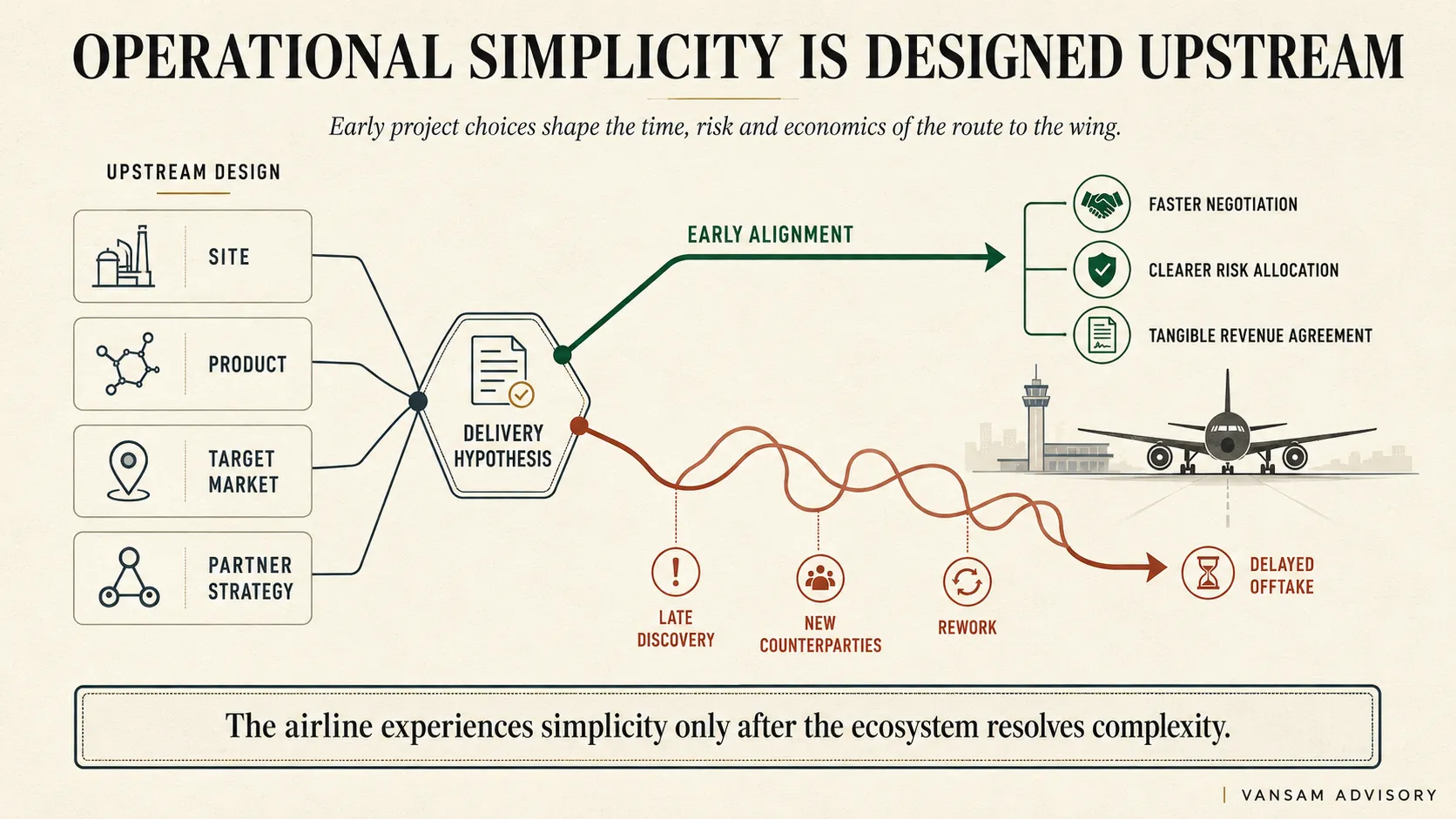
An airline may have preferred fuel suppliers, terminal operators or blending partners whilst remaining willing to help refine the route to supply and, in some cases, actively co-create the solution. But that does not remove the producer’s responsibility to arrive with at least an informed initial perspective. Before approaching an airline, the producer should understand the state in which its product will leave the facility, where it could be received and blended, and how the finished fuel could reach the airline’s principal hubs. It should also have an initial view of the infrastructure owners, fuel suppliers and quality-control parties required to complete that route.
This does not require a fully contracted supply chain before the first airline conversation, but at minimum, a credible delivery hypothesis, and that distinction affects how the producer is perceived. A producer that assumes its component will be integrated automatically may signal that it does not understand the aviation fuel system, while a producer that can present a reasoned supply configuration, identify the remaining decisions and invite the airline to refine that configuration demonstrates a much stronger level of commercial readiness and affords saved time. If downstream integration first emerges as an issue during an advanced airline discussion, the project may have to pause while the team identifies terminals, evaluates infrastructure, establishes quality procedures and negotiates responsibilities, and those activities can materially delay an offtake process and expose assumptions embedded in the project plan.
Project readiness therefore extends beyond technology readiness, feedstock access, permitting, offtake and financing. For an SBC producer, it must include a credible path for converting the component into finished fuel and delivering it through infrastructure that the relevant airline and airport can accept. The answers may evolve as the project develops, the airline may introduce preferred partners, midstream operators may offer better terminals, a different market may produce a stronger supply configuration. The purpose of early planning is not to freeze the solution prematurely, but to ensure that the project is being developed with the full operating system in view.
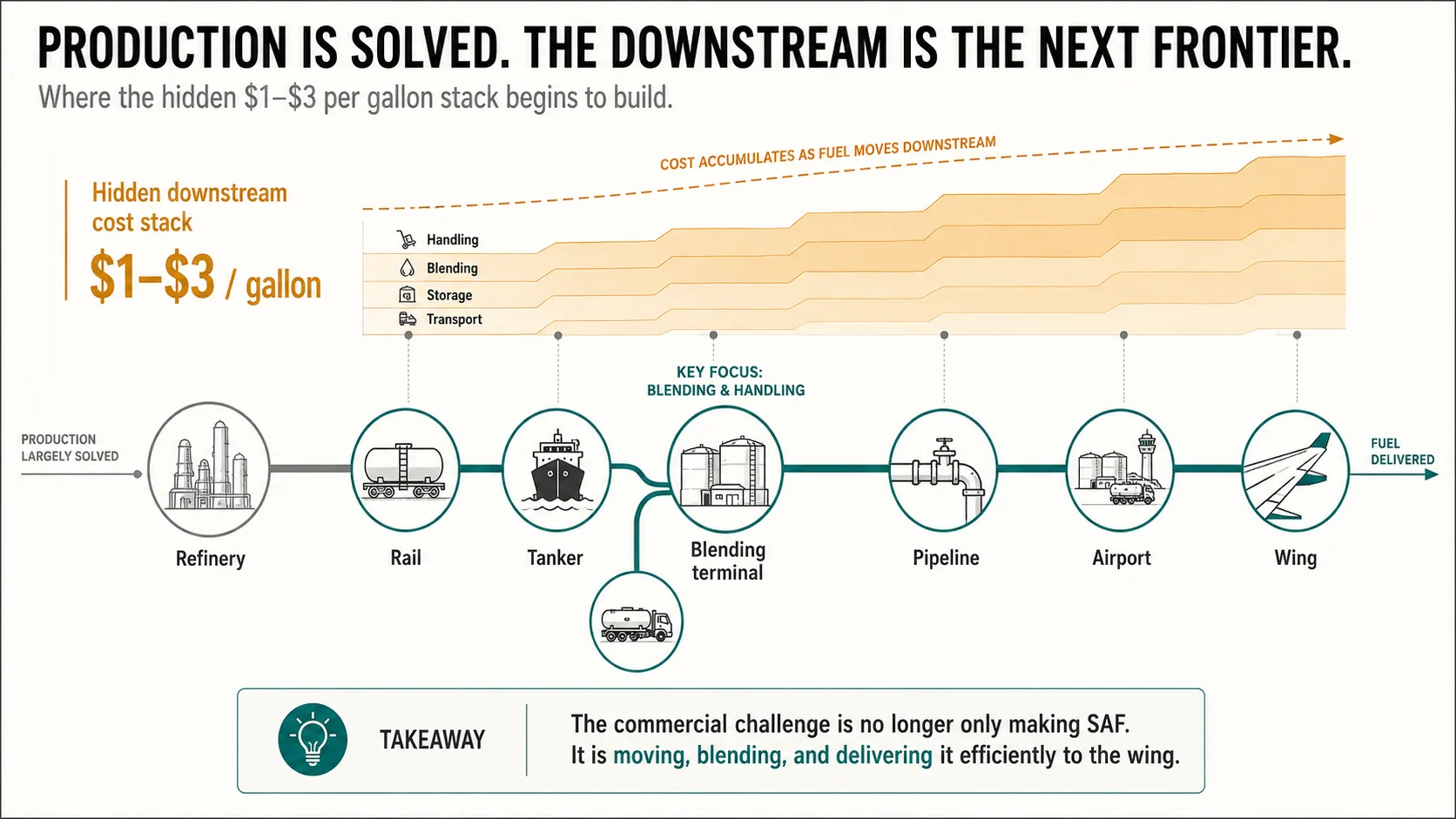
There is also an economic dimension. Storage, blending, quality assurance, transportation and access to controlled infrastructure all have costs, and the parties providing those capabilities will expect to capture value with those costs ultimately affecting the producer’s delivered netback and project return. That monetary question deserves its own analysis, but the immediate point is operational: value cannot be realized through a supply chain that has not been built.
The strongest route-to-wing strategy is not necessarily the one in which the producer owns the most infrastructure; asset ownership can add control, but it also requires capital, specialist capability and operating responsibility. The more important question is whether every critical responsibility has a credible owner?
A producer may complete the chain through partnerships with an integrated oil company, an independent terminal operator, a pipeline company, an aviation fuel supplier, an airport consortium or a combination of these parties. The airline may help shape the configuration and nominate preferred partners. The producer’s role is to understand the system well enough to design a credible commercial architecture around it. Making SAF and delivering SAF are therefore different achievements: the first proves that a production pathway can create a qualified low-carbon component, while the second proves that a complete ecosystem can turn that component into usable fuel and supply it reliably to an aircraft.
Airlines need the second.
For SBC producers, the implication is clear: downstream integration should not be treated as a logistical detail to resolve after the technology, offtake and financing strategies are already defined. It is part of the product, part of the customer proposition and part of project readiness from the beginning.
- ASTM International, ASTM D7566, Standard Specification for Aviation Turbine Fuel Containing Synthesized Hydrocarbons: https://store.astm.org/d7566.html
- ASTM International, ASTM D1655, Standard Specification for Aviation Turbine Fuels: https://store.astm.org/d1655.html
- International Air Transport Association, SAF Handbook, Section 2.1: https://www.iata.org/en/programs/sustainability/reports/saf-handbook/section-2.1
- Energy Institute, EI 1533, Quality Assurance Requirements for Semi-Synthetic Jet Fuel and Synthetic Blending Components: https://www.energyinst.org/industry/publications/sectors/aviation/ei-1533-quality-assurance-requirements-for-semi-synthetic-jet-fuel-and-synthetic-blending-components-sbc
- Energy Institute and Joint Inspection Group, EI/JIG 1530: https://www.jig.org/standards-publications/ei-jig-1530-standard/
- Airlines for America, ATA Specification 103: https://publications.airlines.org/products/spec-103-standard-for-jet-fuel-quality-control-at-airports-revision-2023-1
- Joint Inspection Group, JIG 1 and JIG 2 Standards: https://www.jig.org/standards-publications/
- Delta Air Lines, “Delta Joins Minnesota Leaders to Celebrate Opening of New SAF Blending Facility Serving MSP”: https://news.delta.com/delta-joins-minnesota-leaders-celebrate-opening-new-saf-blending-facility-serving-msp
- Montana Renewables, “Montana Renewables Begins Sustainable Aviation Fuel Deliveries to Shell”: https://calumet.com/montana-renewables-begins-sustainable-aviation-fuel-deliveries-to-shell/
- Montana Renewables, “Montana Renewables LLC Ships Sustainable Aviation Fuel to MSP Airport”: https://calumet.com/montana-renewables-llc-ships-sustainable-aviation-fuel-to-msp-airport/
- Neste, “Neste’s Newly Commissioned Terminal Capacity in Houston, Texas Expands Availability of Neste’s Sustainable Aviation Fuel”: https://www.neste.com/news/neste-s-newly-commissioned-terminal-capacity-in-houston-texas-expands-availability-of-neste-s-sustainable-aviation-fuel-at-airports-in-the-central-and-eastern-parts-of-the-u-s
- Biofuels International, “EcoCeres, SF Group and China National Aviation Fuel Collaborate to Advance Low-Carbon Air Cargo Development”: https://biofuels-news.com/news/ecoceres-sf-group-and-china-national-aviation-fuel-collaborate-to-advance-low-carbon-air-cargo-development/
- OFI Magazine, “EcoCeres, SF Group and China National Aviation Fuel Collaborate to Launch SAF Fuelling Programme in China”: https://www.ofimagazine.com/news/ecoceres-sf-group-and-china-national-aviation-fuel-collaborate-to-launch-saf-fuelling-programme-in-china
hello@vansamadvisory.com