Delivery, Infrastructure & Operations
Operational Simplicity Is Designed Upstream
Early delivery planning can shorten SAF offtake negotiations, clarify risk allocation and strengthen project economics, revenue certainty and bankability.
August 21, 2026 · 9 min read · Elvis Ebikade
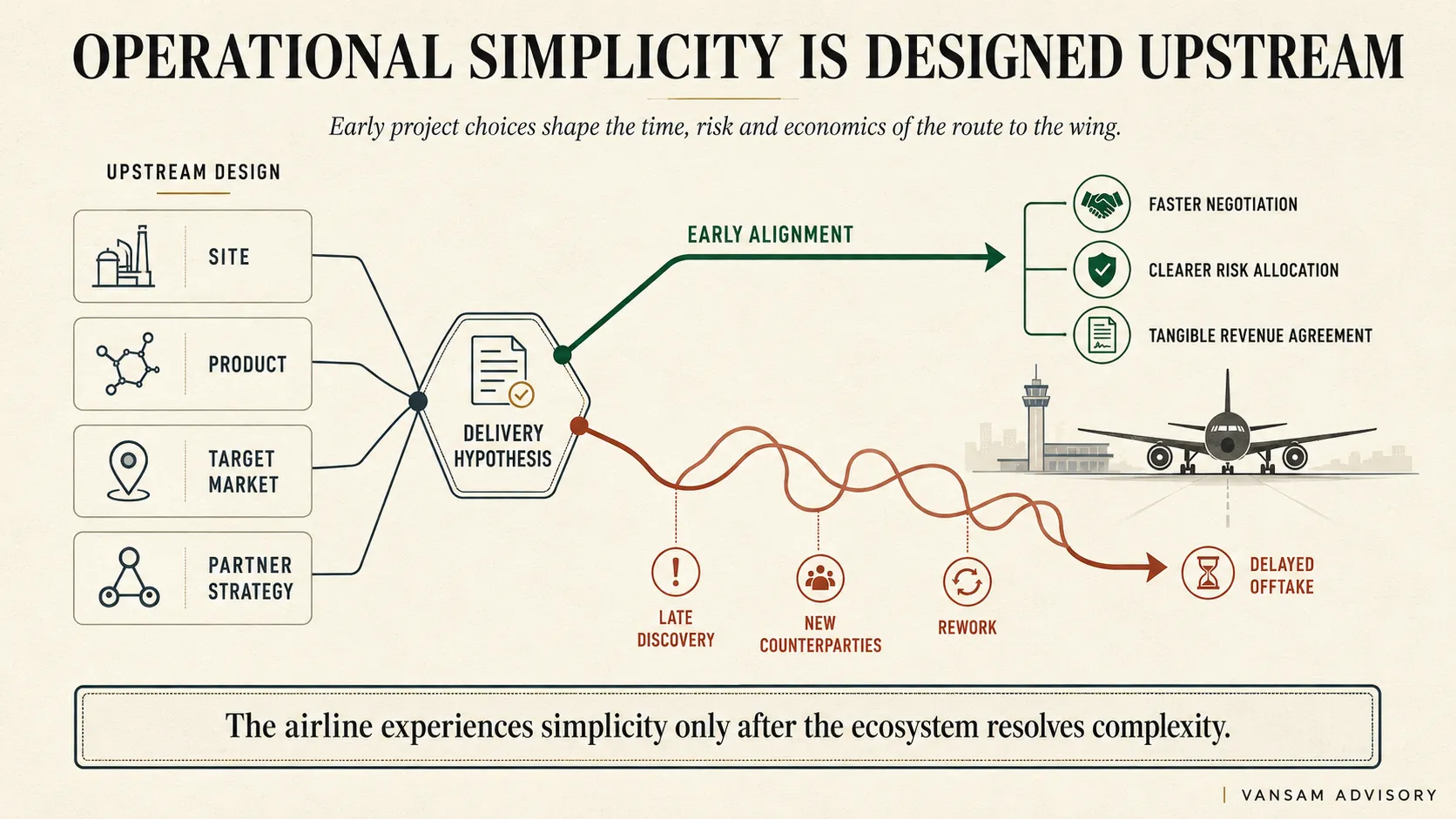
sustainable aviation fuel (SAF) project is designed primarily around the production facility. The developer optimizes the technology, feedstock, site and plant-gate cost, then approaches an airline expecting the route to delivery to take shape during the commercial discussion. By that point, many of the decisions that determine whether the fuel can be delivered reliably have already been made. Plant location affects access to transportation and blending infrastructure, while product configuration determines what must happen before the fuel becomes fungible. Market selection shapes the applicable incentives, specifications and infrastructure requirements. The target airline determines where demand is concentrated and which fuel suppliers, terminals, pipelines and airport systems control access to it. Operational simplicity at the aircraft wing is therefore rarely created at the airport. It is designed much earlier through the decisions that shape the project itself. The route to market begins with project designIn “Making SAF Is Not Delivering SAF,” I examined the operating system required to turn a synthetic blending component, or SBC, into finished fuel that an airline can use. The next implication is that downstream execution cannot be separated from upstream project design. A facility located near an inexpensive feedstock source may appear to have a strong production advantage, but that advantage can weaken if the SBC must travel long distances to reach suitable blending and distribution infrastructure.
- A project targeting an attractive policy market may still struggle if it lacks access to the fuel suppliers and terminals serving the airline hubs where demand is concentrated.
- A site near a major airport may look commercially compelling while offering no practical route into that airport’s fuel system.
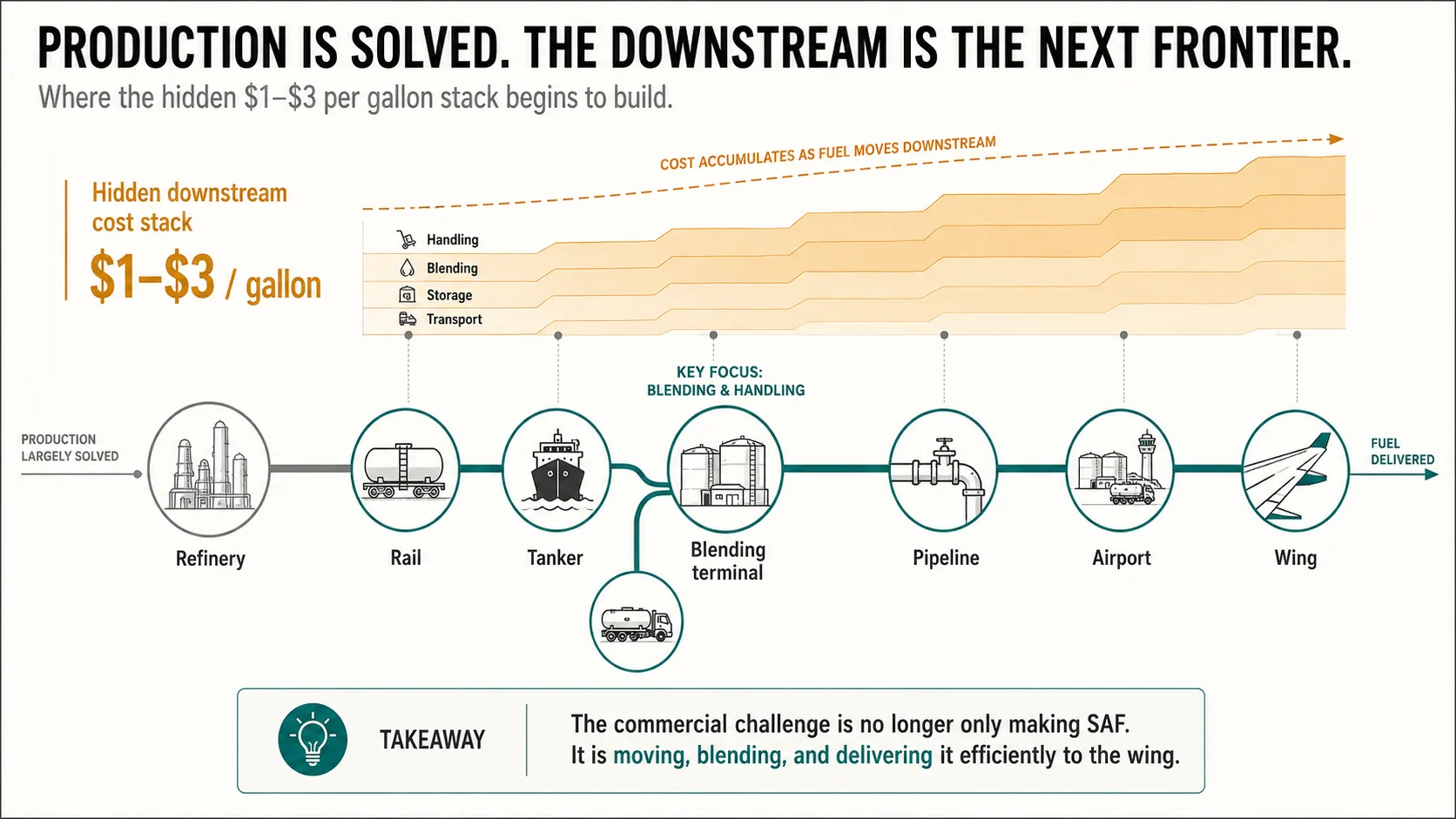
These are not logistics questions to resolve after the project has been designed, but are part of determining whether the project has selected the right site, product, market and customer in the first place. The plant-gate cost remains important, but it is only one component of the delivered economics. A project only creates usable value when its production advantage can be connected to a commercially credible route to the customer.
Two producers can offer technically equivalent components while presenting very different commercial propositions. One enters the airline discussion with an informed view of the infrastructure, counterparties and commercial handoffs required to serve its target hubs. It can explain the delivery configurations it has considered, the assumptions underlying them and the decisions that still require input from the airline. The other assumes that downstream integration will happen once the airline expresses interest.
The first producer is not necessarily presenting a fully contracted supply chain. However, it is presenting a credible delivery hypothesis that the airline can evaluate, challenge and refine, allowing offtake discussions to move more quickly toward questions that shape a transaction: volume, location, timing, price, responsibilities and risk. The second producer must first establish whether a viable route exists, then the parties may spend months identifying infrastructure operators and potential suppliers before they can determine what services will cost, where delivery can occur or whether the proposed commercial terms are achievable.
That difference can materially affect the duration of an offtake process.
SAF negotiations already require alignment across technical qualification, sustainability, pricing, policy treatment, volume, credit, internal approvals and project timing. If downstream integration remains undefined, the negotiation acquires additional workstreams involving parties outside the original discussion. Not every three-to-five-year negotiation can be compressed into twelve months. However, a producer that addresses major delivery questions before entering advanced negotiations can remove entire discovery and design phases from the transaction. In the right project, that can save years rather than months.
The benefit of accelerating an offtake extends beyond receiving a signature sooner. A tangible revenue agreement can support investor and lender diligence, clarify the assumptions underlying future cash flows and identify which risks must still be addressed before financing. It can also inform infrastructure planning, transportation arrangements and the sequencing of other commercial agreements.
When the offtake process remains open for years, uncertainty spreads across the project, revenue projections depend on provisional delivery costs, infrastructure requirements remain unsettled, other counterparties may hesitate to commit because the route to market is still unclear, and management continues allocating time and capital to a transaction whose final structure is not yet visible. An informed delivery hypothesis does not eliminate uncertainty, but it makes the uncertainty easier to manage.
The producer can distinguish among questions it can resolve independently, decisions requiring airline input and responsibilities that must be assigned to a fuel supplier or infrastructure partner. Those workstreams can then advance in parallel rather than waiting for one unresolved issue to expose the next, resulting not merely in a faster airline negotiation, but greater certainty across the project development plan.
An airline may be interested in a producer’s technology, carbon intensity and proposed volume while remaining unable to sign a bankable agreement. The obstacle may be less about demand than about unallocated risk. If the transaction does not establish where delivery occurs, when title transfers, how downstream costs are treated or who bears the consequences of an unavailable route, the commercial proposition remains incomplete.
These questions influence both the legal structure and the economics of the transaction, as they determine what the producer is selling, what the airline is committing to purchase and which obligations sit with the intermediaries connecting them. A producer that understands the likely delivery configuration can identify these allocation questions earlier. It can engage the relevant counterparties before contractual language hardens around assumptions that the operating system cannot support.
The airline may introduce preferred suppliers, nominate delivery locations or help develop the final configuration, and that collaboration is valuable, but it should refine an informed starting point rather than substitute for one. An airline should not be expected to assume undefined downstream integration risk simply because it wants more SAF.
Delivery planning affects who controls the commercial relationship and who captures the available value: a producer with only one feasible route may become dependent on the incumbent fuel supplier or infrastructure owner controlling access to it. That operator may provide essential capabilities, but it will negotiate from a strong position because the producer has few alternatives.
The resulting dependence can affect service charges, working-capital requirements, liability allocation, title transfer and the producer’s delivered netback. It may also determine whether the producer can contract directly with an airline or must sell its component to an intermediary earlier in the chain. These outcomes are not created solely at the negotiating table. They are partly established by earlier decisions about siting, infrastructure access, market selection and counterparty strategy.
The objective is not to create as many theoretical routes as possible. It is to develop enough credible options to understand the trade-offs, preserve appropriate leverage and prevent one untested assumption from determining the project’s economics. Operational flexibility begins before commercial dependence becomes unavoidable.
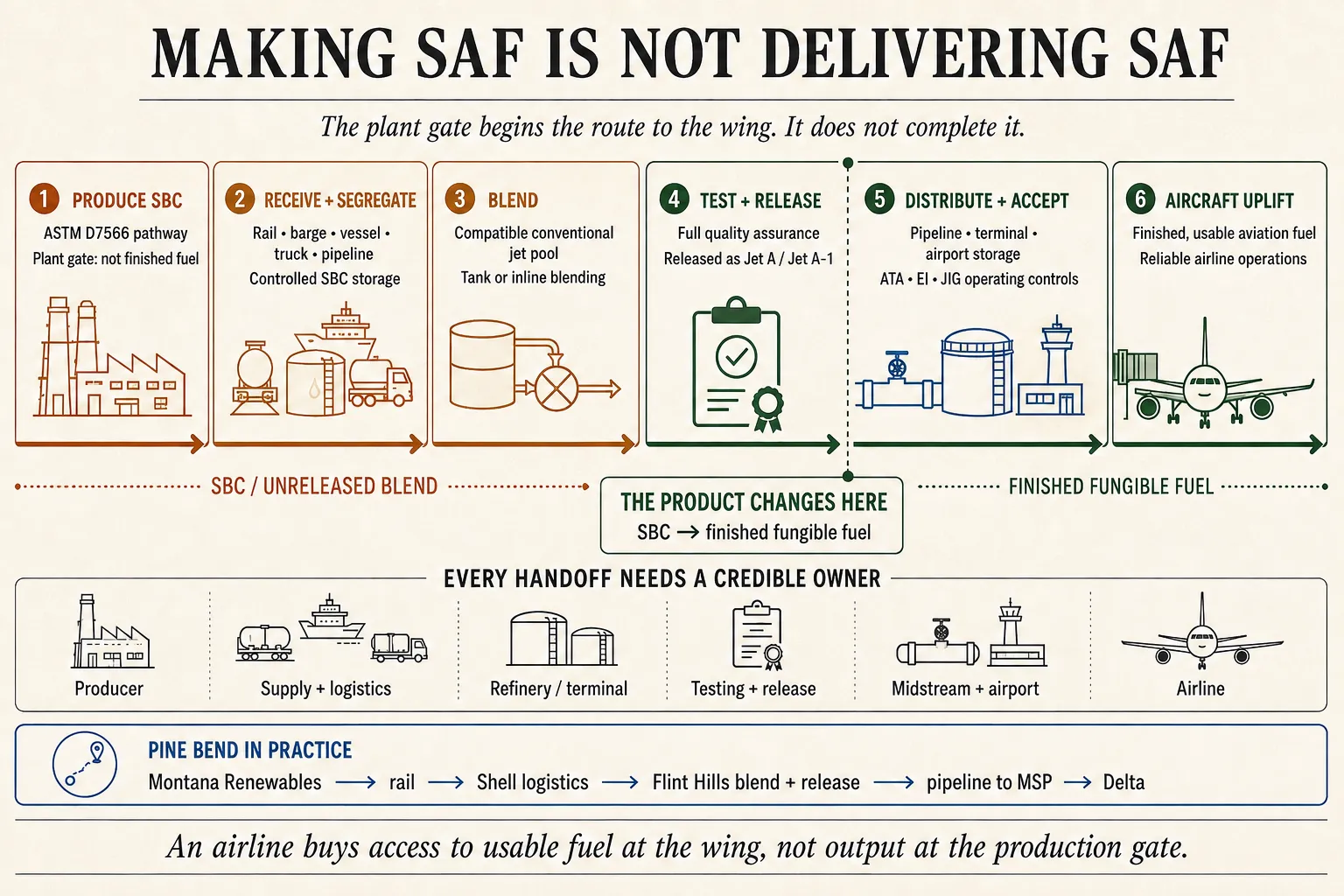
The SAF supply route serving Minneapolis-St. Paul International Airport is useful here for a different reason than the physical chain examined in “Making SAF Is Not Delivering SAF.” Its significance is the alignment among several decisions that could easily have been evaluated separately.
Montana Renewables’ production location does not coincide with the airline hub it ultimately serves. The distance is workable because the route connects rail logistics, a refinery with conventional jet-fuel supply and blending capabilities, existing pipeline infrastructure and concentrated airline demand at MSP. The production location, logistics model, blending site, infrastructure access and target customer therefore operate as one commercial configuration. The distance has not disappeared, nor has the complexity. Both have been accommodated by selecting and connecting counterparties whose assets fit the route, and that is the relevant design lesson.
A project does not necessarily need to locate production beside its customer or own every downstream asset. It needs a configuration in which geography, infrastructure, operating capability and demand reinforce one another. Pine Bend should not become a template that every project attempts to reproduce, as another project may rely on a port terminal, independent midstream operator, different transportation mode or multiple airline markets. The important question is whether the project has identified its own equivalent configuration before an airline negotiation is forced to discover it.
- For developers, delivery readiness should influence major project decisions while those decisions can still be changed.
- For airlines, it provides a basis for distinguishing between a technically qualified product and a commercially credible supply proposition.
- For investors and lenders, it is evidence that projected offtake volumes can become deliverable fuel and that the revenue case is not resting on an unexamined route-to-market assumption.
The relevant diligence question is not simply whether every step is technically possible a most individual steps may be possible somewhere. The key question is whether they can be assembled into a specific, economical and contractable route for this project, serving this customer, through the infrastructure available in the target market.
A technically mature project may still carry significant delivery and revenue risk if that configuration has not been established. Conversely, a project that understands its route, counterparties and unresolved decisions can demonstrate a stronger level of commercial readiness even before every agreement has been signed.
Operational simplicity is not achieved by ignoring complexity or postponing it until an airline becomes interested. It is achieved by understanding that complexity early enough to shape the project around it even if the final route may evolve.
An airline may nominate a preferred supplier, a midstream operator may propose a better terminal, another airport may offer stronger infrastructure access or more attractive delivered economics, still, early planning should preserve that flexibility rather than lock the project into a weak initial design. What matters is that the producer enters the market with an informed view of how its component can become finished fuel, which parties must participate and where the unresolved risks sit.
That starting point can accelerate airline negotiations, clarify risk allocation and help convert an offtake discussion into a tangible revenue agreement. By shortening the period of commercial uncertainty, it can also create greater clarity for financing, infrastructure planning and the wider development programme.
Operational simplicity is experienced by the airline at the end of the chain, but the time, cost and risk required to create it are determined much earlier and designed upstream.
- Delta Air Lines, “Delta Joins Minnesota Leaders to Celebrate Opening of New SAF Blending Facility Serving MSP”: https://news.delta.com/delta-joins-minnesota-leaders-celebrate-opening-new-saf-blending-facility-serving-msp
- Montana Renewables, “Montana Renewables Begins Sustainable Aviation Fuel Deliveries to Shell”: https://calumet.com/montana-renewables-begins-sustainable-aviation-fuel-deliveries-to-shell/
- Montana Renewables, “Montana Renewables LLC Ships Sustainable Aviation Fuel to MSP Airport”: https://calumet.com/montana-renewables-llc-ships-sustainable-aviation-fuel-to-msp-airport/
- Vansam Advisory, “Making SAF Is Not Delivering SAF”: https://www.vansamadvisory.com/perspectives/making-saf-is-not-delivering-saf
Making SAF Is Not Delivering SAF
hello@vansamadvisory.com