Pricing, Offtake & Customer Economics
Can book-and-claim add buyers and revenue to your SAF project?
Explore how SAF book-and-claim connects producers with corporate buyers, funds the fuel premium and shapes attribute ownership, revenue and project value.
October 20, 2026 · 11 min read · Elvis Ebikade
What this changes
SAF producers and project developers can evaluate book-and-claim as a route to additional buyers and attribute revenue. Investors can test who owns that value, what the project must deliver and how dependable the payments are. These questions help determine which commercial arrangements can improve retained revenue and support financing.
Phillips 66 says it will supply up to 11 million gallons of sustainable aviation fuel (SAF) to United Airlines. At Smart Freight Week 2026, it described a collaboration with United, freight forwarder DSV and Microsoft that could reduce lifecycle emissions from air freight by about 100,000 metric tons. The example brings a fuel supplier, airline, logistics company and corporate buyer into one commercial picture. Public announcements leave each party’s payment and environmental-claim rights unclear.
Ready to pressure-test a live SAF commercialization decision? Book a consultation
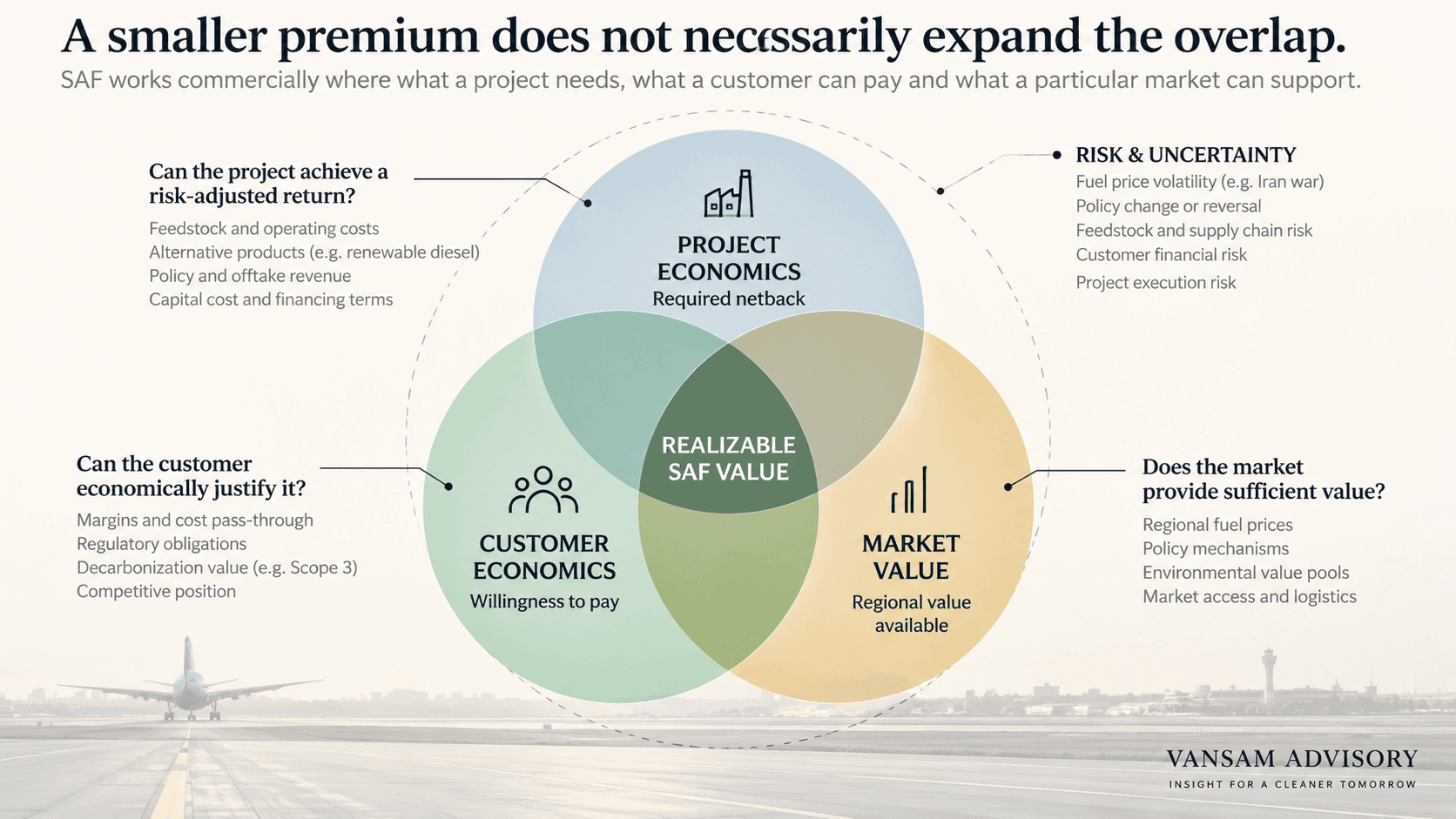
For SAF producers, that raises a practical question: can the project sell its fuel and its environmental attributes through different routes? Book-and-claim can connect eligible SAF to a buyer that does not take delivery of that same fuel. Voluntary corporate purchases can broaden the buyer pool and contribute revenue toward the SAF premium. Project value depends on attribute ownership, qualifying fuel and evidence, buyer requirements, transaction costs and the netback the producer retains.
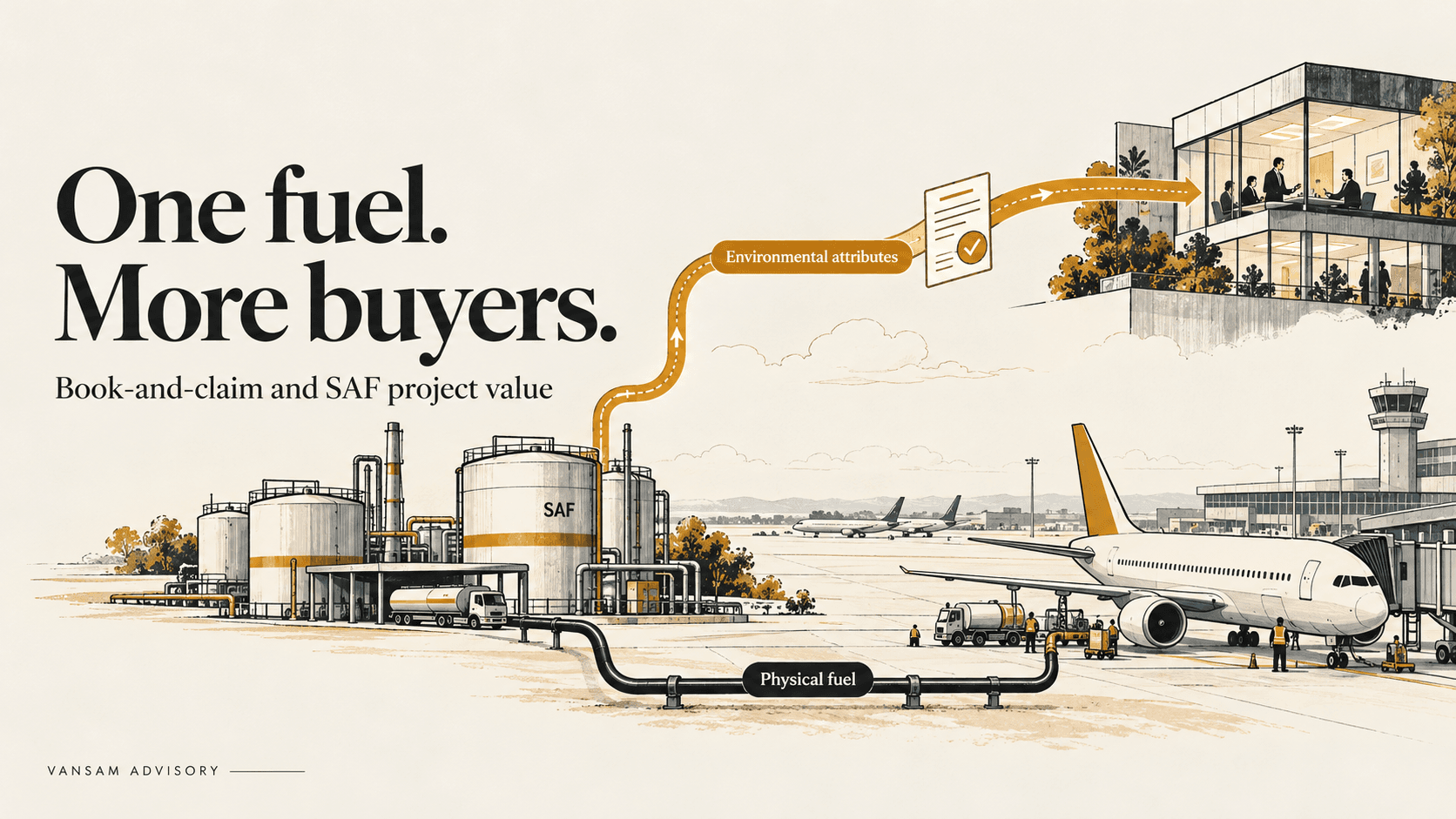
One eligible batch, two linked routes
The physical route starts with SAF produced through an eligible pathway, supported by feedstock and lifecycle-emissions documentation. The fuel enters the aviation supply chain, where the applicable scheme defines blending, delivery and control-point requirements.
The attribute route links the batch’s environmental value to records of ownership, transfer, allocation and retirement. A registry or approved tracking system records those attributes under its rules, while a corporate travel or freight buyer may purchase an eligible certificate for a permitted claim even when the fuel is used elsewhere in the network.
Each scheme sets its own issuance sequence. SAFc Registry rules tie issuance to certified fuel and chain-of-custody evidence; specified mass-balance routes require evidence that blended fuel reached a control point such as an airport fuel system. The IATA/CADO Registry also links registry actions to defined physical and documentary milestones. A project should map these conditions before promising a certificate delivery date. The buyer can be remote from the fuel’s destination; the claim still rests on eligible fuel, the required physical milestones and auditable records.
Who receives the Scope 1 and Scope 3 allocations?
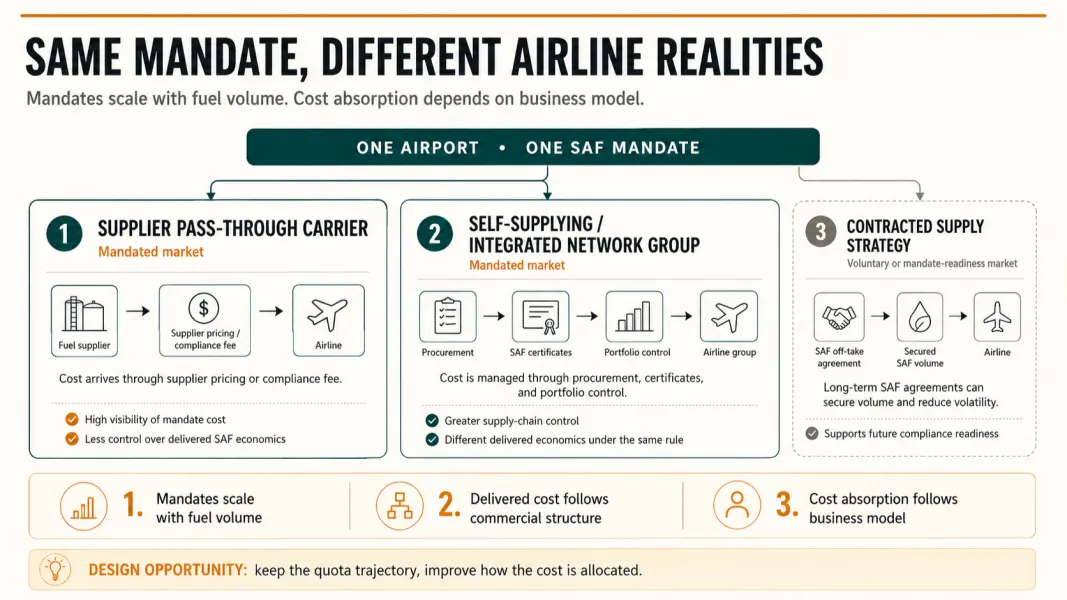
The airline operating aircraft that use the physical blend may receive the corresponding Scope 1 allocation. A corporate buyer may receive an associated Scope 3 allocation for employee air travel or freight when the programme and methodology permit it. Business travel usually sits in Scope 3 Category 6; freight classification depends on the company’s role and the transport service.
A recent GBTA workshop example makes the allocation visible: 46 round-trip staff flights, 3,228 gallons of SAF, 29.29 tonnes of CO₂e abated and an 80.7% lifecycle reduction. The discussion identified Diamond Green Diesel as producer, Shell as supplier, trader and attribute issuer, Avelia in the registry chain, Delta as Scope 1 recipient and GBTA as Scope 3 recipient for business travel. For cargo, a buyer must also know how the SAF benefit is allocated when an aircraft carries both passengers and freight. The certificate should state the covered activity and allocation method so each party can substantiate its claim.
What determines attribute value and revenue certainty?
In voluntary markets, corporate certificate purchases can help fund the SAF premium. The producer’s share depends on who owns the attributes and how payments flow through the airline, supplier or intermediary. Any regulatory support or compliance use must be disclosed and assessed against the programme’s and buyer’s rules before the same batch supports a voluntary claim.
Carbon intensity further establishes the documented emissions performance under the applicable methodology, while feedstock preferences and technology scale-up objectives can also influence buyer selection and price. Fuels with comparable verified performance can appeal to different buyers. American Airlines’ and Infinium eSAF offtake, supported by a separate agreement transferring associated reductions to Citi, illustrates corporate participation intended to help scale a new technology. Producers should make sure to establish which characteristics a buyer values and what commitment it will make to secure them.
IATA, Airbus and Accenture’s recent October 2026 study estimates corporate purchasing could support 1.0–1.9 million tonnes of SAF in 2030, conditional on clearer accounting, traceability and simpler purchasing. Around 15% of surveyed corporates currently buy, with reported certificate prices generally ranging from $150–$500 per tonne of CO₂e abated, against stated willingness to pay closer to $300. Business Travel News Europe’s coverage identifies demand concentrated in financial services, consulting, technology, and transport and logistics, mainly among large North American and European companies with public decarbonization goals. Therefore, it’s important for project developers to test its proposed price against the intended buyer’s requirements and purchasing terms.
In some cases, buyers may prefer small purchases and short contracts to manage annual budgets and preserve access to future price reductions, while a producer may seek a ten-year offtake to support financing. An airline, aggregator or intermediary can connect those preferences by taking a longer commitment, but must then manage renewal and price risk. The project case should identify who carries that risk, what revenue is committed and when payment becomes due. If those commitments are still taking shape, discuss your project’s revenue assumptions before relying on certificate income in the financing case.
What buyers need before they buy
- Sylvera’s business-travel purchase shows how these requirements affect procurement. It received around 20 offers in less than a week and found roughly twofold price differences among offers it viewed as comparable. Budget limits led it to pilot certificates for about 10% of flight emissions while making a separate commitment under SBTi’s Ongoing Emissions Responsibility programme. It cited differences in claim scope, carbon-intensity calculations and baselines, certification, registry treatment, additionality and data formats.
- UNOPS’s 2026 request for unbundled Scope 3 SAF certificates makes the evidence requirements concrete. It requires qualifying batch documentation under a CORSIA sustainability scheme, identifiable certified producers, buyer-facing evidence and supplier-managed permanent retirement. Quotations are requested per tonne of CO₂e reduced. An intermediary can supply the certificates, while the bidder remains responsible for compliant retirement. Producer-level certification must be supported by documentation for the offered batch.
- SBTi’s Corporate Net-Zero Standard V2.0 provides a route for eligible book-and-claim instruments to support target implementation, subject to its hierarchy and integrity criteria. Actions outside the physical GHG inventory are reported separately. Certificates must be issued, transferred and retired through transparent tracking systems that prevent double counting, with certification supplied through relevant third-party frameworks. For a producer, the commercial question is whether the offered certificate meets the buyer’s applicable programme and reporting requirements.
Vansam’ recommended approach is to start with the intended buyer’s specification: which certification scheme does it accept, and what must the proof of sustainability show for the offered batch? ISCC EU, ISCC CORSIA and the relevant RSB certification each serve particular requirements. The buyer’s procurement and claims framework determines which evidence it needs.
Sustainability documentation then helps to establish the batch’s credentials, while attribute records establish ownership, allocation and retirement for the claim being sold. Agree on the lifecycle-emissions value, baseline, feedstock information and reporting units before quoting, and assign responsibility for supplying evidence, completing registry steps and resolving shortfalls.
Who connects the buyer, fuel and records?
Several systems perform different jobs. CADO, RMI’s SAFc Registry, RSB’s Book & Claim Registry, 4AIR’s Assure SAF Registry and 123Carbon provide registry or attribute-tracking services. Their eligible pathways, transaction stages and claim rules vary. A June 2026 interoperability pilot involving CADO, Assure and 123Carbon, followed by an IATA framework developed with those organizations, shows that registry connections are being worked on.
Platforms help participants source, administer or report transactions. Shell’s Avelia supports SAF programmes including corporate travel; CHOOOSE provides airline and corporate programme software and connects workflows to RMI’s SAFc and RSB registries. Assure combines registry and programme functions. SABA coordinates corporate buyer demand, while the Book and Claim Community, co-led by RSB and Smart Freight Centre, develops shared practices and interoperability.
Airlines can also manage buyer programmes directly. United’s Eco-Skies Alliance, launched in 2021, aggregates corporate demand to help fund SAF’s price premium. United purchases SAF for its operations, and participating corporate customers receive travel-related emissions allocations under programme rules. This airline-led route brings fuel procurement and buyer participation together.
Future Energy Global (FEG) illustrates an intermediary-led route with FEG reporting delivering Microsoft Scope 3 SAF certificates derived from Cathay Pacific purchases through the IATA/CADO Registry. In a May 2026 trade with ITOCHU, physical SAF went to an airline at Tokyo Narita while the associated attributes went to FEG for airline and corporate clients; the trade was recorded on 4AIR’s Assure Registry. The route affects who originates the buyer, controls the customer relationship, manages registry steps and captures transaction value.
Different commercial structures are emerging
Company-led purchases offer one route as a primary commercial structure. At New York Climate Week, World Energy presented an Etihad scenario in which transporting SAF about 3,700 kilometres to a distant point of use added an estimated $60,000 in logistics. The scenario shows why a producer should compare the physical-fuel outlet and its delivery costs with the potential value and costs of a separate attribute sale.
Amazon’s Sustainability Exchange offers verified SAF inset credits linked to its transportation value chain. Carbon Herald reports that suppliers, business customers and Climate Pledge signatories can participate, and that Amazon attributes favorable buyer pricing to its purchasing scale. This offers a potential customer channel for producers, with their share of the payment determined by the supply agreement.
Importantly, Amazon’s lower-carbon-fuel framework prefers wastes and residues; permits intermediary and energy crops under land-use conditions; treats purpose-grown crops as transitional; and excludes palm oil and all derivatives, including POME and PFAD which is particularly important for SAF producers and project developers as the buildout their feedstock procurement strategy. For electrofuels, it prefers direct-air-capture or qualifying biogenic CO₂ and treats fossil industrial CO₂ as transitional. These preferences show why a producer must match its pathway and feedstock to the buyer alongside demonstrating emissions performance.
- National and regional systems are also developing under different rules.
Singapore’s SAFCo is designed to combine levy-funded and voluntary procurement while allocating airline Scope 1 and corporate Scope 3 attributes separately; its first voluntary trial involved nine organizations. - Brazil’s August 2026 ProBioQAV decree defines CS-SAF certificates and permits separate commercialization of physical fuel and attributes, with detailed implementation still dependent on ANP and ANAC rules.
- China’s ICAO-reported “book and refuelling” pilot uses its centralized fuel system and is developing national traceability.
- The European Commission has commissioned work on options for a ReFuelEU Aviation mechanism.
- UK statutory SAF certificates operate under the UK SAF Mandate’s compliance rules.
What should a project developer and investor test?
Before adding attribute sales to a project case, answer five questions:
1. Fuel and batch: Which pathway, feedstock and batch meet the intended buyer’s specification, and which certification, sustainability documentation and physical milestones must be evidenced?
2. Attribute rights: Does the fuel-sale contract transfer the attributes, or does the project retain the right to sell them separately?
3. Buyer and claim: Which airline and corporate buyer receive the relevant allocations, what activity does the claim cover, and which procurement and reporting requirements must be met?
4. Transaction route: Which registry records and retires the certificate, which platform or intermediary manages the sale, who pays each counterparty, and how does the process prevent double issuance, double claiming or conflicting compliance use?
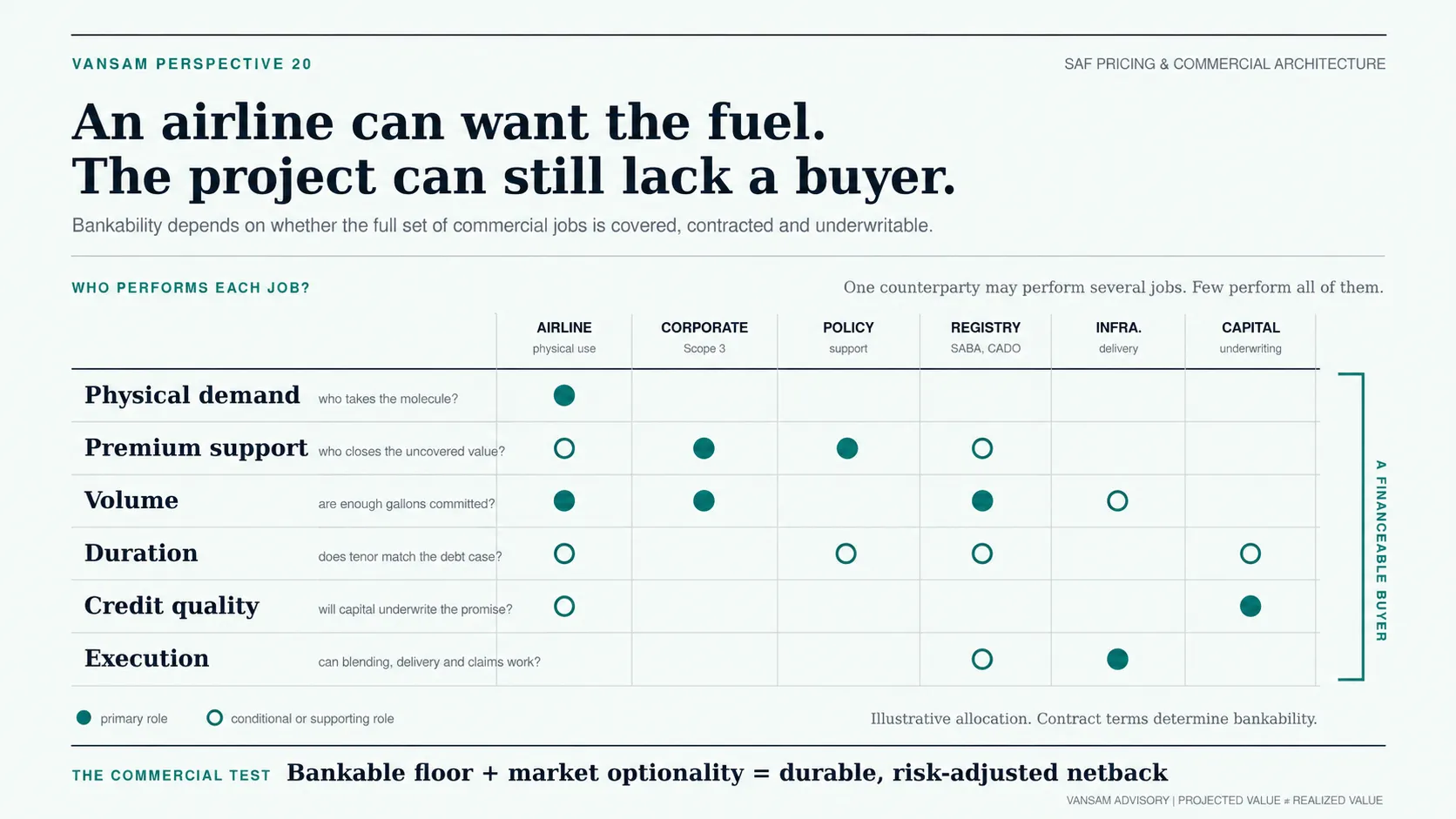
5. Retained value: What price, volume, duration, payment trigger and buyer commitment are contracted? What remains after certification, verification, registry, platform, administration, blending, delivery and customer-acquisition costs?
So start with modeling the fuel and attribute components of revenue, followed by tracing their ownership and payment terms through each contract. Where a fuel-sale price already includes the attributes, reflect that allocation before adding any separate certificate revenue. Contracted volume, payment security and risk allocation determine how much revenue can support project returns and financing.
To assess book-and-claim for your project, book a 30- or 60-minute consultation to examine the fuel route, attribute rights, buyer requirements and revenue the project could retain.
Sources
Transactions and buyer evidence
- American Airlines, Infinium offtake and Citi participation.
- Phillips 66, cross-industry collaboration and United supply agreement.
- Amazon SAF inset credits.
- Amazon lower-carbon-fuels approach.
- UNOPS RFQ/2026/64721.
- Sylvera, buyer account.
- Future Energy Global, Microsoft/Cathay Pacific transaction on the IATA/CADO SAF Registry.
- Future Energy Global and ITOCHU, Narita SAF environmental-attribute trade using Assure Registry.
- United Eco-Skies Alliance, 2024 Corporate Impact Report.
Registries and programme documentation
- IATA, SAF Registry Global Interoperability Framework.
- CADO SAF Registry.
- SAFc Registry Rulebook.
- RMI SAFc Registry.
- RSB Book & Claim Registry.
- 4AIR Assure SAF Registry.
- 4AIR, registry interoperability.
- Shell Avelia.
- CHOOOSE and SAFc Registry integration.
- CHOOOSE and RSB Registry integration.
- SABA.
- Book and Claim Community.
Policy and reporting frameworks
- RSB, regulatory additionality and Brazil.
- CAAS Singapore SAF levy and SAFCo.
- Brazil Decree 13.094/2026.
- ICAO working paper on China’s SAF pilot.
- European Union Aviation Safety Agency, possible EU book-and-claim work.
- UK SAF Mandate.
- SBTi Corporate Net-Zero Standard V2.0, target implementation chapter.
- GHG Protocol Scope 3 revision progress.
- SBTi Corporate Net-Zero Standard V2.0 executive summary and transition.
Market research and supporting analysis
- Business Travel News Europe, October 16, 2026, coverage of the IATA–Airbus–Accenture study.
- Carbon Herald, Amazon SAF inset programme, October 9, 2026.
- Relae, Low-Carbon Fuel Certification: How Market Rules Shape the Value of a Fuel, October 15, 2026.
- IATA, Airbus and Accenture SAF EAC study release, October 14, 2026.