Bankability, Capital & Risk
Cost Advantage Is a System Outcome
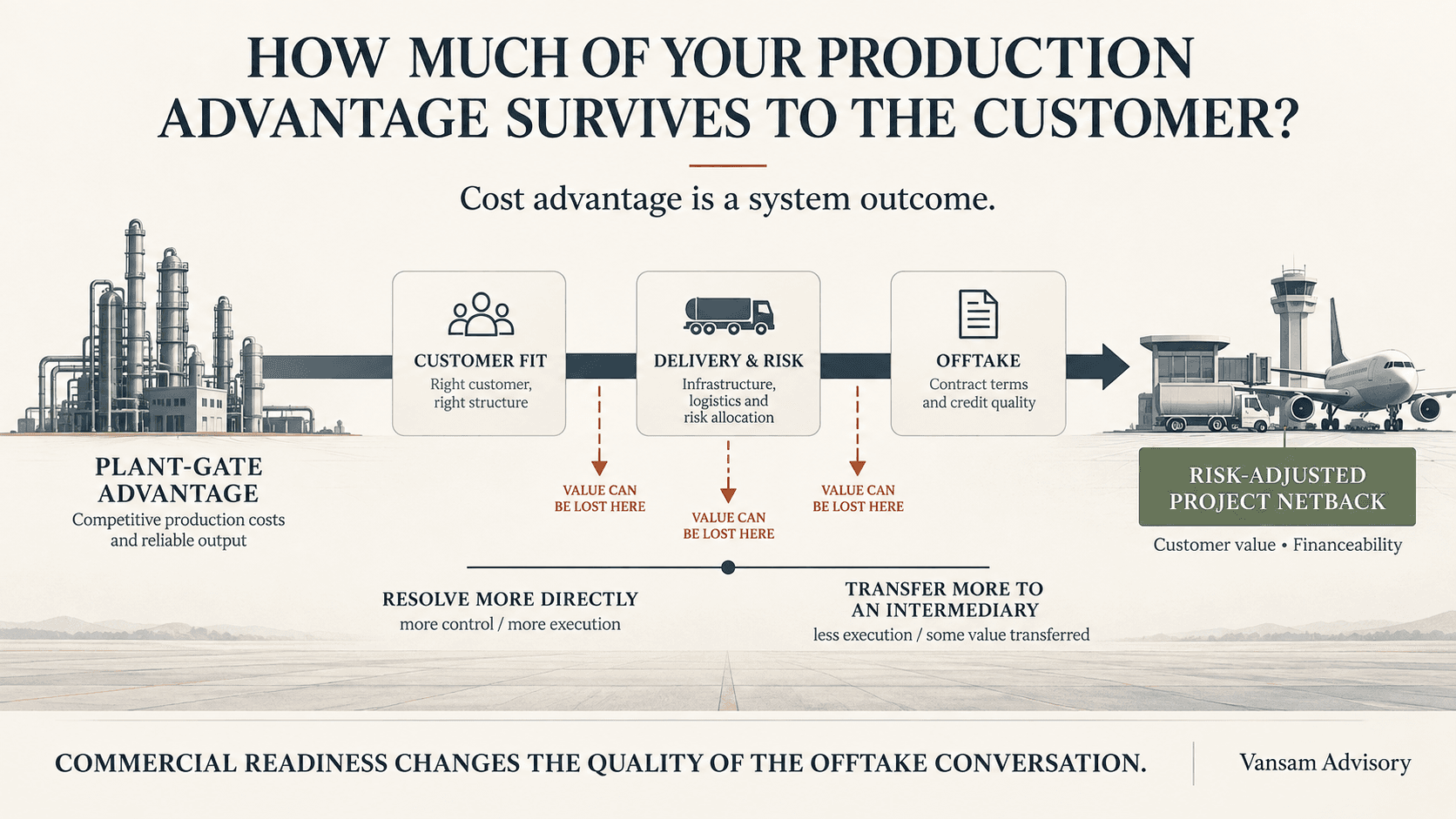
For SAF, the lowest plant-gate production cost does not necessarily create the strongest delivered economics. Production advantage has to survive the customer, delivery architecture, counterparties and contracts that turn output into revenue
September 26, 2026 · 9 min read · Elvis Ebikade
What this changes
SAF developers should evaluate commercialization before project decisions harden. Understanding the target customer, delivery pathway, risk allocation and likely offtake structure early can strengthen commercial readiness, improve the quality of customer negotiations and help preserve risk-adjusted project netback.
The lowest plant-gate cost is not necessarily the lowest delivered fuel cost
SAF economics are usually introduced through the plant: the cost and availability of feedstocks and other critical inputs, conversion efficiency, energy requirements, capital intensity and operating performance. Their relative importance differs by technology pathway; lipids, ethanol, methanol, electricity, hydrogen or carbon supply can each shape the economics of different SAF production systems.
Those questions are essential, but the final customer is not necessarily buying a plant-gate production cost. It needs usable aviation fuel in a particular market, through a fungible supply system that can qualify, blend and deliver it on commercially acceptable terms. The producer, meanwhile, needs a route from production to contracted revenue that preserves enough of the original advantage to support the project. That production advantage is pathway-specific, but the relevant advantage is the one that survives commercialization strongly enough to create durable project netback and support a financeable project.
Arcadia eFuels’ Project Endor in Vordingborg, Denmark provides one useful eSAF example. Endor has completed FEED and received EU Innovation Fund support. On September 3, Arcadia, MB Energy and enport announced a framework covering potential collaboration across transportation, storage, blending and delivery; on September 23, Arcadia and Uniper announced a legally binding agreement for Uniper to purchase 40,000 tonnes of eSAF annually for more than ten years, subject to agreed conditions precedent and the facility entering commercial operation. Arcadia described that volume as roughly 60 percent of Endor’s planned annual production. The public disclosures do not establish the final delivery basis under the Uniper agreement, nor should responsibilities across separate agreements be inferred beyond what the parties have disclosed. However, it demonstrates how a developer is structuring long-duration demand while separately building route-to-market capability before production begins. The commercial significance lies not simply in having an offtaker, but in how well those pieces ultimately fit together.
Commercial readiness changes the quality of the offtake conversation
A producer can approach a customer with expected volume and price, but if blending, receiving hubs, delivery logistics, title transfer and physical supply responsibilities have barely been considered, part of the project-development problem effectively enters the offtake negotiation between the producer and customer.
A commercially prepared developer can however enter a different conversation, and standout to the customer. It can identify credible market and hub options, explore plausible blending and delivery logistics, show which counterparties could perform the required functions, and distinguish what is resolved from what still needs to be co-designed with the final customer. That preparation does not guarantee an offtake, a shorter negotiation or better terms; price, project maturity, competing supply, policy and the buyer’s strategy still matter. It can, however, reduce buyer-side uncertainty and transaction friction while strengthening credibility because the customer is evaluating a more complete commercial proposition.
The physical fuel system explains why some of this preparation cannot be deferred. ASTM D7566 covers multiple SAF pathways and requires the applicable synthetic blending components to be blended with conventional aviation fuel, with the finished batch meeting the relevant specification requirements before release as D1655 aviation turbine fuel. “Drop-in” describes the compatibility of the finished fuel with the aviation system; it does not make the path from production to finished aviation fuel automatic. Infrastructure is similarly specific: tanks, trucks, pipelines and terminals may exist without the required capacity being suitable, available or contractable for a particular product, volume and route. The relevant diligence question is whether the project has a credible path to qualified capacity when it needs it and on terms that preserve its economics.
FedEx provides the airline customer-side view from the broader physical SAF market. In September, the company announced agreements projected to secure more than 20 million gallons of neat SAF across five U.S. airports through 2027; more revealing than the aggregate volume is its statement that future expansion will be evaluated where supply, infrastructure and economics align with the needs of its air network. The contrast is useful as Endor shows an eSAF developer assembling long-term demand alongside route-to-market partnerships; FedEx shows an aviation customer procuring physical SAF around specific airport and network requirements. The architecture differs because the customer and route to market differ, yet the underlying lesson is the same: production advantage has to connect to a system the customer can actually use.
Who takes the downstream risk can determine who captures the downstream value
A sophisticated fuel intermediary or integrated energy company may take title earlier and assume substantial responsibility for storage, blending, logistics, market access and downstream delivery. That can reduce execution burden and provide infrastructure, capabilities and customer relationships the producer would otherwise have to assemble; those capabilities also have economic value, so transferring downstream uncertainty can transfer some of the value that might otherwise remain in the producer’s netback.
Building more of the architecture directly creates the opposite trade-off. It may preserve greater control over pricing, margin, customer access and delivery decisions while increasing development work, working-capital needs and execution risk. Neither structure is inherently better, and not every airline, energy company or fuel marketer wants the same delivery basis.
Petrobrazi illustrates the integrated end of this spectrum. OMV Petrom is building a 250,000-tonne-per-year SAF/HVO unit inside its existing refinery, alongside green-hydrogen capacity; it reports more than 80 percent feedstock coverage for the first eight years and has contracted part of future SAF/HVO production to affiliated OMV Downstream GmbH. The arrangement does not establish that greater integration produces superior economics or independent bankability, particularly because the downstream counterparty is an affiliate. It does show how an integrated energy company can internalize capabilities that a standalone developer might otherwise need to assemble through several counterparties. The commercial question is therefore not how much of the value chain a developer can own, but how much downstream uncertainty it should resolve itself, how much it should transfer, what that transfer costs, and which structure produces the strongest risk-adjusted project netback for the market and customer being targeted.
The delivery point matters alongside the headline price. Transferring product and risk earlier may simplify execution while surrendering some downstream value; carrying the product further toward the customer may preserve more value while increasing logistics, working-capital and performance obligations. Similar headline prices can therefore produce different economics for the project.
Physical fuel and environmental value can also follow different paths. A World Energy case presented during NY Climate Week showed SAF produced in Paramount, California for a transaction associated with an Etihad flight from Washington Dulles to Abu Dhabi. The presentation estimated that physically moving the neat SAF toward the airport would have required eight tanker trucks, roughly 3,700 kilometres of transit, four days, about $60,000 of logistics cost and 34.4 tonnes of CO2 from diesel trucking, while nearby blending infrastructure was unavailable. The mechanism demonstrates that physical matching can erode part of the cost and carbon advantage when production, qualified infrastructure and customer geography do not align. Under established SAF book-and-claim systems, environmental attributes can be decoupled from the physical fuel after the relevant blending and certification requirements are satisfied and then tracked through a registry. That flexibility does not remove the physical supply chain; it can allow environmental value to reach a different buyer while the physical fuel follows the route that best preserves delivered economics.
Commercial architecture should inform FEED and mature before FID
The practical implication is timing. Before FEED hardens the project configuration, the developer should understand credible target markets, customer types and delivery pathways well enough for downstream reality to inform site, scale, infrastructure and engineering choices. The objective is not to have every logistics contract signed before FEED, but to avoid designing the plant in isolation from the commercial system it will eventually serve. As the project advances toward FID, those assumptions increasingly need to become commercial commitments: who takes title, where delivery occurs, who manages blending and logistics, how price reflects the responsibilities and risks each party carries, and which parts of the revenue stack capital can reasonably evaluate.
This is where the quality of an offtake matters more than the existence of an offtake headline. Arcadia’s Uniper agreement provides consequential long-duration demand, but deliveries remain subject to conditions precedent and commercial operation. For projects that depend on contracted revenue to support financing, the period between FEED and FID is therefore not only about completing engineering; it is also about turning market and delivery assumptions into counterparties, responsibilities, pricing structures and sufficiently robust commercial commitments to survive capital diligence. Commercial bankability depends, in part, on the coherence between those arrangements.
The objective is not vertical integration for its own sake, nor is it outsourcing everything outside the fence line. It is commercial readiness. A project approaching FEED should be able to compare credible market-and-delivery pathways on delivered, risk-adjusted netback rather than plant-gate production cost alone; it should understand where its advantage is created, where value can leak, which risks it is equipped to carry and which counterparties are better positioned to carry the rest. The strongest SAF project will not necessarily be the one with the lowest modeled production cost at the plant gate; it will be the one whose production advantage survives the customer, delivery and contracting system strongly enough to become durable customer value, project netback and financeability.
Cost advantage is not one number produced by the plant. It is an outcome of the commercial system built around it.
Sources
- Arcadia eFuels, “Arcadia eFuels completes the Front-End Engineering Design,” May 21, 2024.
- Arcadia eFuels, “Grant agreement signature: Arcadia eFuels’ ENDOR project awarded EU Innovation Fund support,” March 25, 2026.
- Arcadia eFuels / MB Energy / enport, “Arcadia eFuels and MB Energy will work together to build eSAF supply chains for European aviation,” September 3, 2026.
- Arcadia eFuels / Uniper, “Uniper and Arcadia eFuels sign long-term agreement to accelerate aviation decarbonization,” September 23, 2026.
- ASTM International, ASTM D7566, Standard Specification for Aviation Turbine Fuel Containing Synthesized Hydrocarbons.
- FedEx, “FedEx Expands Sustainable Aviation Fuel Agreements Across U.S. Air Network,” September 15, 2026.
- OMV Petrom, “OMV Petrom advances SAF/HVO project at Petrobrazi,” September 21, 2026.
- OMV Petrom, “Secured placement of part of biofuels production,” 2026.
- World Energy / Adam Klauber, Climate Week NYC book-and-claim presentation, September 23, 2026, event-source evidence.
- RSB, Book & Claim guidance and registry materials.
- Sustainable Aviation Buyers Alliance, Book and Claim Fundamentals.
- Vansam Advisory, Production Advantage Market-Screening Methodology and prior Perspectives on delivered SAF economics, pricing and commercialization.