Bankability, Capital & Risk
The Least-Mature Evidence Sets the Pace
How SAF companies can align technology, project and market evidence across venture rounds, FEL, FEED, offtake, FID and project finance.
August 6, 2026 · 11 min read · Elvis Ebikade
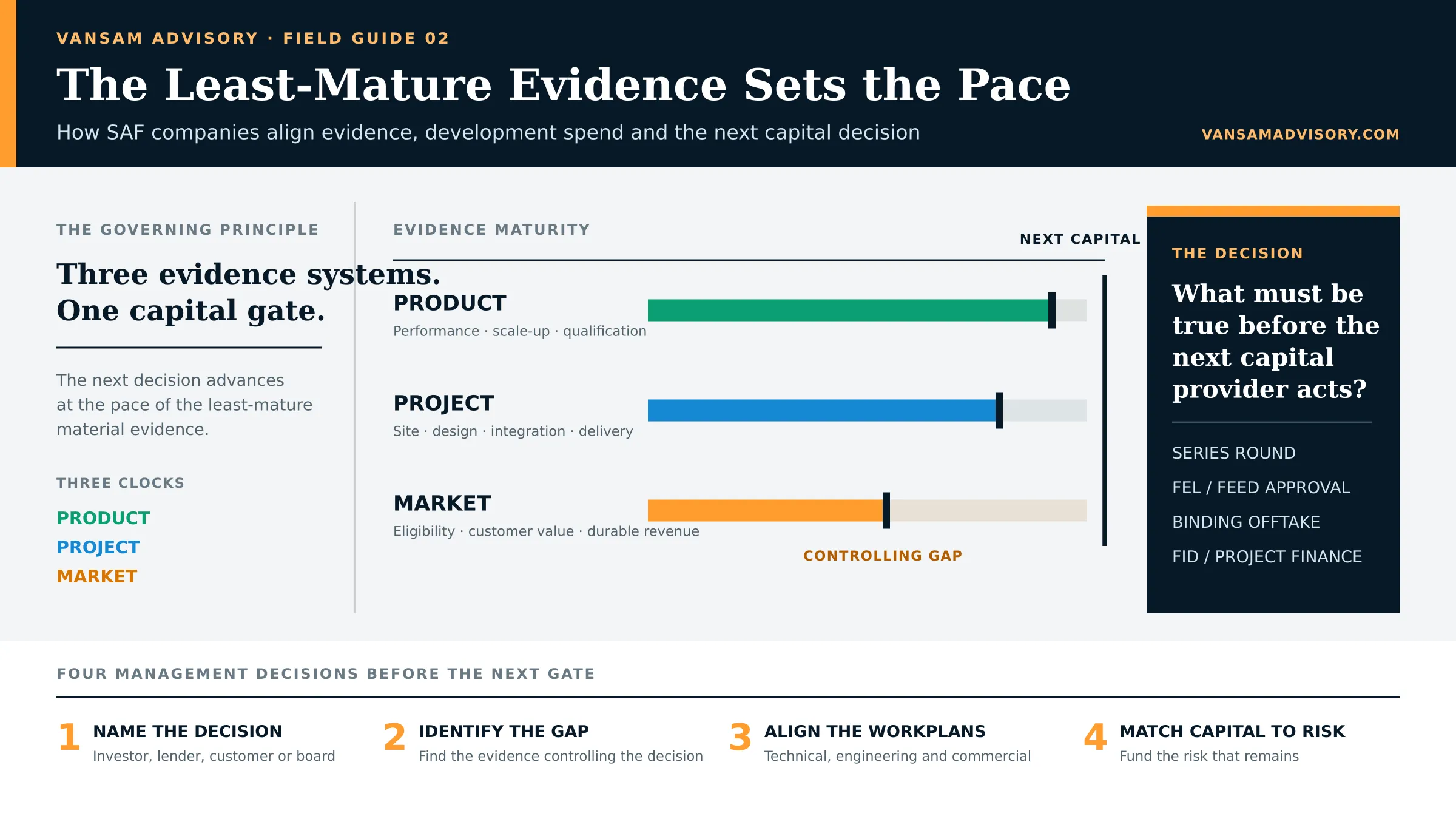
sustainable aviation fuel company can have credible technology, a growing market and interested capital, yet still struggle to raise its next round or finance its first commercial plant. The issue is rarely the absence of progress. It is that technical performance, project definition and market evidence have matured at different rates, while the next capital provider needs them to support one commercial configuration. My view is that a simple principle should govern the development plan:For the next conventional capital decision, the least-mature material evidence usually sets the pace. Catalytic capital can fund ahead of that maturity, while project equity and debt will require the remaining risk to be retired, priced or allocated. This distinction matters because SAF companies do not all travel the same development path, although every company eventually has to connect a qualifying product, an executable asset and durable revenue. #block-592ca37eb8c5ae18e0c8 { } #block-592ca37eb8c5ae18e0c8 .sqs-html-content { } #block-592ca37eb8c5ae18e0c8 { mix-blend-mode: var(--tweak-text-block-blend ); border-radius: var(--tweak-text-block-radius); } @media screen and (max-width: 767px) { #block-592ca37eb8c5ae18e0c8 { } } @media screen and (max-width: 767px) { #block-592ca37eb8c5ae18e0c8 .sqs-html-content { } } @media screen and (max-width: 767px) { } Product, project and market evidence advance toward the next capital gate. The least-mature material evidence determines the pace of the financing decision. The capital plan depends on what is being builtA company scaling proprietary technology commonly uses grants, strategic capital and venture rounds to build progressively stronger evidence of performance, scalability and commercial relevance. Series A, B and C do not automatically map mechanically to technology-readiness levels (TRL), although each round is normally expected to demonstrate a material reduction in technical and commercial uncertainty. Fuel qualification may run alongside that work. ASTM D7566-26a currently contains eight approved pathway annexes. When a candidate fuel or production concept falls outside those provisions, the D4054 process requires structured testing, OEM review, technical reports and ASTM balloting. CAAFI describes a progression from initial specification and fit-for-purpose testing through component, rig and engine evaluation, followed by the formal balloting process. The required fuel volumes, test capacity and stakeholder engagement therefore belong in the technology and capital plans from an early stage. A developer using established HEFA, alcohol-to-jet or Fischer-Tropsch packages follows a different path through FEL, pre-FEED, FEED and Final Investment Decision. Its task is to prove that a defined site, feedstock, process configuration, delivery system and commercial structure can become an operable asset with financeable cash flow. Many PtL and emerging bio/thermochemical projects combine both tracks. A proprietary electrolyser, carbon-conversion process or syngas platform may sit beside licensed synthesis and fuel-upgrading equipment, which means TopCo investors may be financing technology learning and a repeatable pipeline while ProjectCo investors are underwriting a specific asset. A successful venture round supports confidence in the company; it does not establish that the first commercial project is ready for infrastructure capital. The practical implication is that management should first identify the decision being funded, then build the evidence required by that capital provider. Three evidence systems determine commercial maturityProduct evidence: This establishes that the technology can consistently produce the intended fuel or intermediate under representative conditions. It covers scale, operating duration, yield, energy use, product quality and the route to fuel qualification. Feedstock sits at the centre of this evidence. For HEFA, cost, availability and eligibility of the selected lipid can control both margin and market access. For alcohol-to-jet, the alcohol’s cost, carbon intensity and supply security shape the product and commercial case. For PtL, qualifying electricity and carbon are part of the fuel proposition rather than inputs that can be finalized later. The strongest demonstration program therefore generates the operating data, representative product, lifecycle evidence and qualification volumes required by customers, OEMs, technical advisers and certifiers at the same time.
- Project evidence: This establishes that the technology can become an executable and operable industrial asset. The basis of design must connect the process to a real site, with defined feedstock, utilities, infrastructure, storage, blending and product delivery, while cost and schedule estimates should carry the accuracy and contingency appropriate to the engineering stage. Integration boundaries deserve particular attention because a project may include several licensors, contractors, suppliers, project companies and jurisdictions. Each material interface needs a specification, an accountable party and a remedy, while the full system must be capable of producing certified, blended fuel that can enter the customer’s supply chain. Cost is the other central test. A technically executable plant does not become a viable project until its delivered SAF cost can be reconciled with the price and policy value available in the intended market. Engineering choices should therefore be tested against delivered economics, not only plant performance.
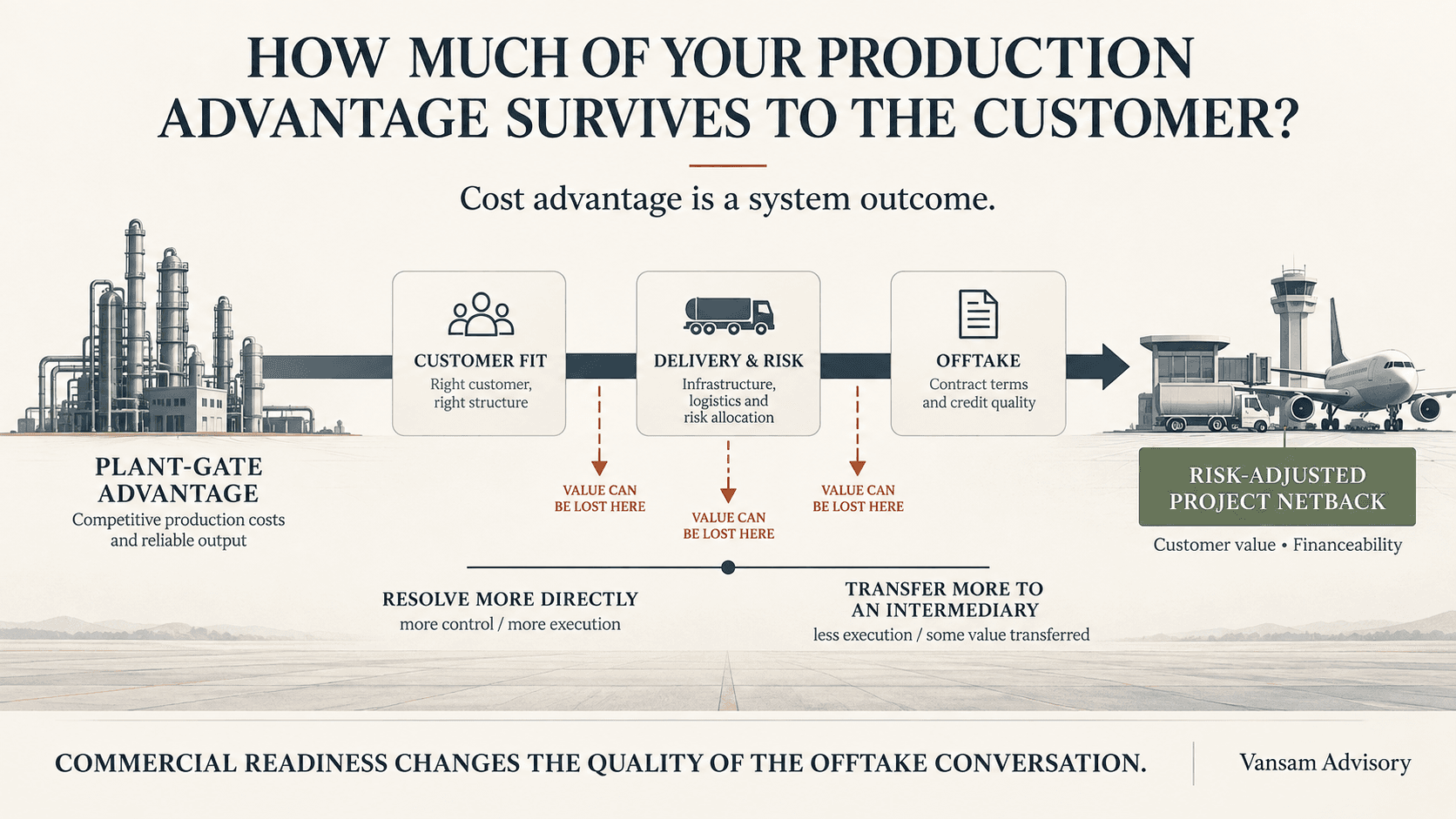
- Market evidence: This establishes that the project can convert production into durable revenue. It begins with qualification under the intended market, then asks a more demanding question: at what price does the fuel clear, who will pay that price and for how long? This is where the SAF cost gap becomes a commercial structuring problem. Airlines want access to lower-carbon fuel, although many are reluctant to accept fixed-price, long-tenor volume commitments that transfer feedstock, policy and technology risk onto their balance sheets. Producers need revenue certainty, while buyers need flexibility and protection against future cost reductions. Obligated fuel suppliers, aggregators, public procurement, contracts for difference and credible book-and-claim structures can help bridge that asymmetry, although each structure creates a different claimant, counterparty and route by which value reaches the project.
Policy support should be treated with the same precision.
- ReFuelEU Aviation and the UK SAF Mandate create obligated demand, while the UK Revenue Certainty Mechanism is intended to support eligible domestic production. The July 2026 RCM allocation strategy sets out the current approach and indicative timing, although it is not a call for competition.
- The US 45Z credit can reduce production cost for qualifying fuel sold through 2029; implementing regulations proposed in February 2026 have not been finalized.
- CORSIA and voluntary procurement depend on recognized sustainability and credible ownership of the environmental claim. These mechanisms support different parts of the revenue stack and should not be modeled as interchangeable.
- The European Commission’s 17 July 2026 EU ETS revision proposal illustrates the distinction. As proposed, reserved allowances would be allocated to eligible aircraft operators based on qualifying fuel use, with the accompanying book-and-claim mechanism and production-origin conditions governing which fuel can receive support. The airline would receive the tradable allowance, not the producer, so producer value would depend on the offtake identifying the eligible claimant, preserving the required records and defining how the allowance benefit affects the fuel price. The proposal remains subject to the EU legislative process, and until the final rules and contractual pass-through are established, that value is potential upside rather than lender-grade project revenue.
Across all three evidence systems, one question should direct the work:
What unresolved fact could prevent the next investor, lender, customer or board from approving the decision in front of them?
Three recurring mismatches explain why a project can appear advanced while remaining difficult to finance.
- Configuration mismatch. The technology performs, but the selected feedstock, electricity source, carbon source or chain of custody does not support the intended market qualification or cost position. More operating data will strengthen the technology case while leaving the controlling commercial question open.
- Engineering and commercial mismatch. FEED advances while the customer, product boundary, blending route or revenue stack remains provisional, which can harden assumptions that the commercial strategy later needs to change.
- Revenue and risk-allocation mismatch. Market interest exists, although price, volume, tenor, policy pass-through, completion support or delivery obligations remain unresolved. A memorandum of understanding may validate demand, while financeable revenue requires agreements that allocate the risks determining whether the cash flow will endure.
These mismatches also develop on different schedules. Technology scale-up and fuel qualification, project engineering and construction, and market policy and procurement rarely move at the same speed. Management can accelerate some activities, while ASTM balloting, legislative processes and customer approvals must be sequenced around or hedged. The relevant question is whether the timing of one workstream prevents another party from making its decision.
Consider a composite PtL developer whose proprietary front end has completed a successful pilot and whose downstream synthesis package is commercially established. FEL work supports a credible site, while the intended power arrangement has not yet demonstrated RFNBO compliance and the airline offtake leaves the future policy benefit outside the pricing formula. The technology company may still attract venture or strategic capital, and a public program may fund the next demonstration or engineering phase. Conventional project debt, however, will wait for the qualification and revenue gaps to be resolved or allocated.
The appropriate response may be to fund those gaps with catalytic capital, revise the configuration or sequence the project around the policy decision, rather than continue maturing the workstream that is already strongest.
The HSBC and BCG FOAK infrastructure paper, published on 17 June 2026, describes the gap between venture-backed innovation and traditional infrastructure capital through eight gates to FID. Its central financing observation is relevant to SAF: venture equity is not structured to carry full first-commercial-plant capex, while traditional infrastructure capital cannot absorb unresolved FOAK risk without suitable allocation or catalytic protection. This is why “the least-mature evidence sets the pace” should be applied to the next capital gate, rather than treated as a claim that every workstream must be complete before any funding can proceed. Grants, strategic investors, concessional instruments and guarantees exist to finance ahead of conventional bankability.
Australia’s current support for HAMR Energy provides a useful live example. In July 2026, ARENA announced up to A$32 million in conditional development funding for a forestry-residue, renewable-methanol and SAF value chain across Victoria and South Australia. The first tranche supports initial development work, while the second depends on co-funding and progress into detailed FEED, aligning the release of catalytic capital with the evidence required to move the project toward a future investment decision.
The management task is therefore not to eliminate uncertainty before raising capital. It is to identify the uncertainty that remains, match it with capital designed to carry it and ensure that each funded work program produces evidence for the same intended commercial configuration.
- Define the decision: Name the specific decision the company is preparing to unlock, whether it is a venture round, FEL approval, FEED authorization, binding offtake or FID, because each requires a different evidence threshold.
- Identify the controlling gap: Determine which unresolved product, project or market question could prevent that decision, including feedstock security, delivered cost and qualification, rather than defaulting to the workstream receiving the most management attention.
- Align the configuration: Ensure that the technical program, engineering scope, qualification plan and commercial strategy describe the same feedstock, site, product, market and schedule, while sequencing around external processes management cannot control.
- Match capital to residual risk: Use grants, venture equity, strategic capital, catalytic instruments, project equity and debt for the risks each is equipped to carry, and let the capital stack evolve as evidence improves.
Development spend creates the most value when it retires the risk controlling the next capital decision.
- For a technology company, the next round should fund the evidence controlling qualification, scale or integration, rather than simply expanding the workstream that is already strongest.
- For an established-pathway developer, FEL and FEED should mature the configuration that the target buyer and financing case can support.
- Investors and lenders should identify the least-mature material evidence and match the residual risk to capital designed to carry it, while offtakers should clarify the product boundary, qualification, price and risk allocation before engineering choices narrow the commercial options.
SAF companies become commercially mature when a qualifying product, an executable plant and durable revenue support one another. The opportunity created by expanding mandates and climate capital becomes financeable only when the cost gap, feedstock position, qualification route, delivery system and offtake structure resolve into one credible business. The discipline is to know which evidence the next capital provider requires, which dependency is setting the pace and which form of capital is best suited to carry the risk that remains.
Which unresolved piece of evidence is setting the pace for your next capital decision?
Vansam Advisory helps SAF and feedstock platforms build cost-competitive, financeable and customer-ready projects. We work with management teams and capital providers to connect technical development, project definition, market strategy and commercial formation around the decisions required to advance.
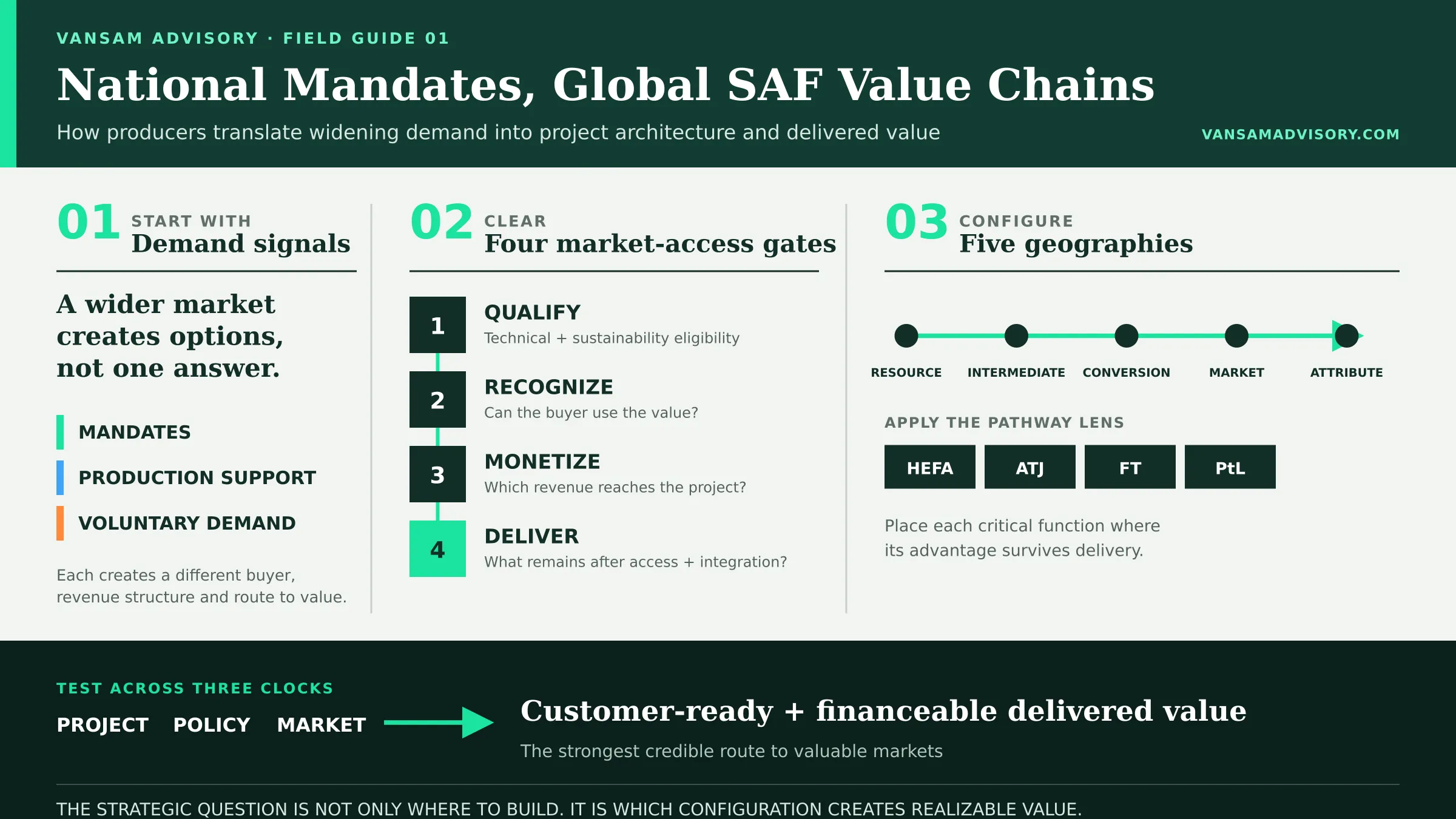
Explore the companion insight:National Mandates, Global SAF Value Chains, which examines how market eligibility, pathway economics and geography should shape project architecture. If you are a technology company defining what the next round must prove, a developer preparing for FEED or FID, a capital provider assessing whether the evidence supports the risk or an offtaker trying to resolve the commercial boundary before engineering advances, Vansam can help identify the controlling gap and define the next decision.
Request an introductory conversation.
hello@vansamadvisory.com