Bankability, Capital & Risk
Where SAF Capital Can Move Next
How U.S.-based SAF developers can assess financing and first-project opportunities across emerging markets.
November 23, 2026 · 10 min read · Elvis Ebikade

Originally featured on SAF Path on November 23, 2026.
Ready to pressure-test a live SAF commercialization decision? Book a consultation
For U.S. SAF developers weighing where to fund a first plant, the next milestone matters as much as the location. This article examines how development finance, buyer commitments and risk allocation shape that choice.
1. The development capital gap before FID
A sustainable aviation fuel (SAF) developer can have a credible conversion process, interested buyers and an engineering partner, and still face a substantial funding requirement before construction lenders engage. At the Alternative Fuels & Chemicals Coalition conference in Washington and the SAF North America Congress in Houston, conversations with developers, engineers and capital-market participants repeatedly returned to this challenge.
Front-end engineering and design (FEED), process validation, feedstock and offtake agreements, permits and independent engineering all require capital ahead of final investment decision (FID). One practitioner estimated pre-FID spending at 3–5% of total project cost, or $30 million–$50 million for an illustrative $1 billion facility.
A technology licensor described developers seeking capital to progress from preliminary engineering (FEL-2) to more detailed design and cost definition (FEL-3). Others had advanced through engineering and were seeking the next financing commitment, buyer agreement or industrial partner.
Northwest Advanced Bio-Fuels' 26 October 2026 announcement of Black Gold Equity Partners as a financing partner for its planned Washington State woody-biomass SAF plant illustrates that search for capital. For a U.S.-based developer, the questions are connected: where can the project fund the evidence needed for FID, and where can a first commercial plant be built on terms that support later growth?
2. Geographic bias is a failure of investment screening
Across Vansam's industry conversations, a recurring assumption has emerged: African and other emerging markets should supply feedstocks, while complex fuel conversion and refining belong in the U.S. or Europe. In some discussions, potential production locations were dismissed before their feedstocks, infrastructure, industrial partners, technical capabilities, customer access or financing options were examined.
Some of those judgments were expressed through racialized stereotypes about local expertise and industrial capability.
These are instances of geographic bias substituting for project-level investment screening. The mechanism can reinforce itself: fewer sites receive diligence and development capital, fewer operating precedents emerge, and a thinner track record is then used to justify further exclusion.
Borrowing costs also differ sharply across markets. Ghana's President John Dramani Mahama has highlighted African sovereign borrowing rates reaching up to eight times those in industrialized economies, a comparison also made by the UN Secretary-General. The United Nations Development Programme (UNDP) estimates that distortions in sovereign credit ratings cost African countries around $75 billion annually through excessive interest and foregone lending.
In a renewable-power analysis, Rabah Arezki cites the International Renewable Energy Agency's (IRENA) 2024 cost-of-capital assumptions of approximately 3.8% in parts of Europe versus 12% in parts of Africa. These figures describe different financing markets, and each SAF project faces its own funding terms. Higher financing costs can offset advantages in feedstock, energy or infrastructure.
Credible locations should face consistent investment-screening criteria, followed by rigorous project-level underwriting. Contracted revenue, currency matching, counterparty credit support and targeted guarantees can address specific exposures where their terms deliver meaningful risk reduction.
3. Four projects illustrate how risk allocation shapes financing options
Once a location receives serious consideration, the financing question becomes more specific: which risks can be allocated, to whom and on what terms? Four projects illustrate different approaches.
Uruguay | NovaSAF-1. Syzygy's planned facility combines renewable electricity and dairy biogas with an electrified Fischer–Tropsch process. Trafigura has signed a binding six-year agreement to buy the planned SAF output, while the International Finance Corporation (IFC) is providing technical and commercial advisory support.
The signed offtake gives lenders an identifiable buyer and contractual terms to assess. Construction financial close remains a subsequent capital milestone.
Morocco | Manara. The proposed hydroprocessed esters and fatty acids (HEFA) project has a potential loan of up to $135 million disclosed by the European Bank for Reconstruction and Development (EBRD), with expected Green Climate Fund participation, concessional margin support and European Union first-loss protection. The financing proposal remained under review on 11 November 2026.
Egypt | SAF Fly. The Emerging Africa & Asia Infrastructure Fund (EAAIF) and Ninety One arranged a $142.9 million debt package. Shell is expected to supply the principal feedstock and buy the output under a long-term take-or-pay arrangement, connecting input supply and contracted revenue to the financing structure.
Brazil | Acelen. IFC recorded approval, signing and an invested milestone in 2026, and FinDev Canada disclosed a $58 million loan within an approximately $854 million construction lending facility.
The planned Bahia HEFA biorefinery will initially process used cooking oil and vegetable-oil inputs, while Acelen develops a longer-term feedstock base around native Brazilian macaúba, with its own sustainability and commercial requirements.
The financing mechanisms differ by project stage and risk. Rabah Arezki's analysis of African gas exports helps explain one channel: creditworthy foreign buyers and hard-currency receipts can reduce currency and offtake exposure. Guarantees, concessional capital and suitable lenders address other risks. For a developer comparing locations, the decision is which combination of contracts, capital and risk allocation can be assembled for each project.
4. Match the funding instrument to the next development milestone
The immediate financing need depends on the development milestone. The Green Climate Fund's Project Preparation Facility offers up to $1.5 million for eligible project preparation applications through accredited entities or other qualifying applicants. In September 2026, the African Development Bank selected four green-hydrogen-derivatives projects for a proposed $20 million package of reimbursable pre-investment grants, subject to Board approval.
These instruments can support specific studies and transaction work. A developer facing tens of millions of dollars of remaining pre-FID expenditure will still need sponsor equity, strategic partners or other risk-bearing capital.
Other initiatives help identify viable sites and prepare projects before construction lenders enter. UK- and EU-financed national SAF studies have examined opportunities and implementation requirements in countries including Ghana and Nigeria. The International Civil Aviation Organization (ICAO) and IRENA also operate the Finvest@ETAF channel, connecting qualifying SAF proposals with project-preparation and potential financing partners.
Developers can build on those studies and introductions through site-specific engineering, market evidence and executable agreements.
As development progresses, financing options change. IFC, EAAIF, the African Development Bank, IDB Invest and regional lenders finance eligible projects; European Union guarantees and Green Climate Fund instruments target specific risks or costs, while U.S. EXIM and UK Export Finance have facilities for qualifying overseas equipment and services. The actual eligibility, availability and terms shape each project's capital strategy.
In India, the Assam biorefinery has produced fuel-grade second-generation ethanol from bamboo, supported by Japan Bank for International Cooperation financing channelled through India's Power Finance Corporation. A future alcohol-to-jet plant there would require its own conversion investment, fuel qualification and customer contracts.
5. Compare the complete investment case, from feedstock to customer
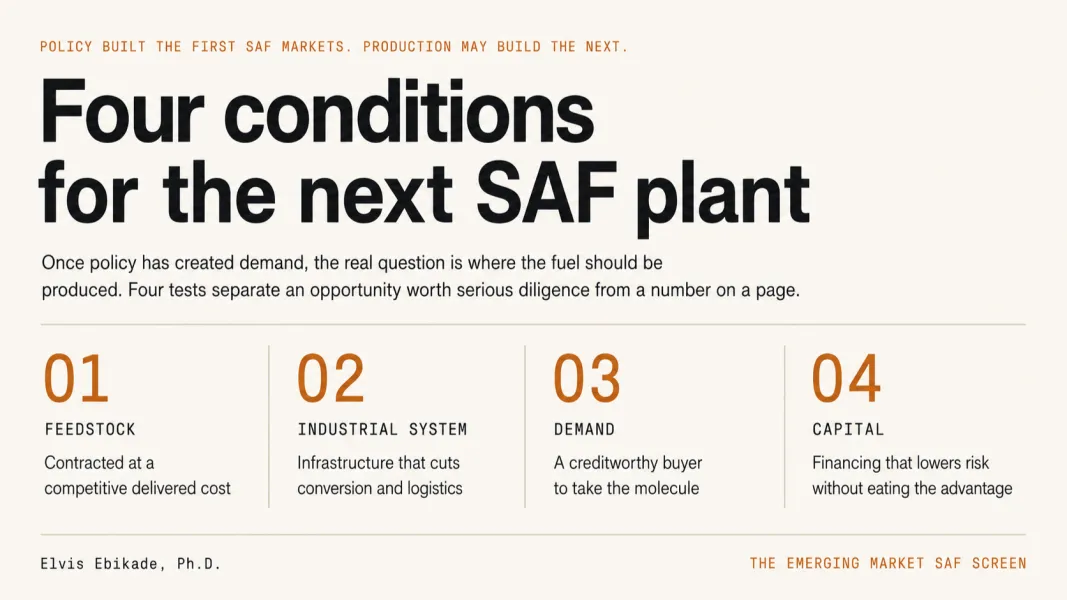
A developer can start with the proposed site and two or three credible alternatives, then estimate the cost and timing of the evidence needed to reach the next investment decision in each location. That comparison should include suitable funding sources, local industrial partners, engineering and permitting requirements, and conditions attached to concessional support.
Feedstock quantity and variability, renewable electricity, water, carbon sources and transport infrastructure must also be tested. Preparation funding is valuable when the resulting configuration can ultimately support an executable plant.
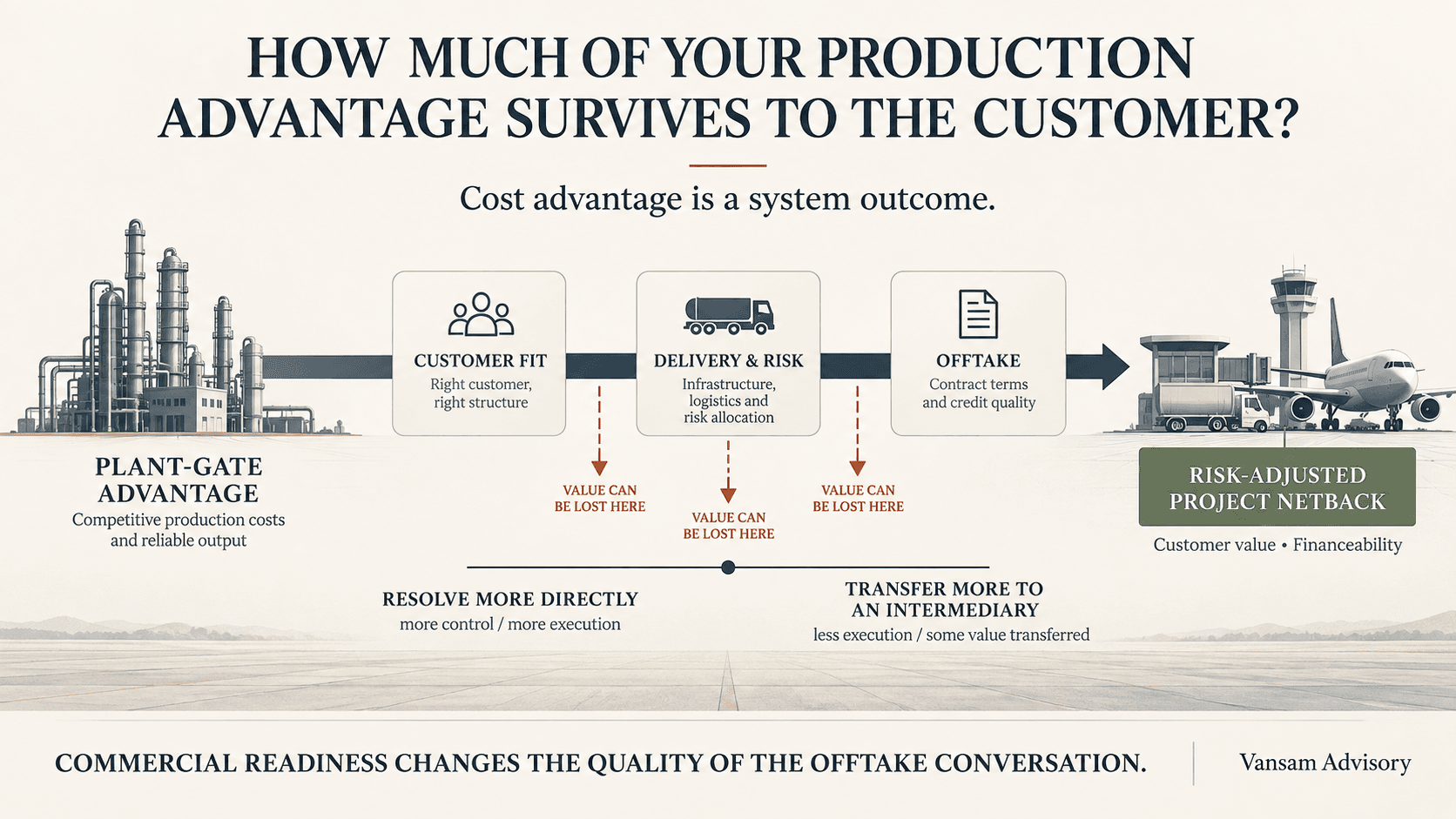
Customer access deserves equal attention. The intended buyer, sustainability eligibility, blending and delivery arrangements, contractual price, tenor and environmental-attribute rights determine how much value the producer retains.
Amazon's publicly stated preference for waste-based lower-carbon fuel inputs, including used cooking oil and agricultural byproducts, shows why feedstock category matters to customers. Cultivated bamboo and macaúba have different resource characteristics and qualify according to their actual supply chains and destination-market rules.
Voluntary SAF book-and-claim arrangements can reach customers beyond the airline physically uplifting a particular batch. Certification, verified fuel use, registry retirement and clear claim ownership underpin the associated environmental claims. Physical SAF supply under regimes such as ReFuelEU Aviation follows separate compliance rules. Each route should be assessed for delivered, eligible fuel economics and producer-retained revenue.
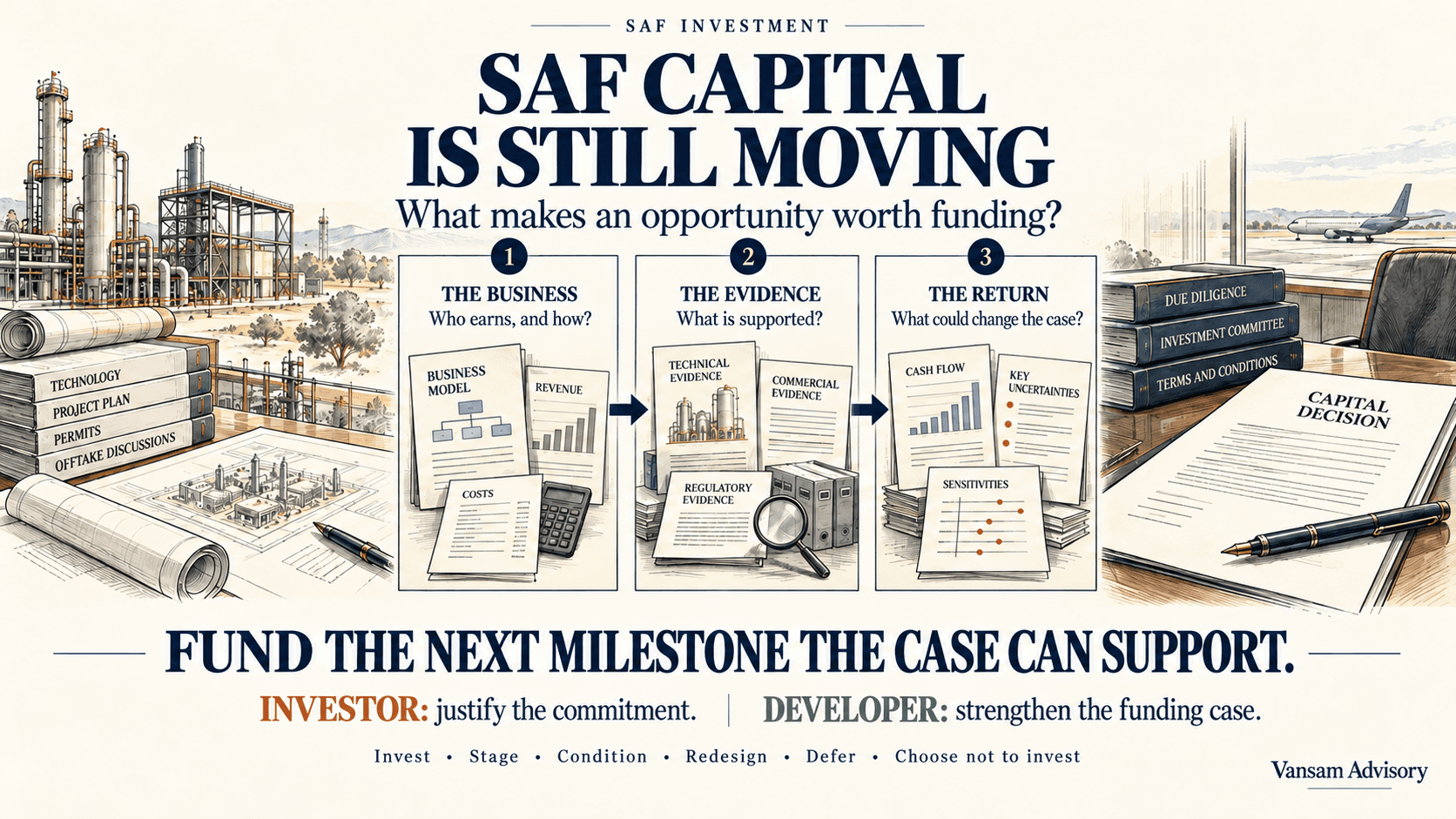
Equity investors assess returns under realistic assumptions; lenders examine who bears completion, feedstock, volume, price, payment and currency risk in downside conditions; and technology providers test whether planned inputs and operations remain within demonstrated process limits. These findings identify the engineering milestone, partner, contract or financing instrument most likely to strengthen the investment case.
6. Make the first project an asset for future expansion
An international development strategy has two practical routes. A company can finance process demonstration in one country and use the resulting engineering evidence to prepare a commercial facility elsewhere. Alternatively, where the industrial base, customer market and financing align, it can build its first commercial plant in the initial country.
That first operating facility becomes a reference for sustained performance, future customer contracts, lender discussions and repeatable engineering and operating practices.
The milestones provide different kinds of evidence. FID records the sponsor's investment decision for a defined asset. Financial close establishes the committed financing structure; commissioning and repeated fuel deliveries demonstrate further capabilities. Subsequent plants can draw on performance data, vendor relationships and commercial experience. Each site still requires its own feedstock qualification, process integration, permitting, sustainability evidence, logistics and customer contracts.
The first successful plant therefore helps reduce uncertainty and development effort across later projects.
7. Put the next development dollar where it can do the most
For a U.S.-based developer seeking pre-FID capital, the next decision is where an additional dollar will most improve readiness to invest. That might mean financing process validation, advancing engineering, establishing a stronger buyer contract, qualifying a different location or assembling appropriate capital partners. A comparison grounded in local industrial capacity and delivered customer economics can identify the investment that moves the project forward.
The starting point is to give credible locations an equal place in the investment screen and compare their actual risks and returns. A first plant supported by competitive inputs, appropriate capital and enforceable customer contracts can provide the operating reference for later projects across regions. Development capital should follow project evidence wherever it leads, including into locations previously dismissed on geographic assumptions.
Selected sources
- Northwest Advanced Bio-Fuels / Dawning PR, funding partnership (26 October 2026)
- President Mahama, Ghana Presidency, borrowing costs and value addition, 22 October 2026
- United Nations Secretary-General, African Union summit, 14 February 2026
- UNDP Sustainable Finance Hub, Borrowing costs and financial architecture, 8 June 2026
- Arezki, R. (4 November 2026), The cost of capital is the main barrier to Africa's energy transition, Communications Sustainability 1, 169. https://doi.org/10.1038/s44458-026-00185-w
- Uruguay XXI, Syzygy site-selection rationale
- Syzygy, Trafigura offtake
- Syzygy, IFC Latin America advisory framework
- EBRD, Manara proposed financing and risk-sharing structure
- EAAIF and Ninety One, Egypt SAF Fly financing
- IFC, Acelen financing milestones
- FinDev Canada, Acelen construction lending
- GCF Project Preparation Facility
- AfDB SEFA, 2026 green-hydrogen pre-investment selections
- EASA, EU-supported ACT-SAF Africa–India work
- UK Department for Transport, Ghana SAF business study
- ICAO/IRENA, Finvest@ETAF
- JBIC, Assam bamboo ethanol development
- Velocys, NovaSAF-1 biogas-to-SAF process and partners
- IFC, Acelen environmental review and planned macaúba feedstock development
- Amazon Sustainability Exchange, lower-carbon-fuels sourcing approach
- European Commission, ReFuelEU Aviation feedstock eligibility FAQ
- UK Export Finance, buyer credit facility
- U.S. EXIM, direct export loans