Bankability, Capital & Risk
SAF Capital Is Still Moving: What Makes an Opportunity Worth Funding?
How developers can strengthen a funding case and investors can assess the evidence, return and risk behind the next commitment.
October 24, 2026 · 16 min read · Elvis Ebikade
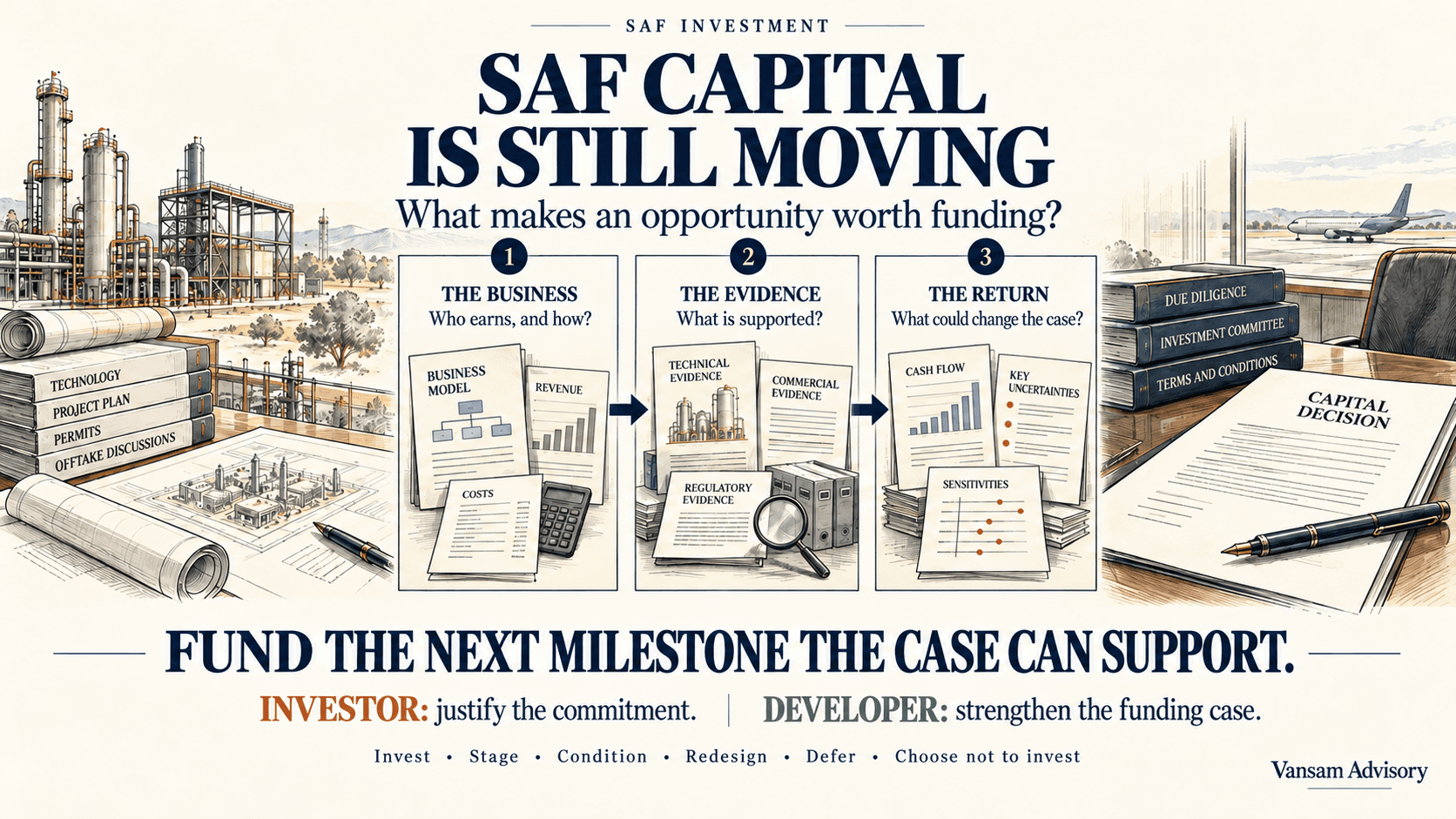
For a developer whose fundraising has stalled or is taking longer than wanted, it can feel as though no one is investing in sustainable aviation fuel (SAF). That experience can reflect genuine financing constraints, but it also raises a practical question: is capital still being committed ? If so, where is capital still being committed, and what could make this opportunity worth funding?
Ready to pressure-test a live SAF commercialization decision? Book a consultation
Even if aggregate investment is slowing, interestingly, some SAF opportunities are still attracting capital. The 2026 disclosures examined here show continuing capital backing for SAF technology companies and production projects, providing both sides concrete cases to examine when preparing or assessing the next commitment.
For your next raise or investment assessment, book a focused consultation to examine the commercial assumptions and prioritize the work that could strengthen the case.
An investor can find a technology innovative and still choose not to invest; for a variety of reasons. Capital for an integrated demonstration, a licensing business and construction of a fuel-producing asset each support different risks and return mechanisms. Therefore, a raise built around the wrong milestone can delay demonstration or growth while development costs consume limited runway. If further capital or another viable route is unavailable, the company may have to stop work or close. This assessment gives both sides a way to structure the next decision:
- For capital providers: identify opportunities that fit the mandate, connect the evidence to the return and exposure, and decide the amount, instrument and conditions to support.
- For technology and project developers: connect the raise to a defined milestone, explain how it could create value and prioritize the initiatives or deliverables that would strengthen the funding case.
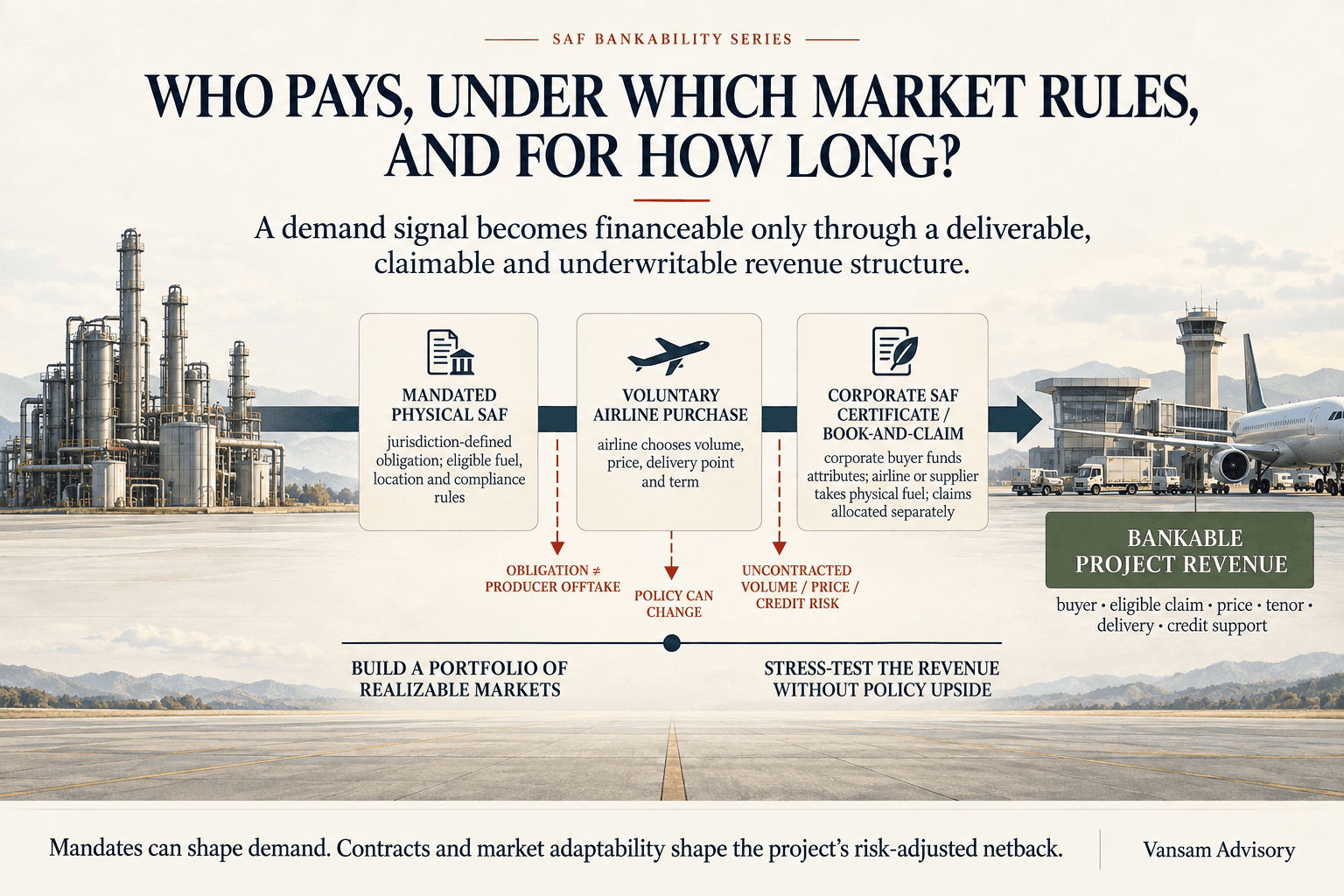
As a project approaches construction funding, the investment case increasingly depends on executable revenue commitments. A forthcoming three-part offtake series will examine the commercial choices beneath that case: where to sell, which buyer or partner to pursue, and how an agreement becomes retained producer revenue.
1. Define the opportunity and match the capital
A technology-developer investor may rely on licensing, equipment sales or services across several deployments; a project-developer investor might rely on a particular project asset, so it’s important to connect customer adoption to payments reaching the technology owner, or fuel sales to cash available to project investors.
The hydroprocessed esters and fatty acids (HEFA) pathway converts oils and fats through an established processing route. An emerging process may still need to establish performance and ASTM fuel qualification. Projects using either route can differ in inputs, configuration, customers and execution requirements.
Separate the applications and business models
A technology that could produce road fuels, chemicals and aviation components, needs a separate customer, competing alternative, qualification route and economic case for each application. Combining them can often times conceal the cost and time of developing distinct businesses which could create a sense of diffused focus and heighten perceived risk.
A staged route through another product needs both an attractive business case and evidence useful to the final SAF application. It’s therefore imperative that what carries forward; road-fuel success alone does not resolve aviation qualification or customer acceptance.
Match the investor to the funding request
An early venture fund may accept technology risk for potential company growth; a plant lender might underwrite operating cash flow. Hence, check the financing instrument, cheque size, horizon, concentration limits and follow-on capacity alongside technical and sustainability requirements.
2. Make early capital fund a consequential milestone
Early capital can deliberately fund missing proof for scaling a technology or project. The case must effectively explain which uncertainty the next milestone will resolve and why the result matters to drive customer adoption and investor return.
Consider a constructed example: a developer has produced synthetic aviation turbine fuel samples and obtained an independent review of component performance. It is raising its next venture round, described as a Series A, to demonstrate the integrated process. Management's commercial model then assumes that the performance observed in individual units can be sustained together across the integrated process, with representative inputs and manageable maintenance.
Establish what the tests actually support
Reconcile that operating assumption with the evidence. Identify what was measured, calculated or modelled, the operating period and any unique intervention required. An electrical-efficiency result needs its heat and utility boundary; a conversion result needs recoverable product quantity, quality and losses, therefore, a basis establishment for interpreting those results is extremely critical before extending or generalizing them for larger scale or more commercial sizes of that project.
It is therefore important to assess the independent review's scope, data access, comparison basis and qualifications. Ask management which assumptions the results replace or impact, how the updated inputs affect or strengthen the economics and what remains unresolved.
Carry technical findings on output, energy use and maintenance into the commercial forecast and proposed financing. Test customer acceptance, achievable netback and contract terms alongside the legal rights, obligations and sustainability evidence needed to earn the modelled revenue.
Define the campaign, budget and runway
Here, an investor could fund a bounded integrated campaign while leaving a larger deployment conditional. The developer's task is to make that campaign usable for the next decision:
- Conditions: specify representative inputs and operating conditions.
- Acceptance criteria: define measurements and criteria that test the assumption carrying the commercial case.
- Evaluator and decision: identify who will assess the result and how the specialists and intended capital providers will use it.
Budget for operation, analysis, records, data rights and the team alongside the test unit. Allow runway to interpret results and prepare the next decision, including the time, dilution and further funding an adverse result could require.
Fuel qualification belongs in that plan. ASTM D4054 provides an evaluation process for new aviation turbine fuels and additives. Establish the route applicable to the proposed product and process, the evidence already accepted, the fuel quantities and testing still required, and responsibility for cost and schedule. Progress through evaluation, coverage under a fuel specification and conformity of a produced batch are different milestones.
Explain how progress could support the investor's return
For a technology-developer investor, connect that progress to customer adoption, prospective licence or equipment receipts, further capital needs and a plausible exit or distributions. Examine what customers have agreed to purchase, and what would prevent adoption. Paid development work, a technical partner contributing resources and a conditional licence support different parts of that assessment. Early venture capital typically funds propositions before long-term offtake exists.
What recent technology-company investments show
Recent disclosures show capital funding different development propositions:
- 8 April 2026 | Sora Fuel: a USD 14.6 million round co-led by Spero Ventures and Inspired Capital, intended to construct and operate a pilot facility.
- 30 July 2026 | Lydian: a USD 43 million Series A led by Breakthrough Energy Ventures, supporting its modular synthetic-fuel platform and development toward a commercial demonstration targeted for 2028.
- 7 October 2026 | Phykion: Breakthrough Energy identified the algal-oil developer among the oneworld BEV Fund's first investments. The commentary discloses neither an amount nor a transaction date.
The Lydian and Sora Fuel figures are total rounds, not individual investors' cheques. Compare what the capital funds and which evidence remains to be established. A technology-company investment does not establish construction readiness or operating returns.
3. Test how performance becomes a durable return
As development moves toward a commercial plant, assess whether its return justifies the capital, time and risk. Equity and debt require distinct views of the same operating and commercial case:
- Project equity: examine cash available over the investment period, the timing of distributions and exposure to losses or further funding.
- Debt: examine repayment capacity and protections under the proposed terms.
Test how dependable the projected receipts and costs are, how long the advantage can last and what happens under weaker performance or market conditions. The US Department of Energy's Adoption Readiness Levels framework helps identify resource, market and deployment dependencies alongside technical readiness.
Translate operating results into the return case
Return to the illustrative developer. Its integrated campaign supports conversion performance under the tested conditions, but cleaning is needed more frequently than the commercial model assumed. Trace the result into availability, saleable output, maintenance expenditure and fixed cost per tonne, then examine the effect on delivery obligations, working capital and investor returns.
For the investor, the result changes the operating case to underwrite: would a supported maintenance allowance or design change preserve the return, or is further demonstration, a smaller deployment or a different application warranted? The developer can then identify the work, cost and time needed to reach that decision before committing to the larger plant.
Secure the inputs and test whether the advantage can be repeated
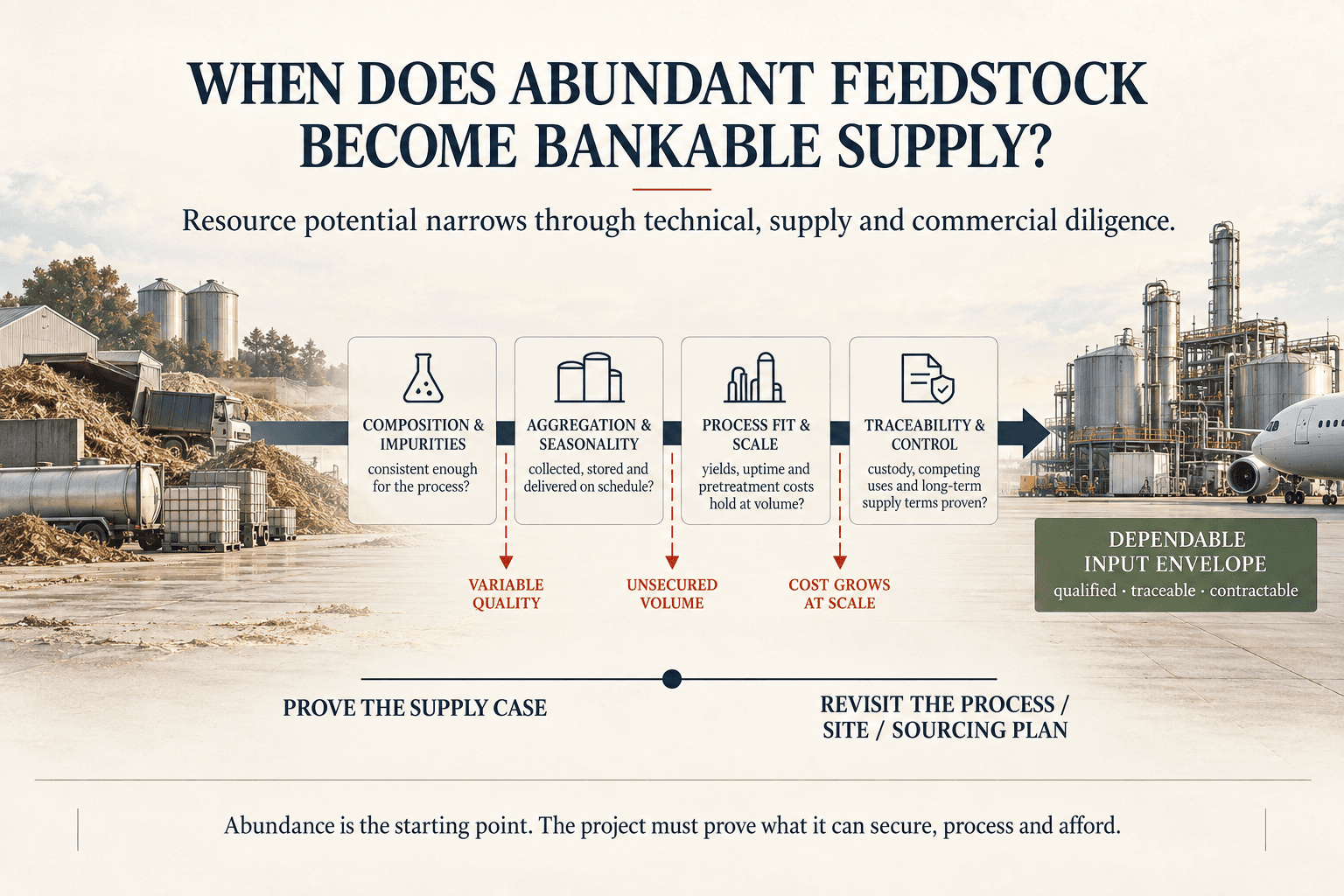
For an attractive energy or feedstock source, establish the quality, quantity, access rights, price and duration the project can secure, together with reliability, eligibility and integration costs. A resource owner may retain part of the benefit through tariffs, access charges or revenue-sharing terms. If supply depends on another plant or utility connection still being developed, assess its funding, commissioning schedule and the SAF project's alternatives if it is delayed.
Across successive deployments, identify which evidence carries forward and what must be established again. Changes in inputs, configuration, site or customer can affect performance, qualification, engineering and commercial requirements. Include the additional work and capital before valuing the expansion plan.
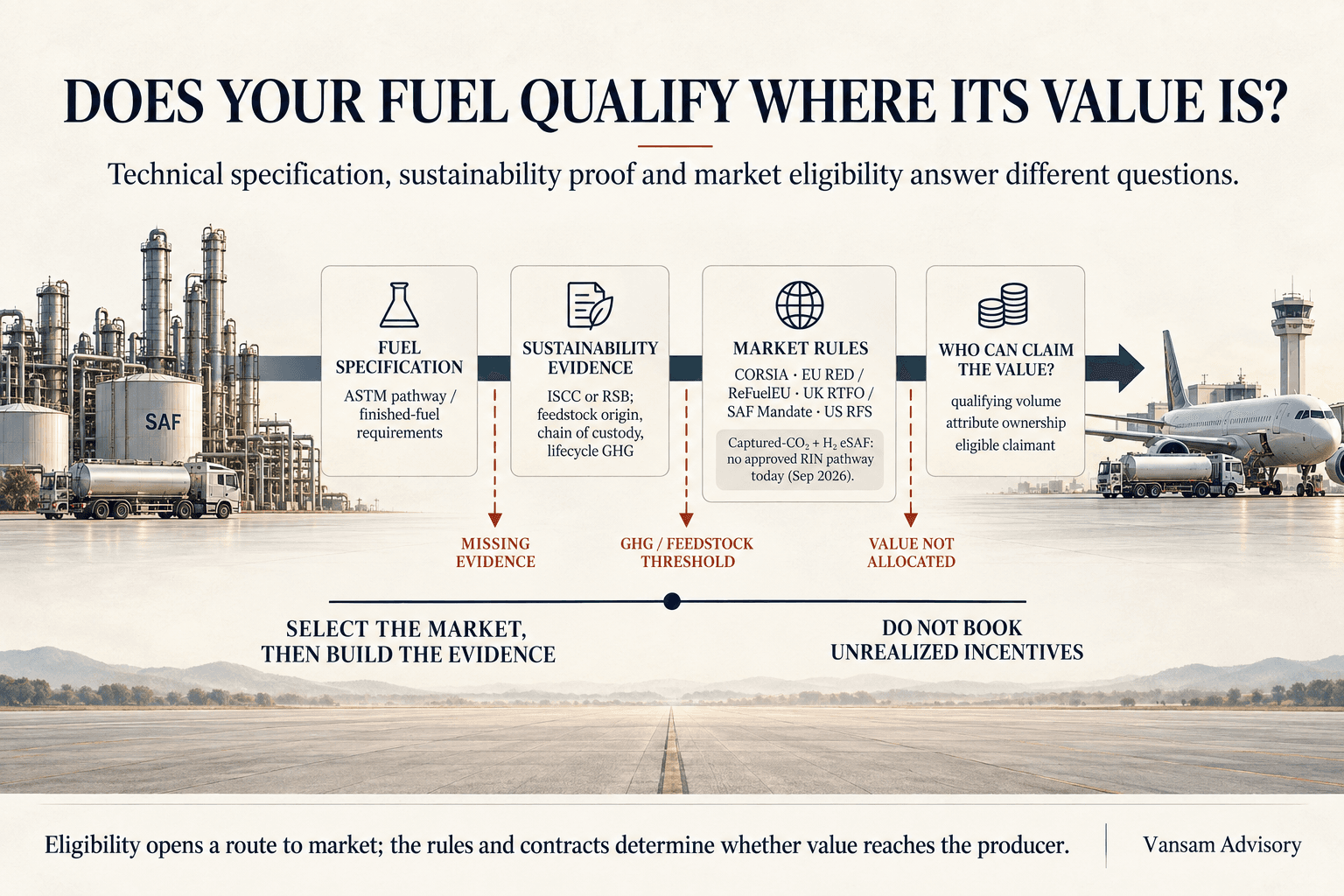
Check the sustainability and policy assumptions alongside supply. Use lifecycle-emissions and traceability evidence appropriate to the actual inputs and applicable scheme, and assess material land, water, labour and community risks at the plant and upstream. Record which incentives or revenue support are secured, their eligibility conditions, expiry and payment timing. Test the return if a claimed benefit is lower, delayed or unavailable.
Establish producer netback and the cash available to investors
Define the product, eligibility basis, purchaser, delivery point and payment mechanism behind the selling-price assumption. Then calculate producer netback at a stated project boundary:
- Receipts: include fuel receipts and any separately retained attribute or policy value.
- Downstream costs: deduct transport, storage, blending, testing and transaction costs the project bears beyond that boundary.
Identify value ownership and payment timing, state the costs included and avoid counting the same value twice. Use that netback in the cash-flow model alongside production costs, taxes, working capital, capital expenditure and financing obligations. Test how changes in volume, price, eligibility or delivery costs affect the amount and timing available for debt repayment and equity distributions.
Where an airline's offtake covers a synthetic blending component that another fuel supplier must receive, blend and deliver, establish that supplier's willingness, capacity and agreed economics. The airline offtake does not by itself establish downstream acceptance or final charges. Identify the missing agreement or open charge that could change the return.
Test downside exposure and the ability to deliver
Compare alternatives under consistent boundaries and coherent scenarios. If higher fossil-jet prices support an assumed SAF selling price, also test the opportunity's own energy and input costs. Contracts may cause those prices to adjust differently or at different times, changing the margin and cash retained.
Where savings depend on a larger plant, test the relationship between capacity, installed cost, utilization and operating expenditure. A lower cost per tonne at full output may coexist with a larger funding requirement or greater exposure during ramp-up. Distinguish savings supported by engineering or operating evidence from those contingent on scale and dependable sales.
The organisation also needs the capability to deliver the plan. Establish who controls technical records, manages contractors, accepts equipment and takes responsibility through commissioning and ramp-up. Where testing depended on exceptional founder intervention, budget for the people, procedures, support and spares required at the proposed scale.
Vansam's The Least-Mature Evidence Sets the Pace and Cost Advantage Is a System Outcome develop these links between evidence and commercial performance.
4. Connect construction funding to executable commitments
Near final investment decision (FID), connect the operating case with construction, supply and revenue commitments. Examine equity contributions, drawdown conditions, contingency, completion support and operating cash required before dependable sales, including exposure to delay or a slower production ramp.
Assess the offtake and the counterparty
Long-term offtake can support the financing case through its obligations, pricing, duration and counterparty credit. Test the price formula against input costs over the proposed financing period, including adjustment lags and exposure on uncontracted output. The required coverage and protections depend on the project and capital structure.
Assess the signing entity's financial strength, including liquidity, credit worthiness, debt obligations and competing capital needs over the contract term. Quarterly operating margins can inform this assessment; the buyer's SAF budget and willingness to commit need separate evidence.
For guarantees, insurance or public risk-sharing, establish the provider, availability, cost, exclusions and limits. Identify who bears uncovered losses and whether the capital provider accepts them. Protection still to be obtained remains a condition to resolve.
Examine why the buyer would accept the requested duration and exposure over other sourcing options. Continuing compliance needs can coexist with a preference for shorter contracts or pricing flexibility. Establish the buyer's benefit, the authority able to approve the commitment, and any outstanding evidence or terms.
5. Examine the arrangements behind project financing
The later-stage disclosures below show capital supporting three HEFA production projects. Read them for the disclosed supply, offtake and execution arrangements supporting the financing case, then identify which equivalent conditions your own project would need. All three use the broad HEFA pathway family, but differ in scale, sponsors, inputs, jurisdiction and development history. The table retains each source's product basis: combined biofuel capacity is not presented as SAF-only output.
5.1 Europe: SkyNRG DSL-01, Netherlands
SkyNRG identifies Technip Energies as EPC contractor and twelve international lenders providing non-recourse debt. Macquarie describes KLM's contractual feedstock-cost pass-through. The disclosed pass-through is intended to reduce exposure to a mismatch between feedstock costs and sales receipts. Its effectiveness depends on the covered costs and volumes, adjustment timing, limits and other terms. An investor would need those details to assess the exposure remaining, alongside the wider obligations and protections supporting the non-recourse financing.
5.2 North Africa: Green Sky Capital / SAF Fly Egypt
Shell's dual role as primary feedstock provider and take-or-pay buyer links procurement with sales. Al Mana and Vision Invest are among the sponsors.
Examine the pricing, quantity, quality and payment obligations together. If feedstock delivery is interrupted or fails specification, do offtake obligations still apply, and which remedies or alternatives remain? Fewer commercial interfaces can also concentrate dependence on one counterparty.
5.3 South America: Acelen Renewables, Brazil
Alongside industrial construction, Acelen describes agricultural development for macauba. Clifford Chance reports that approximately 90% of SAF and renewable-diesel commercialization volumes had been structured and contracted, naming Trafigura, Moeve, Bunge and BGN among commercial counterparties.
Here the assessment must connect industrial ramp-up with input availability and the agricultural programme's timing. Examine which supply is available before the new crop matures, the applicable eligibility conditions, and how the contracts handle changing inputs or output mix. Multiple financiers and commercial partners also require clarity about each party's obligations, the conditions for funding and the risks remaining with the sponsor.
What these financing announcements establish
Check what each certification covers: entity, site, feedstock, chain of custody or produced batch. Public disclosures do not provide a complete, comparable certification record for all three projects.
The announcements record financing and contracting milestones while leaving material pricing, margin, credit and risk terms undisclosed. Verify FID, operating performance and realized returns separately; the disclosures do not support a ranking of the three structures.
6. Give both sides a clear basis for the next commitment
When repeated data-room visits produce no commitment, it’s critical to ask the investor what evidence or terms could change its decision. Establish whether the obstacle concerns the funding request or the investor's specific mandate, allocation or timing. Further technical work cannot fix a mandate mismatch so it’s important to decide whether to improve the funding pitch, approach a more suitable capital provider or stop spending on that process until the team is clear on what is most critical to drive progress. Set out the resulting recommendation in four parts:
- What is being funded, through which entity and instrument, and how the capital provider expects to earn a return.
- Which assumption could reverse the case, what evidence supports it today and what exposure remains.
- What the next commitment funds and is intended to establish, who owns the work and evaluates the result, and the budget, timing and further capital required.
- The evidence or terms that would justify investing now, staging or conditioning the commitment, redesigning the proposition, deferring the decision or choosing not to invest.
An investor can use this record to choose a commitment or decide not to invest. A developer can turn the unresolved conditions into tests or agreements with owners, budgets and dates. The funded milestone should leave enough runway to interpret the result and act on the next decision.
The first article in the offtake series will take a defined project through feasible market alternatives to a priority outlet, a credible fallback and the work needed to pursue the preferred route. That gives the investment case a concrete commercial path to test.
Sources
- ASTM International. ASTM D4054-26: Standard Practice for Evaluation of New Aviation Turbine Fuels and Fuel Additives. Public scope and significance; updated 1 July 2026.
- US Department of Energy. Adoption Readiness Levels Framework. Guidance on commercial and deployment dependencies; accessed 23 October 2026.
- Sora Fuel. USD 14.6 million round to scale air-to-jet technology. 8 April 2026. Round total, co-leads and pilot-facility use of proceeds.
- Lydian. USD 43 million Series A financing announcement. 30 July 2026. Round total, investor participation, platform development and demonstration timetable.
- Breakthrough Energy. The Future of Flight. 7 October 2026. Identifies Lydian and Phykion among the oneworld BEV Fund's first investments; discloses no Phykion amount or transaction date.
- SkyNRG. DSL-01 financial close and construction announcement. 12 February 2026. Capacity, technology, partners, financing and company-level certification disclosure.
- Macquarie. Scaling sustainable aviation fuel production. Feedstock basis, project financing and KLM cost pass-through; accessed 23 October 2026.
- EAAIF / Ninety One. Green Sky Capital and SAF Fly Egypt financing. 6 May 2026. Combined biofuel capacity, debt package, sponsors and Shell's roles.
- White & Case. Green Sky Capital equity and debt raise. 13 May 2026. Equity, senior secured debt, technology and project agreements.
- Axens. Green Sky Capital technology collaboration. 3 June 2026. VEGAN HEFA technology and lipid-based feedstocks.
- Acelen Renewables. Financing announcement for the Bahia biorefinery. 22 May 2026, reporting the 21 May announcement. Combined SAF and renewable-diesel capacity, feedstocks and development programme.
- Clifford Chance. Acelen offtake and feedstock structuring. 25 June 2026. Commercial contracting coverage, counterparties and financing context.
- BBVA. Acelen financing structure. 25 May 2026. Commercial-bank and development-finance participation.
- Oliver Wyman. Airline Economic Analysis: State of the Industry, Q2 2026. October 2026. Airline financial context and sample limitations; not a measure of SAF offtake intent or a forward credit assessment.
- Environmental Defense Fund and Systemiq. Aviation's Climate Transition: An Investor Due Diligence Guide to SAF Opportunities, Risks & Integrity. October 2026. Investor scope, technical and commercial dependencies, eligibility, risk allocation and conditional capital decisions; especially pp. 22–27 and 33–36.
- DNV / Kantar Advisory Partners. Energy Technology Deployment Blueprint, September 2026 Call-to-Action edition. Evidence acceptance, organisational capability, assurance scope and repeatability. Framework guidance, not independent validation of the projects discussed.