Bankability, Capital & Risk
Cheap and Abundant Is Not Bankable
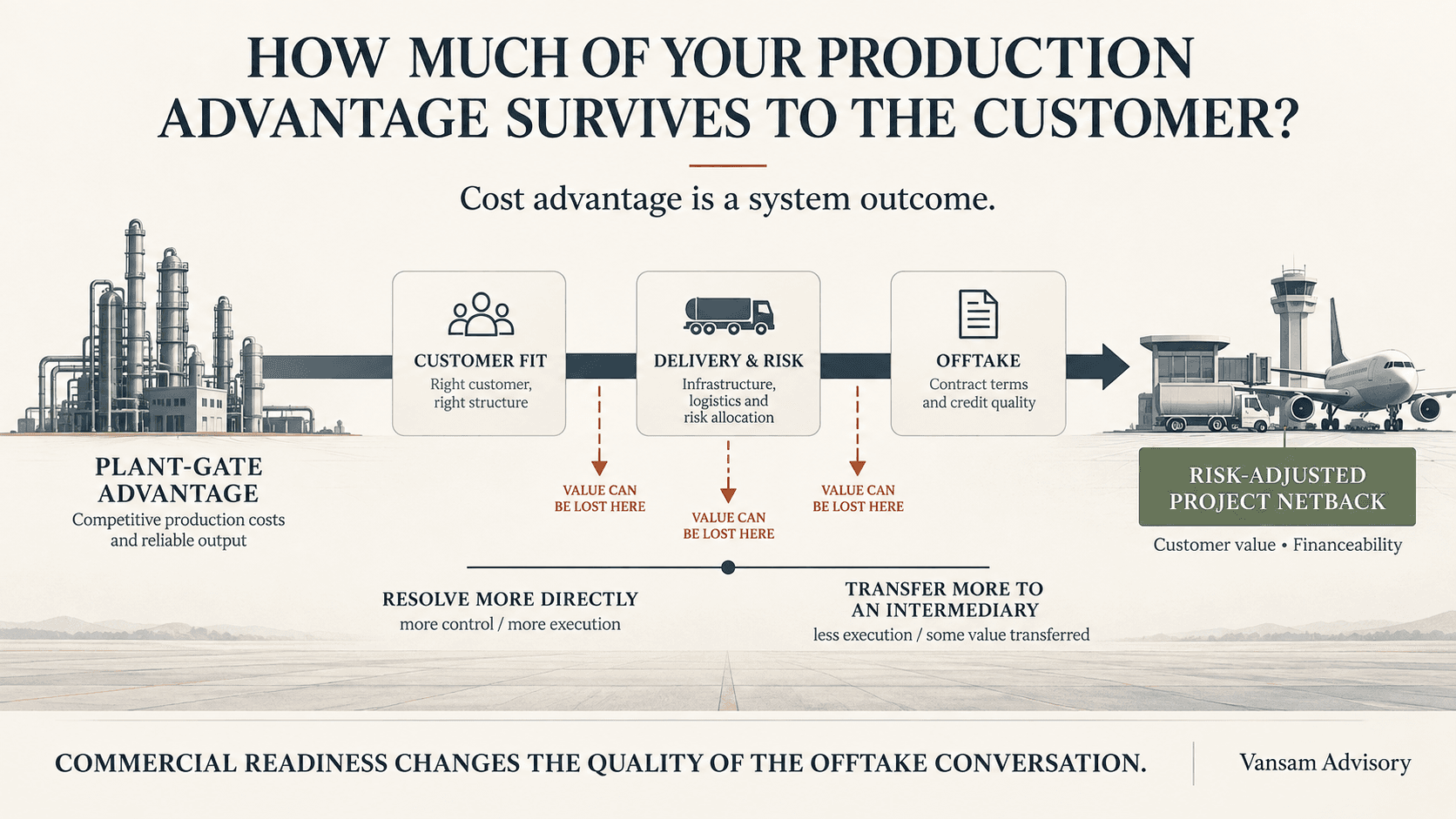
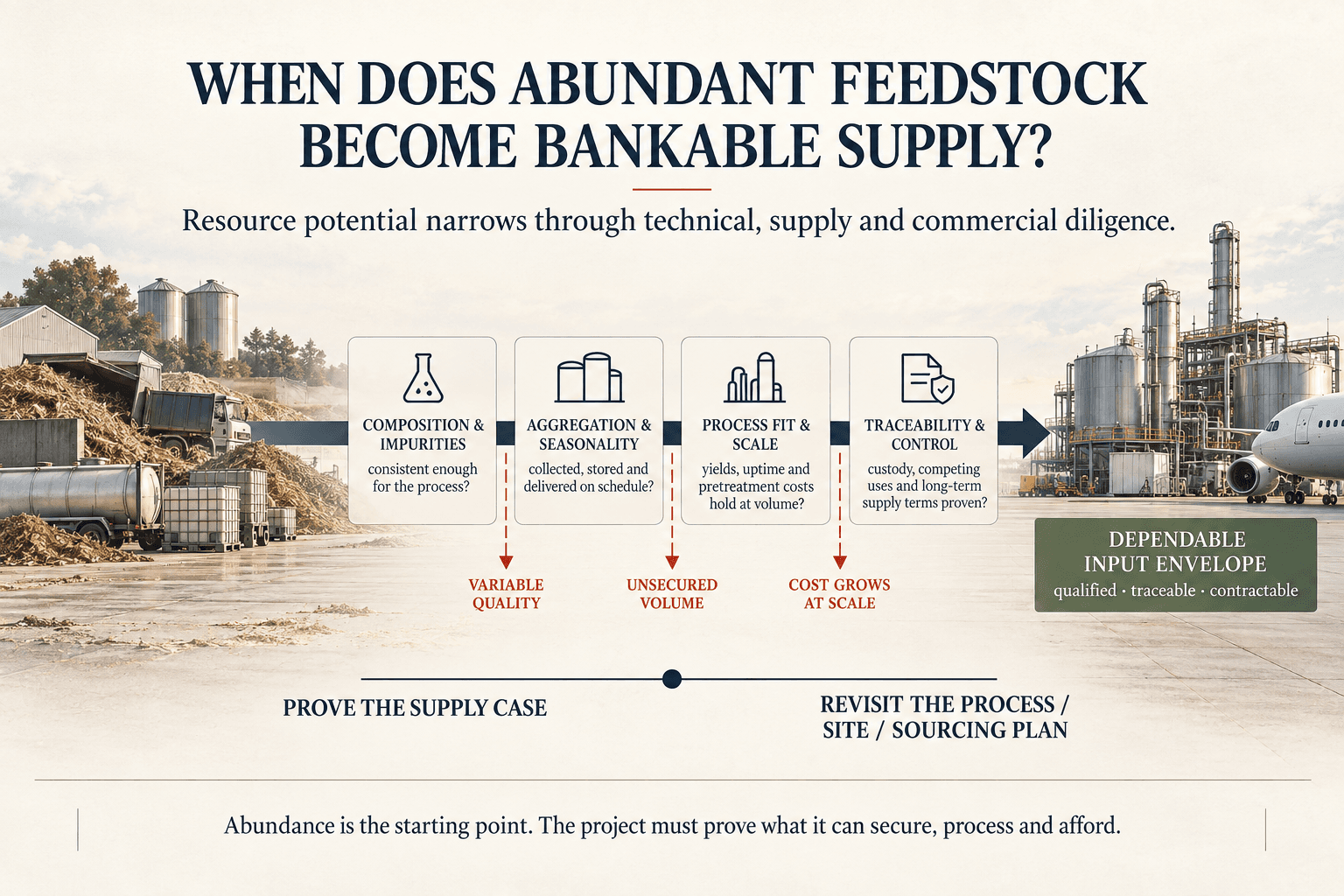
For a team funding a pilot, demonstration, replication or commercial plant, the input and process case shapes what the next capital commitment can achieve. Testing dependable supply, compatibility and delivered cost strengthens the funding estimate and exposes what still needs to be proved.
September 27, 2026 · 12 min read · Elvis Ebikade
What this changes
Test the volume, specification, collection calendar, competing uses and delivered cost the plant can actually secure. Stress-test the plan against supply shortfalls and process performance below the model.
Abundance is an opportunity, not yet a supply case
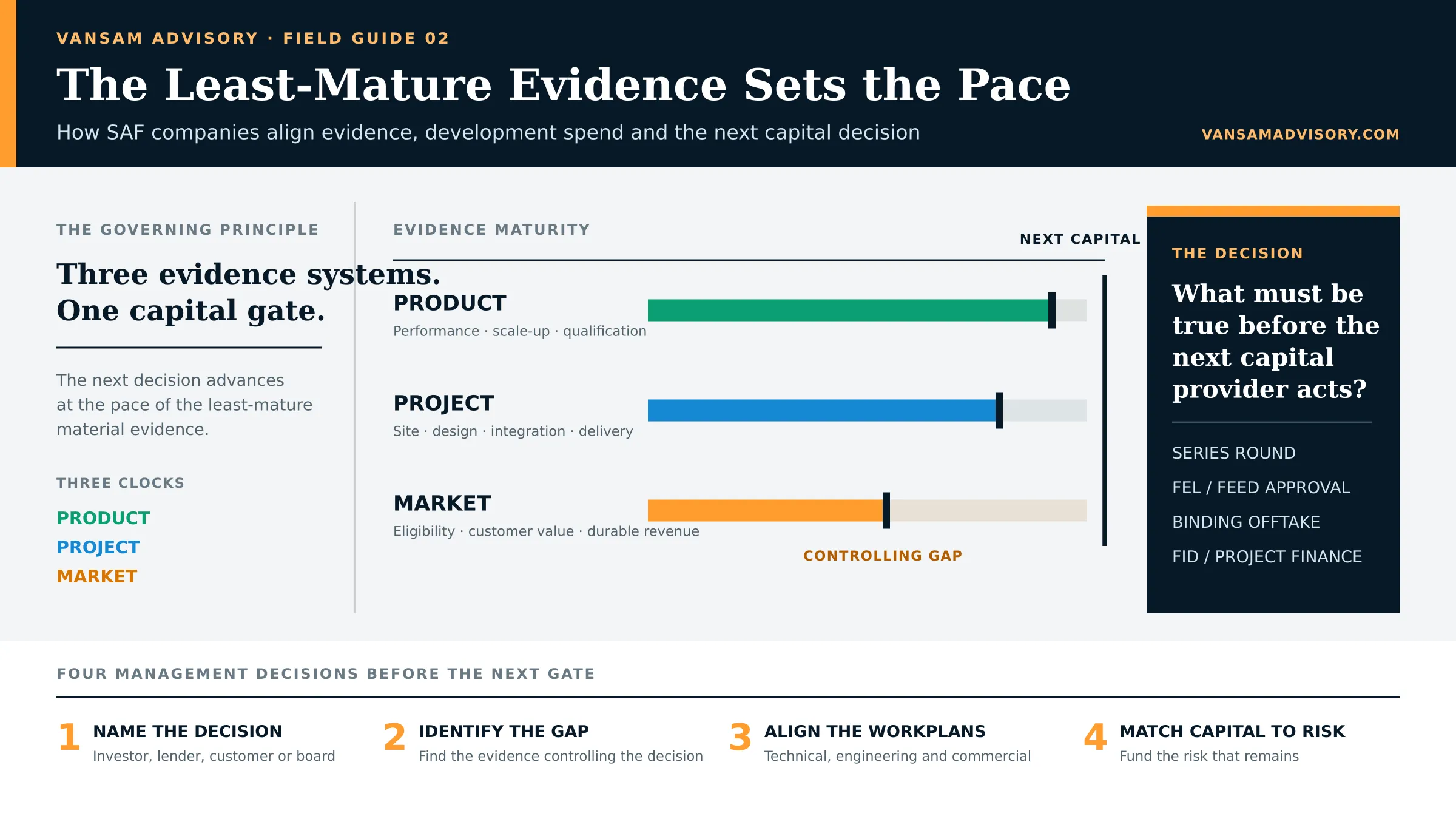
A team raising a pilot round for a novel fuel faces different evidence gaps from one funding a unit-operation improvement or seeking project equity and debt for a plant using established technology. In each case, the capital request becomes stronger when the developer can explain what the money must establish and which unresolved assumptions could prevent that outcome.
- For a fuel outside an applicable ASTM specification, the raise may need to fund process development and qualification testing in parallel. Feedstock variability affects which inputs to test, what the pilot equipment must handle, and the time and budget required.
- Within an established pathway, the innovation may be lower-cost carbon, more efficient hydrogen or syngas, higher yield or longer equipment life. Existing pathway approval does not prove that a new unit operation or its integration performs as modeled. The funding case asks how much saving reaches saleable fuel and what evidence and capital are needed to demonstrate it.
- For a commercially established technology such as HEFA, uncertainty may instead sit in a site’s feedstock contracts, pretreatment, certification evidence and delivered margins. A proven process does not secure a new plant’s supply or revenue.
These situations can overlap, and funding-round labels do not prescribe a technical sequence. Within the full system introduced in Cost Advantage Is a System Outcome, the focus here is the supply and process evidence that strengthens the next commitment. A plant will consume a specific input, at a required specification, in a particular place and operating window, with the evidence needed for its intended market. Some apparent abundance may prove seasonal, dispersed, committed to competing uses, expensive to aggregate or unsuitable. Those findings can change the plant’s size, funding requirement and achievable milestones.
Sustainable fuels draw on resources beyond fossil reserves, including wastes and residues, intermediate crops, renewable electricity, hydrogen and captured carbon. Some supply can be developed through investment, but only through a system that makes it usable. Therefore, expansion needs to account for land, water, food and feed uses, collection, infrastructure, energy and qualification, rather than assume that food crops or productive land can simply be redirected to fuel. Technical milestones can absorb an early stage team’s attention before it has much experience in procurement, certification or continuous operation. Bringing that experience in early helps establish dependable volume, likely interruptions and the cost of responding.
A resource estimate answers a different question
Resource studies are useful starting points. DOE’s Billion-Ton work considers biomass potential alongside price, geography and environmental constraints; RSB’s Southeast Asia assessment accounts for major existing uses, but neither substitutes for establishing what a particular plant can procure at the required price, place and time. EASA’s 2026 ReFuelEU report illustrates the distinction: UCO accounted for 80% of SAF supplied at EU airports in 2025, and feedstocks originating outside the EU supported 85% of SAF supplied, even though most finished SAF was produced within the EU. A domestic plant and a dependable input system are different achievements.
For the developer, the proposed customer commitment provides the operating requirement against which to test a resource estimate. The volume, quality, sustainability evidence and delivery timing the plant must sustain determine how much of that resource can credibly underpin capacity and the capital request. For HEFA, that may mean testing waste-lipid collection, competing demand and pretreatment. For ATJ, it includes the ethanol intermediate’s price, carbon intensity, provenance and reliability. For eSAF, power, hydrogen and carbon supplies need to support a compatible production profile and the intended market’s requirements.
The depth of evidence should develop with the investment especially because representative input trials may establish a pilot’s test basis, while demonstration or replication requires evidence of sustained throughput, yield and equipment life. By construction financing, supplier commitments need to fit the operating limits the process has demonstrated.
Process compatibility is part of that answer.
Moisture, ash, metals, sulfur and other constituents can affect pretreatment, yield, catalyst life and reliability, differently across pathways. A pilot using selected feedstock establishes performance within the conditions tested. Month-to-month commercial variation needs to be tested against those limits: additional treatment, blending, rejected deliveries or downtime may change the assumed unit cost. Representative trials and supply specifications strengthen the engineering basis before capacity and performance commitments are fixed.
Cost claims need the same discipline. A cheaper capture step may add conditioning or replacement costs; higher yield may come with shorter equipment life. An early eSAF model makes a hypothesis worth testing. If meaningful volumes of specification-compliant fuel remain the next milestone, the raise still needs to establish sustained operation, manufacturability and integrated economics. What matters is the saving per unit of saleable fuel, the cost of demonstrating it and the runway if testing takes longer. Fischer–Tropsch Is Mature examines this distinction between an established conversion route and the upstream system feeding it.
Annual abundance has to survive the operating calendar
ICAO’s India SAF feasibility work describes rice-straw supply chains with a collection period of roughly three weeks, variable bale quality and storage exposed to rain damage and fire. A large annual resource may therefore require collection, storage and inventory systems capable of turning a short harvest into dependable year-round operation as the cost and reliability of that system become part of the production case. Municipal waste depends on reliable collection and consistent composition. Several lipid suppliers may rely on the same collectors, crop basin or port. Hydrogen and carbon must arrive on a compatible schedule, while annual renewable-power averages may not match the qualifying hourly supply profile.
Supplier diversity strengthens resilience when substitution fits demonstrated process limits, permits, qualification and contracts. Establishing a backup input’s procurement route, treatment and changeover cost, together with its effects on throughput and lifecycle performance, shows whether it offers a usable operating option when the primary supply is disrupted. A ten-year offtake also raises a supply-duration question. How much feedstock is secured over that period, at what price basis and specification, and how will uncovered years or volumes be procured? Not every project needs identical contract tenors, but renewal, replacement and price exposure need a credible plan. Collection reliability, storage losses, inventory finance and correlated supplier failures belong in the operating and cost estimates, rather than outside them as problems to solve later.
Consider what the input could earn elsewhere
The input’s alternatives matter to both supplier and project economics. Ethanol can serve road-fuel blending; methanol can serve chemicals and marine fuel; RNG already has gas markets; renewable hydrogen can serve industrial users. These markets differ in accessible demand, price and contractability. Their existence alone does not establish an accessible alternative buyer. For a producer considering conversion, the useful comparison is between the input’s accessible return elsewhere and the SAF route after additional capital, energy, processing and delivery costs. Changes in lifecycle carbon and eligibility then need to be reflected in achievable customer price, volume and contract term. Once those obligations are included, a higher selling price may still yield a weaker risk-adjusted return. SAF may be the stronger use where the complete production system can meet customer requirements and earn the needed margin. Testing alternative outlets and input-price changes shows how much cushion remains before more conversion capital is committed.
Qualification changes the volume that counts
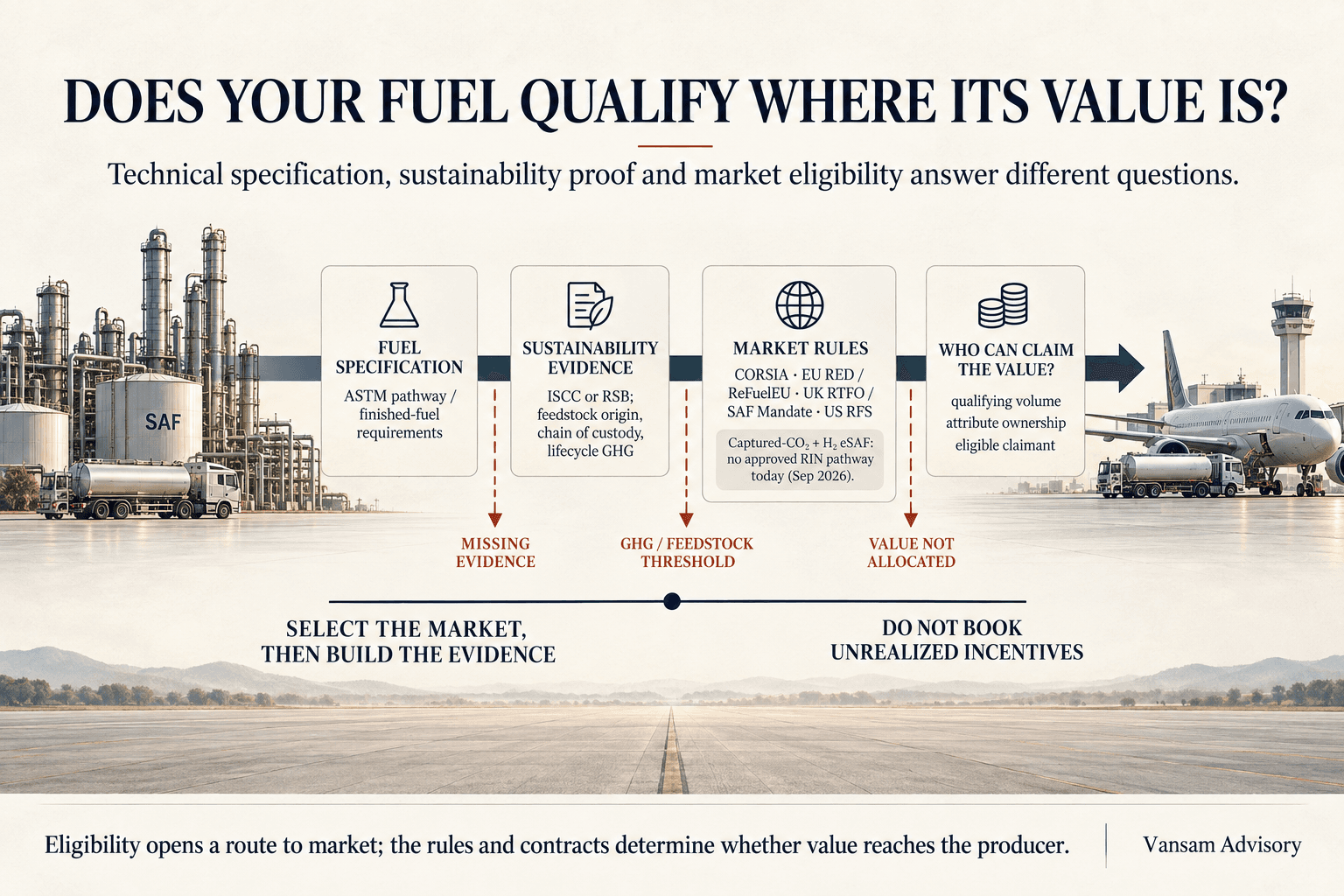
A resource can be physically usable without supporting every market the project may want to serve. CORSIA, ReFuelEU and other frameworks apply their own requirements to qualifying fuels; depending on the production route and market, those requirements can affect which feedstocks, lifecycle performance, provenance and evidence support the intended claim. The commercial implication is straightforward: physically processable volume may exceed the volume qualifying for the intended customer and revenue case. Traceability, supplier evidence, chain of custody and certification responsibilities therefore need to be built into procurement and operations. Discovering missing evidence after delivery can leave the project with fuel it can produce but cannot sell on the assumed terms. Knowing which supply can qualify narrows the commercial case, but leaves further questions about claim rights and the value a buyer will recognize. Eligibility Is Not Value follows that connection through the fuel, feedstock, process and destination.
Availability can be expanded; supply still has to be built
Current accessible supply and expandable potential describe different stages of a supply system, not additive volumes. Collection, crop development, renewable generation or processing may increase what a particular project can use, over time and at a cost. Expanded supply needs its own schedule, economics and accountable counterparties, plus a costed response if collection, infrastructure or supplier capacity develops more slowly than the plant.
Intermediate crops show how supply can be built: Bayer and Neste’s newgold, bp and Corteva’s Etlas, and Nuseed’s Carinata connect crop development with growers, processors and downstream demand. These initiatives are at different stages, so they illustrate development work rather than establish future bankable volumes. Concawe’s estimates of EU intermediate-crop potential provide context, not project-specific supply. The same work extends beyond crops: better waste collection can expand usable volumes, and new generation can expand power supply. Captured carbon still needs a suitable source, conditioning, energy and transport; direct air capture also carries material energy and cost requirements.
Sizing a plant around expanded supply therefore depends on a credible account of its volume, timing and cost, with an identified party responsible for delivery. Aligning the plant’s ramp-up commitments with that evidence reduces the exposure if supply development falls behind. This work also strengthens the customer conversation as airlines need confidence in proposed fuel volume, carbon intensity, certification and delivery. Substantiated supply coverage, traceability, lifecycle analysis and a clear account of residual risks help the producer explain what supports its commitments.
Build capacity around supply and performance the project can substantiate
The next commitment should resolve a specific uncertainty: input tolerance at pilot scale, sustained performance before replication, or contracted supply and delivered cost before FID. The value of that work lies in how it changes decisions. A limited initial input base may favor phasing, a costly collection radius may change location or scale, and qualification may narrow the resource enough to require a different market or configuration. Dependence on a shared supplier, corridor or infrastructure node also needs to be visible in the operating case so that apparent diversity does not conceal a common point of failure.
As the project advances toward FID, the input thesis increasingly needs to be reflected in specifications, evidence responsibilities, logistics arrangements, contracts and contingencies that can be evaluated against the operating plan. That does not mean every unit of future supply must be locked under one form of contract or that all commodity exposure should disappear; different projects and financing structures can support different levels of residual risk.
A conservative baseline gives those decisions a starting point grounded in substantiated supply and process performance. Testing lower yields, higher delivered input costs and slower ramp-up, individually and together, shows how much runway a technology company may need to reach its next fundable milestone. For a plant, the same findings inform contingency, working capital and capacity to service debt. Where the case requires near-perfect performance from the outset, recognizing that dependency while the design can still change gives the team more room to respond.
Suppliers, engineers, operating specialists, sustainability experts and commercial advisers can complement the team’s technical strengths. Leadership’s task is to connect their findings to design, costs, schedules and contracts, with owners and tests for unresolved assumptions, and that responsibility continues after FID. The next funding conversation becomes more concrete when the team can show which supply and performance assumptions have evidence, what the requested capital will establish and how adverse results would change the plan. That is how resource potential develops into a stronger project case. Eligibility Is Not Value then asks whether the resulting fuel can demonstrate the sustainability, emissions and traceability required by its intended market.
Sources
- U.S. Department of Energy / Oak Ridge National Laboratory, 2023 Billion-Ton Report overview.
- RSB, Sustainable Feedstock Assessment for SAF Production in Southeast Asia, 2024.
- ICAO, Feasibility Study on the Use of Sustainable Aviation Fuels in India.
- ICAO, CORSIA Sustainability Criteria, June 2025.
- European Commission, ReFuelEU Aviation and renewable-hydrogen guidance.
- EASA, ReFuelEU Aviation Annual Technical Report 2026, reporting 2025 data.
- Bayer and Neste, newgold winter canola commercial agreement, September 9, 2026.
- Corteva and bp, Etlas biofuel feedstock joint venture announcement, January 7, 2026.
- Nuseed, Carinata sustainable production and value-chain materials.
- Concawe, Availability Potential of Intermediate Crops in the EU to 2050, Report 6/26, May 19, 2026.
- Vansam Advisory, Cost Advantage Is a System Outcome, published September 26, 2026.
- Sora Fuel, “The Real Cost of SAF: Why the Unit Economics of Feedstock Will Decide Which Approach Replaces Fossil Fuels,” April 14, 2026.
- Sora Fuel, “There Isn’t Enough Used Cooking Oil in the World to Scale SAF,” July 7, 2026.
- Lydian, “How to make synthetic jet fuel that people will actually buy,” August 26, 2026.
- Technical literature reviewed, including “A review on biomass gasification syngas cleanup,” Applied Energy 155 (2015), 294–307; supports the general impurity and cleanup mechanism, not a claim that all pathways share the same contaminants or failure modes.
- U.S. Department of Energy, Alternative Fuels Data Center: Ethanol Fuel Basics; Renewable Natural Gas Production; Natural Gas Distribution.
- U.S. Department of Energy, Hydrogen; Maritime Innovation.
- Celanese, carbon capture and utilization operations at Clear Lake and low-carbon methanol for acetyl-chain products.
- Honeywell UOP, eFining methanol-to-jet technology. Technology description, not evidence of project-specific certification, economics or offtake