Bankability, Capital & Risk
Eligibility Is Not Value
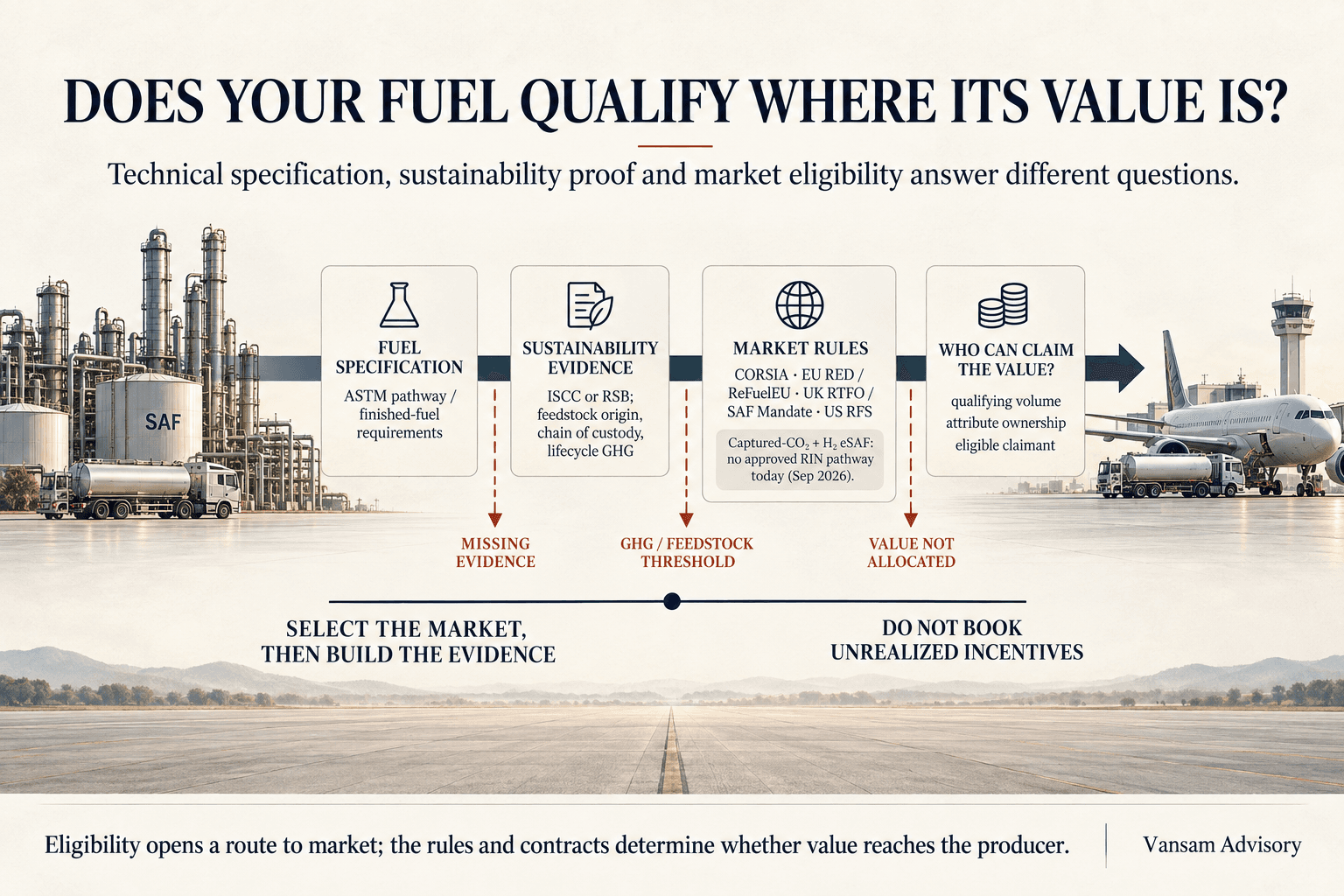
Specification-compliant fuel still needs market-specific sustainability evidence. Qualification opens a route to value; it does not guarantee the producer’s receipt.
September 27, 2026 · 8 min read · Elvis Ebikade
What this changes
Model only the benefits that the specific fuel, feedstock, process, destination and claimant can qualify for. Exclude RIN revenue for CO₂-based eSAF unless EPA approves that pathway; keep qualification, claim rights and payment terms distinct.
A producer approaching demonstration of specification-compliant fuel also needs to establish the sustainability benefits its intended customer requires. Missing provenance, an unsupported lifecycle emissions estimate or the wrong certification scope can change market access, testing spend and revenue timing, making the evidence plan part of what the next capital commitment must fund, and that plan develops with the project. A novel fuel needs qualification work, while an innovation within an established pathway needs proof that its changed process still meets market rules. A project using established technology must establish site-specific compliance. Progress on fuel specification therefore needs to be connected to the separate requirements of sustainability certification, program eligibility and financing readiness.
Technically compliant fuel still needs sustainability proof
The intended market and claim determine where that work begins, because CORSIA, the EU Renewable Energy Directive framework and national programs set distinct requirements. ISCC offers different certification schemes, including ISCC EU and ISCC CORSIA, so the label alone does not establish scope. For UK aviation supply, the applicable support route needs to be checked against the SAF Mandate rather than assumed from the RTFO. These distinctions shape the feedstock, lifecycle emissions, chain-of-custody and verification evidence the developer must assemble.
CORSIA provides a useful illustration: eligible fuels must come from producers certified by an ICAO-approved sustainability certification scheme. Its lifecycle methodology considers emissions across the supply chain, not merely at the conversion unit, and provides routes for default or properly supported actual emissions values.
- For a developer, a low carbon-intensity number is therefore a claim to substantiate under the applicable method, not a property established by calling the feedstock renewable.
- For the project team, applying that method means connecting supplier provenance records and assumptions about energy, hydrogen, transport, yield and co-products to the operating data needed to substantiate them.
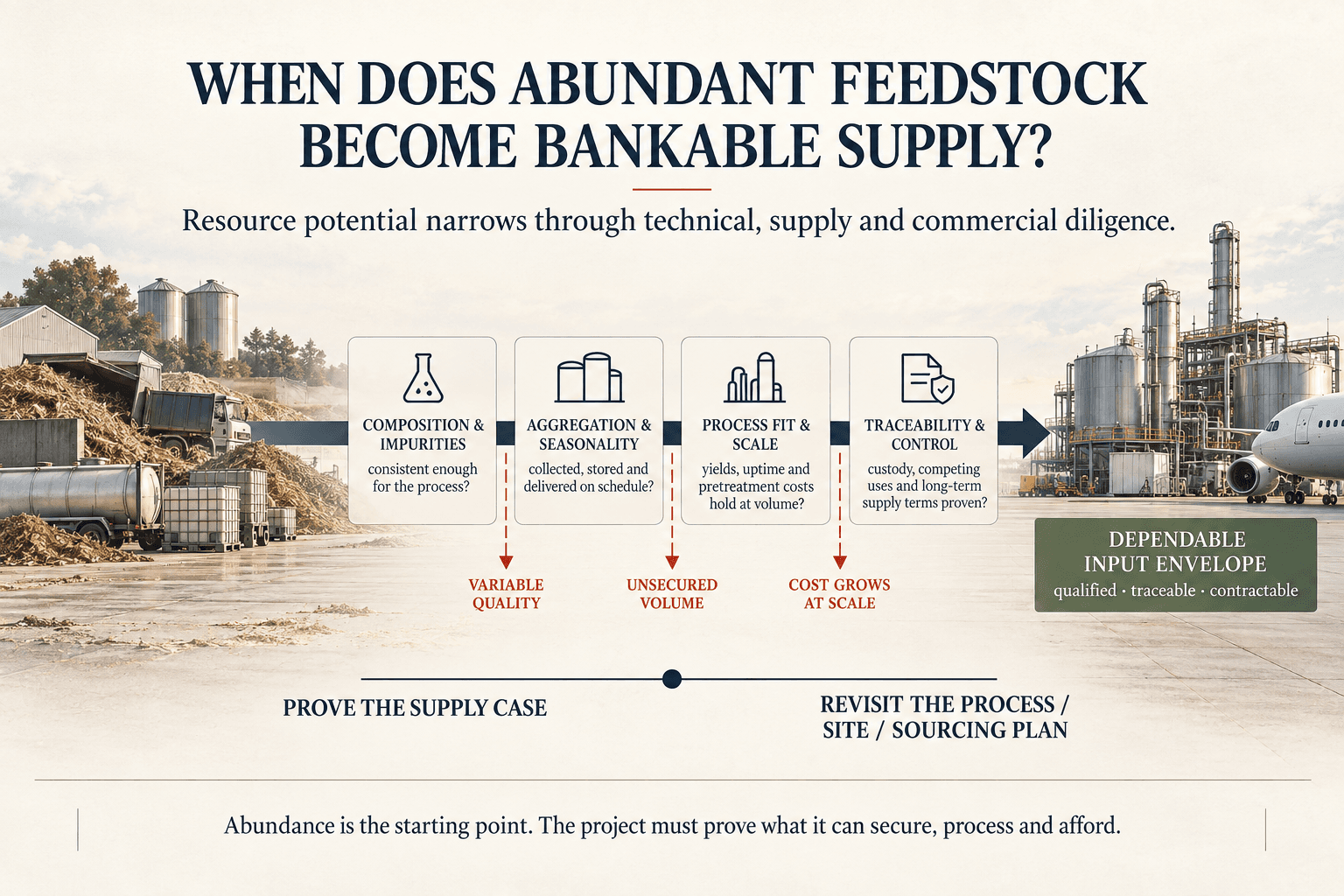
Land-use and waste or residue classifications matter alongside the GHG threshold. Building those requirements into procurement, metering, record retention and audit responsibilities makes the resulting claim reproducible. This is where supply diligence in Cheap and Abundant Is Not Bankable becomes a qualification case. A technically usable alternative input may have a different provenance, emissions profile or evidentiary burden. Establish which variations the proposed certification scope can accommodate and which would require further assessment. A flexible supply strategy is stronger when the team knows what remains eligible after it changes.
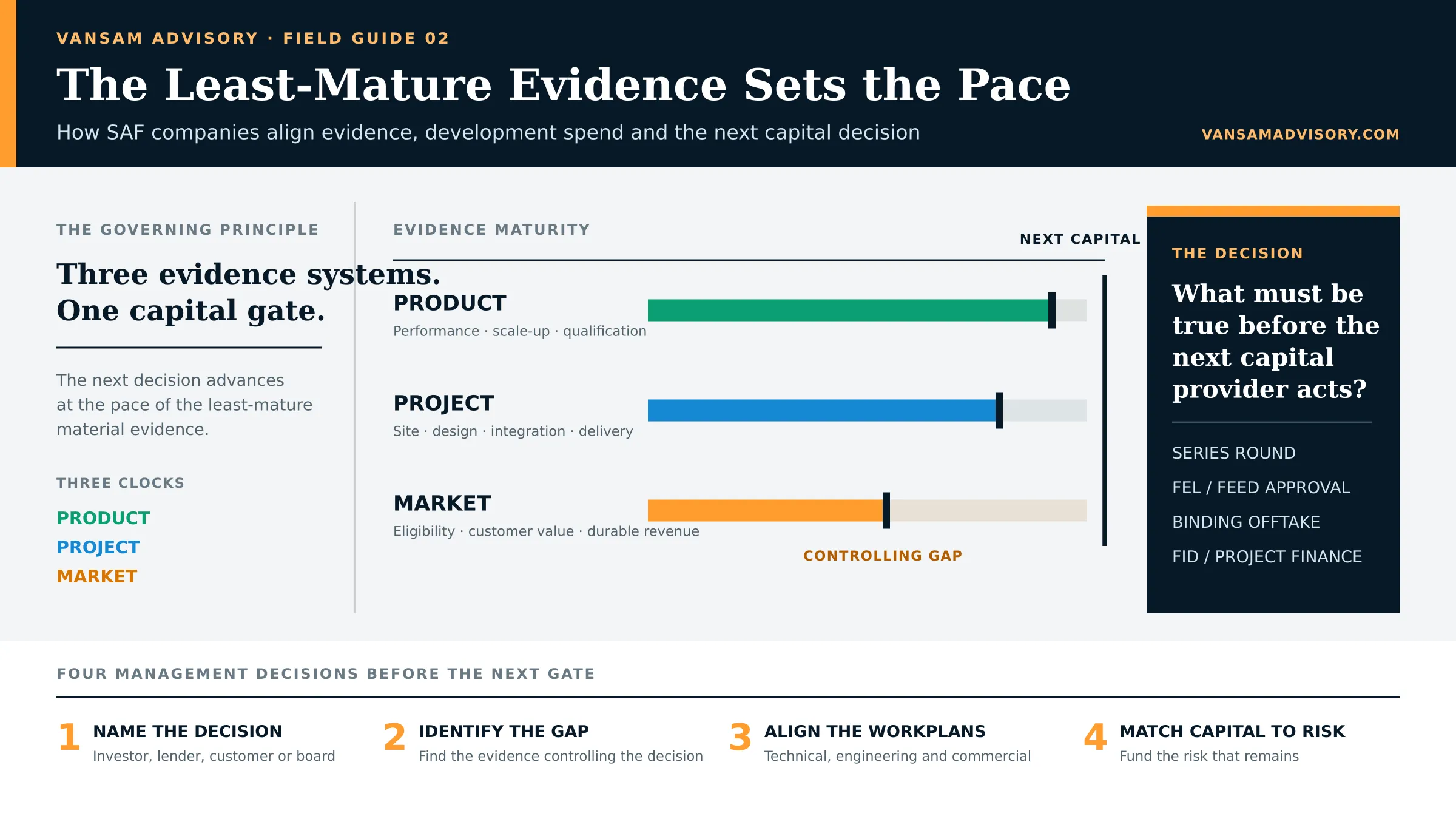
Distinguishing an evidence gap from a commercial allocation gap helps the developer estimate runway and working capital more accurately. Missing sustainability evidence may require a supplier or process change, further verification or delayed acceptance, whereas a qualified benefit allocated to someone else calls for a response through the commercial arrangement, and the funding sequence should reflect those needs. A pilot or Series A may fund testing toward approval, with demonstration or replication funding establishing whether the sustainability evidence holds across the integrated process. By construction financing, the project needs a market-specific revenue basis and a response to qualification delays or rejected claims. Each commitment then establishes evidence on which the next can build.
Qualification opens the door; trace how value reaches the project
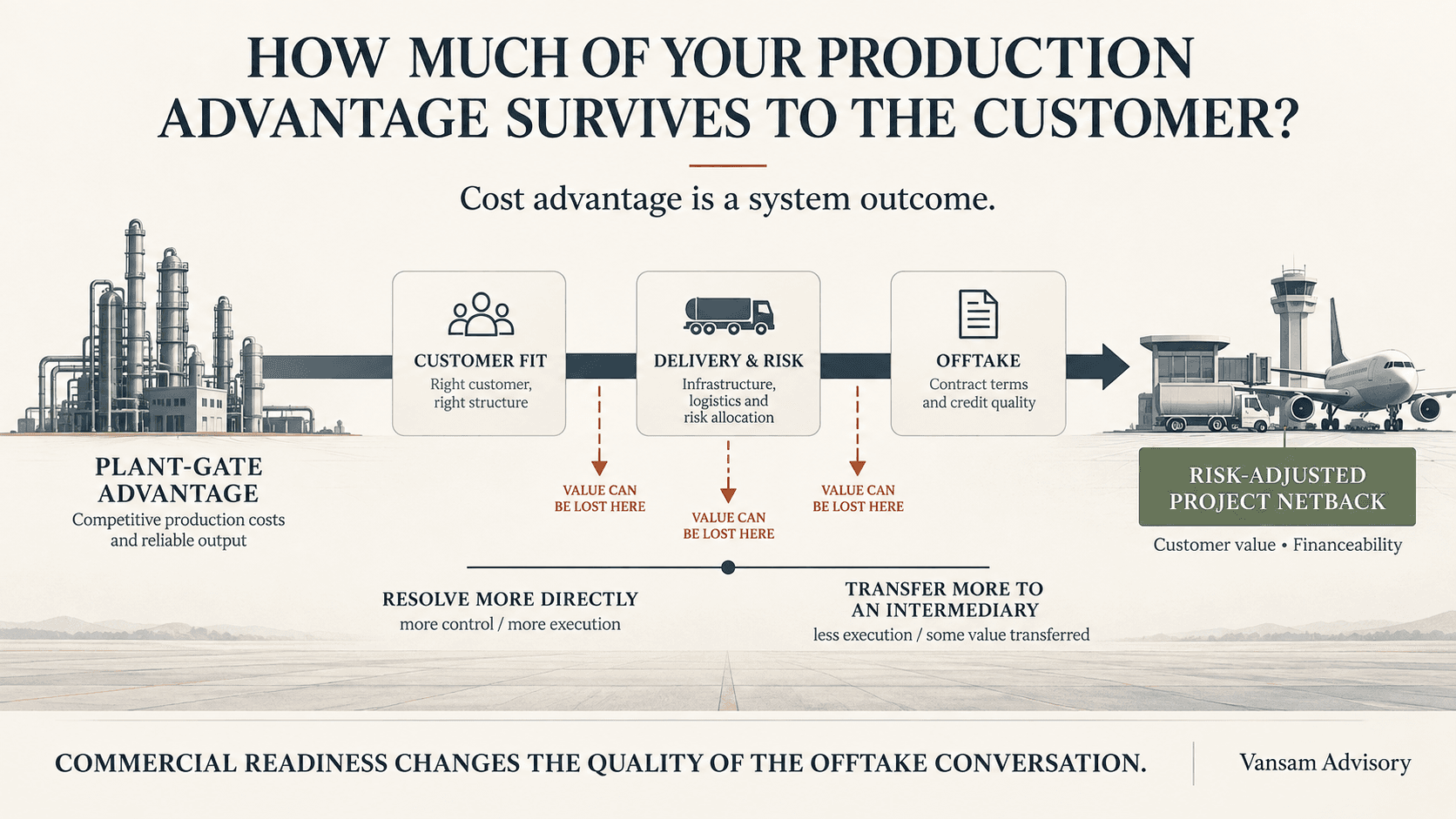
Following a proposed transaction makes the route from qualification to value visible. The product, feedstock and process determine which rules apply, while the destination and required evidence connect that pathway to a program and legal claimant. Eligible volume, the claimant’s ability to use the benefit, and payment or certificate timing then shape what the transaction can deliver. Where an airline or fuel supplier controls the benefit, the contract must establish attribute ownership, consideration, payment timing and responsibility if the claim fails. A counterparty’s potential entitlement is not automatically producer revenue.
A change in the project can alter that chain. A lower-cost hydrogen source, new capture unit or revised process may improve one cost line while changing lifecycle emissions or required evidence. Similarly, entering another jurisdiction may require additional qualification work, audit time and cost. Certification and market specialists can help the developer assess those requirements and preserve realistic options without assuming that approval in one market carries into another.
An RFS pathway is specific, not generic
The U.S. Renewable Fuel Standard illustrates why the production route matters. EPA defines a pathway through a specific combination of fuel type, feedstock and production process. Its current approved-pathways table includes several renewable jet-fuel pathways, but does not list an approved renewable-jet pathway using captured carbon dioxide and hydrogen. On that basis, CO2-based eSAF does not currently have an approved RIN-generating pathway under the RFS. EPA has a petition process for evaluating new pathways; a possible future approval is not RIN eligibility today.
This conclusion is specific to EPA’s current table. Qualifying biogas-to-renewable-CNG/LNG pathways, including D3 routes, concern a different fuel and process. Their eligibility does not transfer to eSAF made by further conversion.
Compare RNG’s accessible gas-market return with the eSAF route after added capital, energy, processing, lifecycle and delivery costs. Cheap and Abundant examines such competing uses. The comparison should not include an eSAF RIN receipt without approval of that specific pathway.
A headline credit may belong to someone else
Illinois shows another kind of gap: a benefit can be real and still not be unrestricted producer revenue. Under the state’s SAF purchase-credit provisions, an air common carrier purchasing qualifying SAF for Illinois use can earn a per-gallon credit. The credit can be applied to a defined portion of the carrier’s state aviation-fuel tax liability, subject to statutory limits and conditions. It is not simply a portable cash payment to any producer for every gallon it makes.
The project’s contract must translate the customer’s usable credit into producer value. Destination, tax exposure, eligible volume, purchase timing and certificate mechanics constrain that value; multiplying all plant output by the headline rate does not establish it.
The same discipline applies when several programs appear to offer value. Policy incentives, environmental attributes, compliance certificates and physical fuel receipts have distinct rules and contractual allocations that determine whether claims can coexist and how one claim affects another. Following those connections from feedstock provenance through production, delivery, claim and payment gives the auditor, buyer and capital provider a record they can assess.
Build the model from what can be substantiated
A substantiated base case begins by excluding claims unavailable to the specific pathway and establishing the conditions for those the project can pursue. Uncertainty about price, qualification timing and payment can then be assessed separately from eligibility and entitlement. Where a rule remains unsettled, testing the economics without the disputed value helps the team judge whether an alternative market, conditional commercial commitment or staged investment would strengthen the case while it awaits clarity.
Long-tenor RIN assumptions deserve a separate stress test. EPA’s final volume and percentage standards currently cover compliance years 2026 and 2027. That does not mean the RFS ends after 2027, but the standards do not guarantee RIN prices for 2026 and 2027 or for later years. For a ten-year forecast, distinguish pathway eligibility from price exposure: do not carry recent or peak D3 or D4 prices across the term as though they were contracted. Use a conservative low-price case the project can defend, then test a sustained low-price case and a zero-RIN or policy-loss case for unprotected years. Compare the effect on margin, funding needs and debt service with any price floor or hedge actually in place. EPA’s historical weekly price data show past volatility, but historical lows are test references, not guaranteed floors.
Turning these findings into decisions requires an owner, budget and timetable for unresolved work, together with a response if the result is adverse. Sustainability, lifecycle, tax, policy and commercial specialists contribute different expertise; leadership connects their findings to procurement, engineering and the capital request while those choices can still change.
A conservative case does not require a project to work without support. It reveals whether returns depend on verified entitlement, uncertain prices, counterparty decisions or unprotected policy assumptions, making the next funding conversation more specific.
Eligibility connects technically compliant fuel to substantiated sustainability, market access and claim rights. It does not establish that a buyer will purchase it on terms the project can deliver and finance. Mandate Demand Is Not Bankability takes up that next question across mandated and voluntary demand: who will pay, for what, under which obligations, and how can the project retain value as market conditions change?
Sources
- ICAO, CORSIA Eligible Fuels
- ICAO, Life Cycle Emissions of Aviation Fuels
- ISCC, Which certification is right for me?
- European Commission, ReFuelEU Aviation
- UK Department for Transport, RTFO and SAF Mandate technical information
- UK Department for Transport, The SAF Mandate: an essential guide
- EPA, Approved Pathways for Renewable Fuel
- EPA, Fuel Pathways under the Renewable Fuel Standard
- EPA, Renewable Fuel Petition Review Process
- Illinois General Assembly, Use Tax Act, 35 ILCS 105, Section 3-87
- Illinois General Assembly, Service Use Tax Act, 35 ILCS 110, Section 3-72
- Illinois Administrative Code, Title 86, Section 130.333
- EPA, Renewable Identification Numbers under the Renewable Fuel Standard Program
- EPA, Final Renewable Fuel Standards for 2026 and 2027
- EPA, RIN Trades and Price Information