Bankability, Capital & Risk
Mandate Demand Is Not Bankability
Mandates and voluntary targets create opportunities. A financeable project needs executable sales, clear risk allocation and credible choices when conditions change.
September 27, 2026 · 9 min read · Elvis Ebikade
What this changes
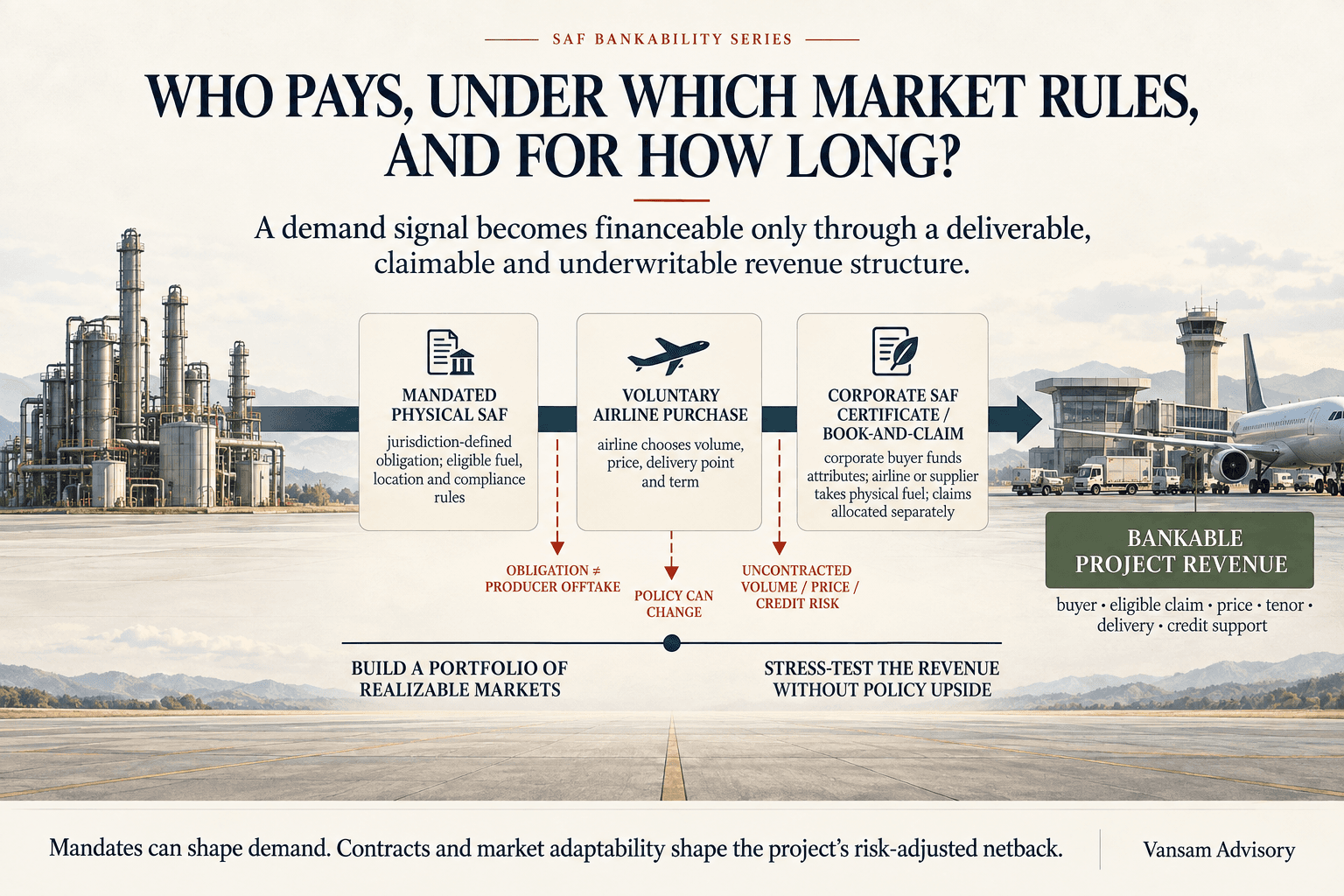
Build the case from the actual obligated party or voluntary customer, eligible claim, delivery route, price, term and credit support. Stress-test uncontracted or policy-dependent value and cost a viable alternative market.
A developer seeking its next raise or construction financing may point to an airline target or SAF mandate as evidence of demand. However, the investment case needs a more specific answer: what can this project sell, to whom, where, at what price and under which obligations? Dependable inputs, credible process performance and substantiated sustainability qualification strengthen the offer. They do not decide which customer will buy it or whether the project can deliver on terms that support its funding and operating plan. This final Perspective in the Vansam SAF Bankability Series follows mandated and voluntary demand into customer revenue, retained netback and the choices a developer needs when conditions change.
A mandate answers one question, not every question
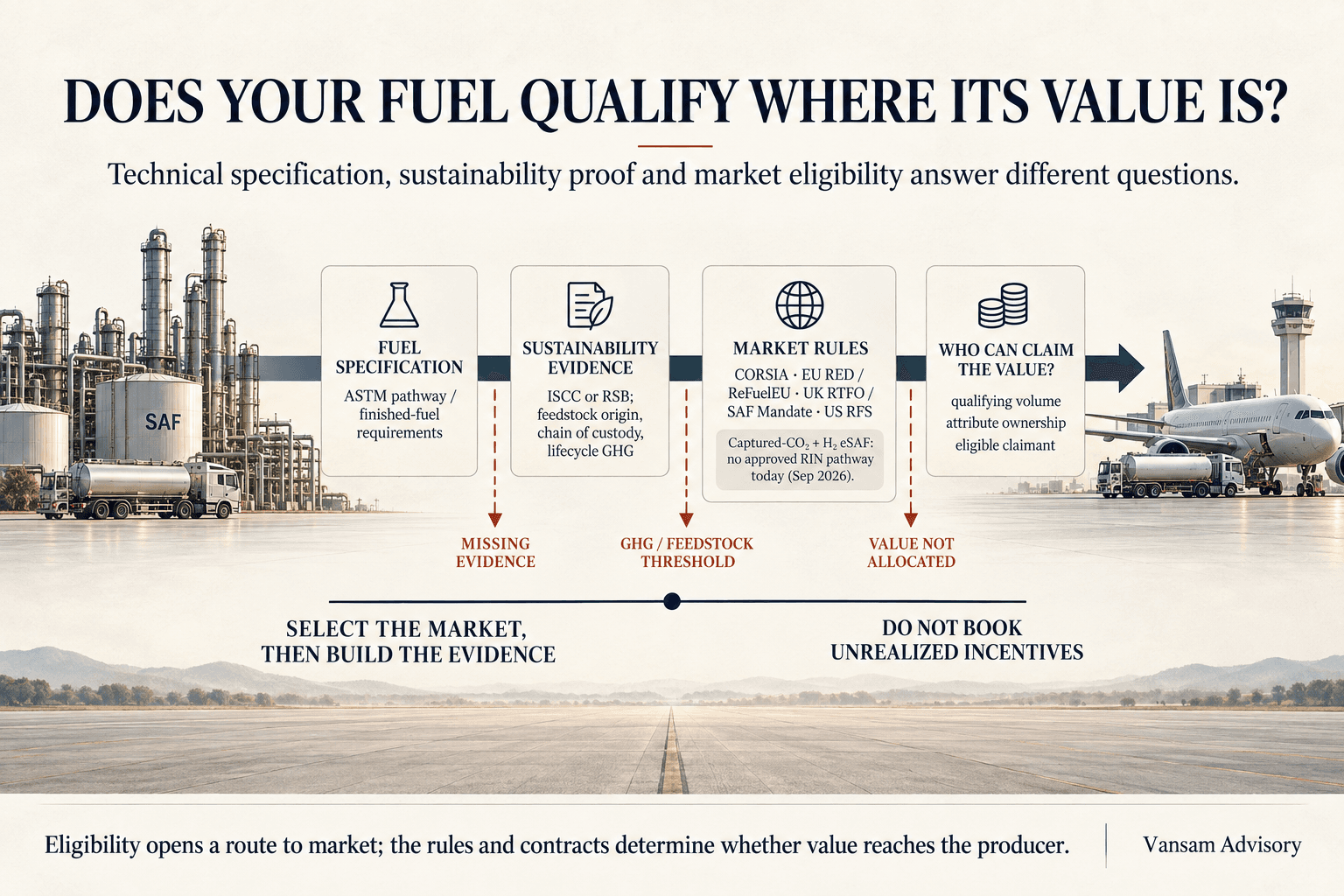
A mandate establishes a legal obligation within a defined jurisdiction and places that obligation on specified parties. Some systems also use tradeable certificates or allow another compliance route. Those rules can create a strong market signal and help buyers plan, but they do not automatically create an offtake for a particular producer. For the developer, understanding that market begins with the roles of the obligated fuel supplier, physical buyer, attribute owner and airline. The party that must comply may have several compliance alternatives, while airport delivery and payment to the producer may sit with other counterparties. Those relationships determine whom the project needs to engage and what it can credibly offer. ReFuelEU illustrates the distinction: aviation-fuel suppliers face SAF-share obligations at Union airports, while aircraft operators separately must uplift at least 90% of their yearly aviation fuel requirement at each Union airport. The rules engage different parties and make location part of the commercial design; they still do not identify a producer’s customer. National demand is not project-specific volume, eligibility, timing, location, production profile and delivery determine what the plant can address. There Is No Single SAF Market examines these distinctions; here the question is how the chosen market becomes financeable revenue.
The UK mandate shows both the value and limit of policy demand
The UK SAF Mandate places an increasing obligation on aviation-fuel suppliers. Suppliers demonstrate compliance using certificates issued for eligible and sustainable fuel, may trade certificates with other parties, or may use a buy-out route. Certificate issuance is linked to lifecycle emissions savings. That is a real demand mechanism, not simply an airline aspiration. The first provisional UK statistics for the mandate show that regulated supply and certificate reporting are being measured, while the Department for Transport notes that the dataset is incomplete. Such reporting can help a developer understand the market’s direction. It does not show that a specific plant has a buyer, has secured the relevant delivery arrangements or can finance its projected sales.
The UK’s own policy documents make the distinction explicit: Government describes the mandate as a demand-side measure, while also recognizing that it may not by itself provide sufficient long-term revenue certainty for first-of-a-kind commercial-scale projects. The Revenue Certainty Mechanism is intended to address part of that gap, but its funding and detailed design are separate from the mandate itself. A developer must confirm whether its project, pathway, contract and timing meet the actual mechanism’s rules before counting support as contracted cash. A buy-out gives the supplier a compliance alternative that can affect willingness to pay. Model the buyer’s actual procurement choices rather than assuming every required gallon must come from the project at its forecast price. A durable, enforceable mandate can strengthen investment conditions. Commercial contracts must still resolve what policy leaves open.
Follow demand to the buyer, claim and delivery basis
The customer evidence needed also develops with the project. A pilot or Series A can use customer requirements to shape its test plan, while a team improving a unit operation needs to show that the saving survives into competitive delivered fuel. As a project approaches FID, those findings need to become delivery and revenue commitments investors can assess against the operating plan.
For mandated demand, the obligated party’s compliance choices help explain its willingness to buy. Voluntary demand requires a corresponding understanding of the buyer’s budget, desired claim, committed premium and term. An airline purchasing physical SAF and a corporate customer purchasing aviation-related emission attributes may therefore need different propositions, even where their interest originates in the same production. Book-and-claim can connect an attribute buyer to qualifying fuel supplied elsewhere, but it does not make every market interchangeable. RSB’s system, for example, governs registration, transfer and retirement of sustainability attributes, including claims and double-counting safeguards. Verify that the buyer’s intended claim and the relevant program accept the proposed arrangement. A voluntary attribute purchase is not, by itself, proof that a separate mandate’s physical supply or accounting obligations have been met.
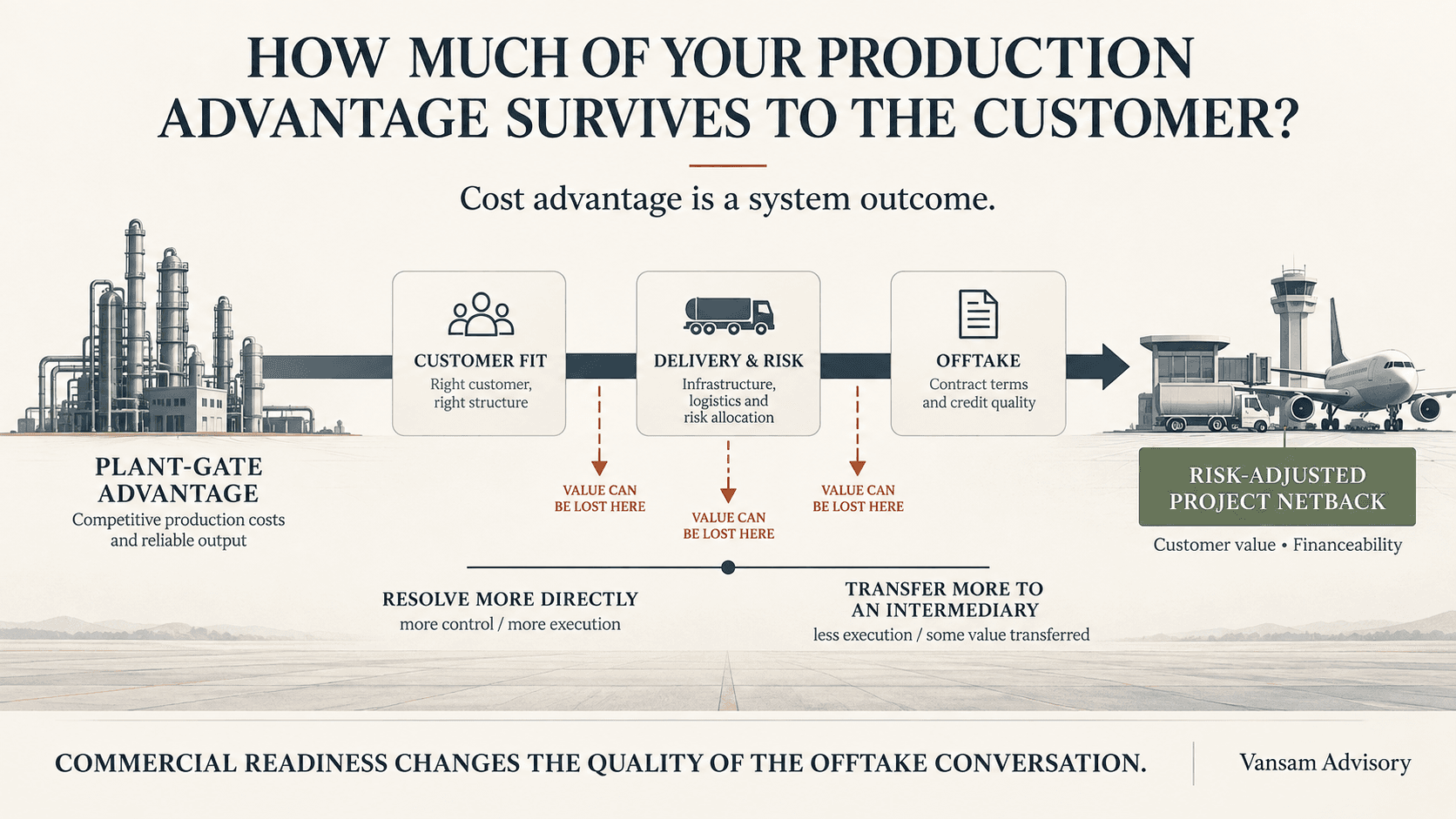
A credible revenue model connects each receipt to a buyer, eligible volume, delivery or registry event, claim rights and payment terms. Reconciling those streams prevents an attribute from being counted both in the fuel premium and as a separate receipt. Once title, blending, infrastructure and certificate-transfer responsibilities are allocated, the developer can assess the netback retained after meeting those obligations.
The answers should shape site selection and commercial design early as plant-gate selling price is not the same as a delivered customer price. If a producer relies on an intermediary to manage storage, blending, certificates and airport delivery, the contract needs to state which services it receives and how the value is allocated. If the developer proposes managing more of that route itself, it should include the working capital, operating capability and execution exposure in the capital plan.
An expression of interest can inform the evidence plan, but is not binding offtake. A signed agreement may still depend on commissioning, qualification, conditions precedent or flexible volumes and prices. Assess those terms and buyer credit quality before treating announced demand as secured revenue.
Make contract terms match the operating and cash plan
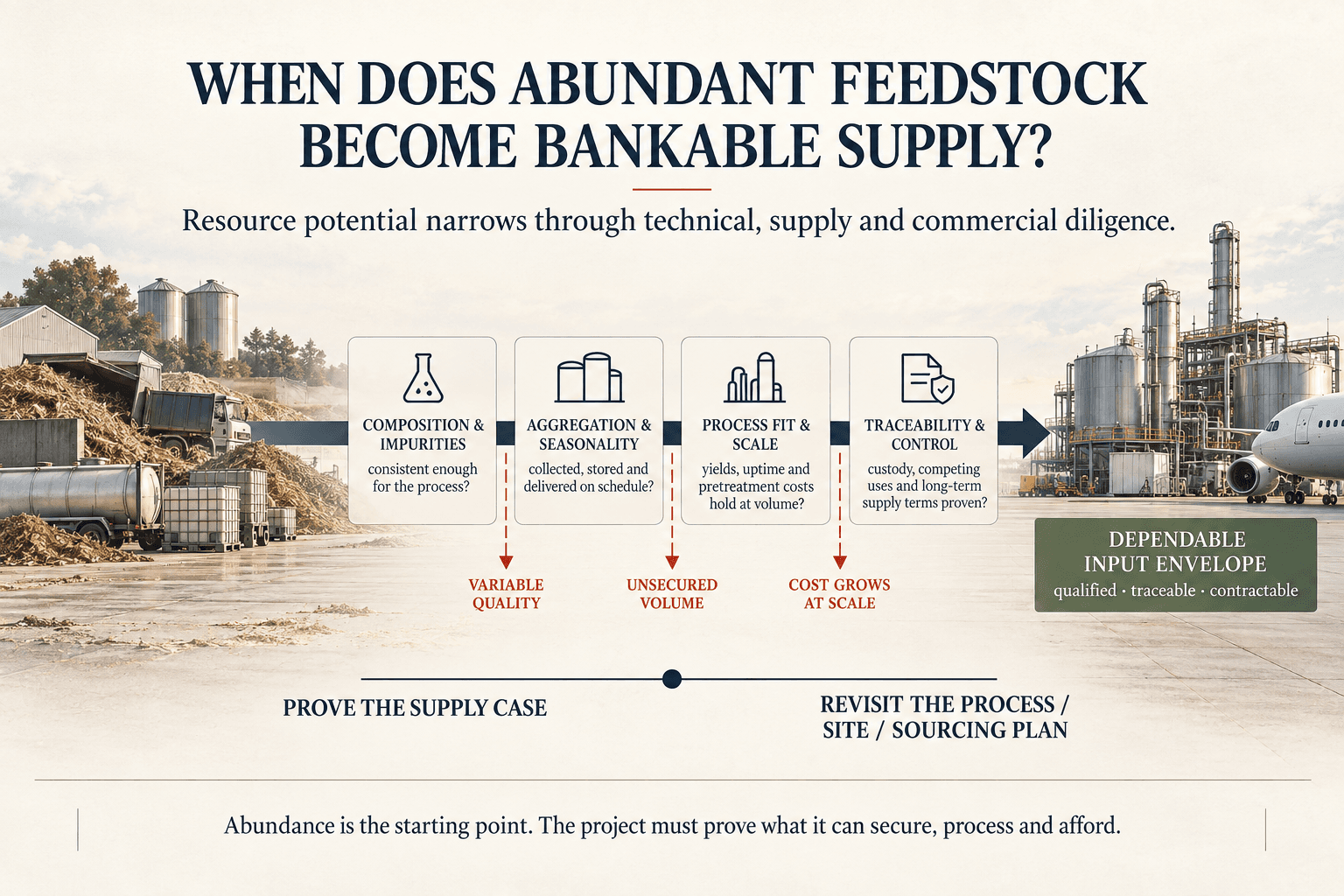
An offtake becomes more credible when its commitments fit the project’s operating evidence. Contracted volume needs to reflect feedstock coverage and the production ramp, while quality and lifecycle commitments must hold across expected operating conditions. Delivery capacity at the named location completes that connection to the customer. Allocating the costs of a delayed shipment, failed batch review, missing certificate or unavailable infrastructure then makes the project’s residual exposure visible. In this way, the supply and process evidence in Part 2 and eligibility work in Part 3 inform the contract itself. The price formula determines how much of that exposure reaches margin and cash flow. Fixed, indexed and certificate-linked prices respond differently to changing conditions, as do contracts with reopening provisions. Attribute ownership and the allocation of changes in policy, eligibility, specifications, freight, blending and fees shape what the producer retains. Payment timing and the counterparty’s ability and obligation to pay then determine when that value can fund operations or service debt.
Contract tenor needs to be read alongside those terms as a ten-year agreement can leave substantial price, volume, termination or delivery exposure with the producer, while a shorter conditional commitment may help an earlier-stage team establish what the buyer needs next. Its usefulness depends on the project’s stage and obligations, as well as the duration of the relationship.
Build adaptability into the next commitment
An evidenced operating and commercial baseline gives the team a starting point for assessing that exposure. Slower commissioning, lower utilization, higher delivered cost, lower certificate values, delayed eligibility or reduced buyer volumes can affect the case individually and together, particularly where contract protection is limited. Translating those changes into the size and timing of a raise, additional runway, working capital or pressure on debt service shows which uncertainties deserve attention before the next commitment.
Where policy remains unsettled, testing the economics without disputed value helps the developer judge whether conditional commitments or staged investment would preserve a viable route forward. Separating enforceable contract protection from exposure to policy, certificate prices and buyer budgets makes clear what is secured and what the project still needs to manage. An alternative market offers protection only if the project can reach it in time and on workable terms. Buyer capacity, qualification, delivery access and contract restrictions determine whether entry is feasible; switching costs, lead time, working capital and any plant changes determine whether the resulting netback is worth pursuing. An option that becomes available only after cash reserves run out cannot serve as a timely contingency. Making that option usable also means deciding who acts and what prompts the decision. A change in price, eligibility timing or buyer volume may justify renegotiation, rerouting or staged investment, but keeping each route open has a cost. Comparing that cost with the protection it offers helps the team maintain a manageable set of choices it can execute.
Customer, policy, logistics and financing specialists can help a technical team develop those choices while decisions remain open. Leadership’s role is to connect their findings to capital requests, customer commitments and the exposure the business retains, so that commercial adaptability becomes part of project development. A market’s underlying need may endure even when a particular support mechanism changes. Equally, a durable need does not establish that this project can meet it competitively or secure dependable revenue. Keeping structural need, policy support and contracted receipts distinct helps a developer investigate opportunities without turning the next market thesis into another untested assumption.
The series connects system economics, dependable inputs and processing, sustainability qualification and customer revenue. The aim is a team that understands exposure and can respond before an adverse change becomes a financing or operating crisis, giving its project a stronger route to successful operation. This is the work Vansam supports: complementing a developer’s technical strengths with intimate knowledge of markets and customers, and translating those requirements into project and commercial decisions. The aim is to maximize durable, risk-adjusted project and enterprise value, with a clear view of both the opportunities and the risks that remain. The next body of work asks where credible projects and financing are advancing, what creates accessible opportunities and which underlying needs will persist. Those answers should strengthen the same disciplined project case.
Sources
- RSB, Book & Claim System
- UK Department for Transport, The SAF Mandate: an essential guide
- UK Department for Transport, Sustainable Aviation Fuel Mandate statistics 2026: first provisional release
- UK Department for Transport, SAF Mandate: SAF supply and industry certainty in an evolving market
- UK Department for Transport, Sustainable aviation fuel revenue certainty mechanism: levy design
- UK legislation, Sustainable Aviation Fuel Act 2026, Explanatory Notes
- European Union, Regulation (EU) 2023/2405, ReFuelEU Aviation